

Active recovery for neck pain is defined as controlled, purposeful movement that reduces stiffness, restores function, and prevents the muscle weakening that comes with prolonged rest. Most mild to moderate neck pain improves within 2–3 weeks with structured self-care, making early movement one of the most effective tools you have. The active recovery neck pain examples in this guide cover stretching, strengthening, posture correction, and thermal therapy, giving you a practical, evidence-based plan you can start today. Whether you are managing everyday stiffness or recovering from a sports-related strain, the right movement done consistently is what moves the needle.
1. Active recovery neck pain examples: gentle stretching
Gentle stretching is the foundation of any neck recovery plan. It lengthens tight cervical muscles, restores range of motion, and signals the nervous system that movement is safe. Done correctly, it reduces pain without aggravating inflamed tissue.
The core stretches to start with:
- Slow neck rolls. Drop your chin toward your chest, then slowly roll your ear toward your right shoulder, pause, and return. Repeat to the left. Keep the motion fluid and stop if you feel sharp pain.
- Side bends. Tilt your right ear toward your right shoulder until you feel a gentle pull along the left side of your neck. Hold for 20–30 seconds. Switch sides. Do 3 repetitions per side.
- Chin tucks. Gently pull your chin straight back, as if making a double chin. This realigns the cervical spine and stretches the suboccipital muscles at the base of the skull. Hold 5 seconds, repeat 10 times.
- Shoulder rolls. Roll both shoulders backward in slow circles for 10 repetitions. This releases tension in the upper trapezius, which directly affects neck comfort.
Warm the tissue before you stretch. A warm shower or a heating pad applied for 10 minutes loosens the cervical muscles and makes stretching more effective and less uncomfortable. Avoid forcing any movement or using momentum. Slow and controlled is the rule.
Pro Tip: Perform your neck stretches within 30 minutes of waking up. Cervical muscles are often at their stiffest after sleep, and early morning movement sets a better tone for the rest of the day.

2. Isometric holds for cervical muscle strength
Isometric and dynamic neck exercises improve range of motion and reduce chronic neck pain by building the muscular support the cervical spine needs. Isometric exercises are the safest starting point because they create muscle tension without moving the joint, making them ideal during the early stages of recovery.
How to perform the key isometric holds:
- Frontal resistance hold. Place your palm flat against your forehead. Press your head forward gently against your hand while your hand resists the movement. Hold for 5–10 seconds. Repeat 5 times.
- Lateral resistance hold. Place your right hand against the right side of your head just above the ear. Press your head sideways into your hand while resisting. Hold 5–10 seconds per side, 5 repetitions.
- Posterior resistance hold. Clasp both hands behind your head. Press your head backward into your hands while resisting. Hold 5–10 seconds, 5 repetitions.
- Chin tuck with resistance. Perform a chin tuck and hold the position while pressing two fingers lightly against your chin. This activates the deep cervical flexors, the small stabilizing muscles that are often the first to fatigue.
The goal is not to strain but to activate. Use about 30% of your maximum effort during each hold. Gradually increase the hold duration and number of repetitions over 1–2 weeks as strength builds.
Pro Tip: If you feel your neck shaking or compensating during a hold, reduce the resistance. Shaking means the target muscle has already fatigued and a larger muscle is taking over, which reinforces the wrong pattern.
3. Dynamic strengthening for lasting stability
Once isometric holds feel manageable, dynamic exercises add controlled movement to build functional strength. Small deep neck muscles act as primary stabilizers. When they fatigue, larger muscles like the upper trapezius compensate, creating the cycle of tension and pain many people recognize.
Dynamic exercises break that cycle by retraining the stabilizers to do their job. Resistance bands add load progressively without putting the cervical spine under compression. A light resistance band anchored at head height works well for lateral pulls and forward flexion drills.
Scapular retractions are equally important. Squeeze your shoulder blades together and hold for 5 seconds, then release. Repeat 15 times. This exercise directly reduces the forward shoulder posture that loads the cervical muscles. Pair it with prone Y and T raises, lying face down and lifting your arms into a Y or T shape, to strengthen the lower trapezius and rhomboids.
For athletes managing neck pain during training, these exercises fit naturally into a warm-up or cool-down. Perform dynamic strengthening 3–4 times per week, with at least one rest day between sessions.
4. Posture corrections that protect your neck all day
Poor posture, including forward head position and side sleeping with shoulder elevation, contributes to neck pain by causing muscle fatigue and joint stress. Correcting these habits removes the daily load that keeps the cervical muscles from fully recovering.
Key posture adjustments to make now:
- Monitor height. Your screen should sit at eye level so your head stays neutral. Every inch your head tilts forward adds roughly 10 pounds of effective load on the cervical spine.
- Smartphone use. Bring your phone up to eye level instead of dropping your chin to look down. This single change reduces the most common driver of neck stiffness in adults under 40.
- Sleep position. Sleep on your back or side with a pillow that keeps your head aligned with your spine. Avoid sleeping on your stomach, which forces the neck into prolonged rotation.
- Breathing pattern. Chest breathing overactivates the scalene and sternocleidomastoid muscles in the neck. Practice diaphragmatic breathing: inhale so your belly rises first, not your chest.
For people who sit at a desk, the posture problems from office work are well documented and correctable. Set a timer to stand and reset your posture every 30–45 minutes. Consistency matters more than perfection.
5. Heat and cold therapy timed for recovery
Thermal therapy is not passive. Used correctly, it prepares the tissue for movement and controls inflammation so active exercises are more effective.
How to apply heat and cold:
- First 48 hours: ice. Apply an ice pack wrapped in a thin towel for no more than 15 minutes at a time, several times per day. Ice reduces acute inflammation and numbs pain signals without causing tissue damage.
- After 48 hours: heat. Low-level heat relaxes muscles and promotes blood flow to the cervical region. A warm shower, a moist heating pad, or a warm towel applied for 15–20 minutes works well.
- Before stretching: heat. Apply heat before your stretching session to loosen the cervical muscles and increase tissue elasticity.
- After exercise: ice. If your neck feels sore or inflamed after a strengthening session, a brief ice application reduces post-exercise soreness.
Avoid applying heat directly to skin or leaving either modality on for extended periods. Red light therapy offers an additional option for supporting circulation and nerve function during recovery, particularly for people who find traditional heat uncomfortable.
The key principle is sequencing. Cold controls the acute phase. Heat enables movement. Movement drives recovery.
6. When to seek professional care
Most neck pain responds to self-directed active recovery. Some situations require professional assessment to rule out serious causes and guide treatment.
Seek evaluation if you experience any of the following:
- Pain radiating down one or both arms, or numbness and tingling in the hands
- Weakness in the arms or hands that limits grip or fine motor control
- Neck pain following a significant impact, fall, or collision
- Pain that does not improve after 3–4 weeks of consistent self-care
- Severe headaches originating at the base of the skull
Supervised exercise programs that combine physical and psychological components reduce disability after neck sprain better than rest alone. Adding stress management to a structured exercise plan improves long-term functional recovery. A physical therapist can also identify specific movement deficits that generic exercises miss.
Wearing a neck collar for more than 1–2 weeks promotes muscle atrophy and joint stiffness. Early mobilization remains the clinical standard over immobilization. If a provider recommends a collar, clarify the expected duration and have a plan to transition to active movement as soon as possible.
7. Building active recovery into your daily routine
Consistency is the variable that separates people who recover fully from those who cycle through recurring flare-ups. Active recovery focused on restoring mobility and strength produces better outcomes than passive treatments alone. Passive therapies like massage provide temporary relief but do not build the muscular support the cervical spine needs long-term.
A practical daily structure looks like this. In the morning, perform chin tucks and side bends after a warm shower. During the workday, reset your posture every 30–45 minutes and do 10 shoulder retractions at your desk. In the evening, perform isometric holds and finish with a 15-minute heat application before bed.
Tracking your progress matters. Note your pain level, range of motion, and which movements feel easier each week. Progress is rarely linear, but a clear trend toward improvement over 2–3 weeks confirms the plan is working. If it is not, that is the signal to seek professional input.
Neck mobility exercises for seated workers offer a structured starting point if you need specific guidance tailored to a desk-based lifestyle.
Key takeaways
Active recovery for neck pain works because controlled movement rebuilds cervical muscle strength, restores range of motion, and prevents the stiffness that prolonged rest creates.
| Point | Details |
|---|---|
| Start moving early | Most mild neck pain improves within 2–3 weeks with structured self-care and early movement. |
| Sequence thermal therapy | Use ice in the first 48 hours, then switch to heat to prepare muscles for exercise. |
| Prioritize deep stabilizers | Isometric holds and chin tucks target the small cervical muscles that prevent larger muscle overuse. |
| Fix posture daily | Forward head position and poor sleep alignment sustain neck strain between exercise sessions. |
| Know when to escalate | Arm numbness, grip weakness, or no improvement after 4 weeks requires professional evaluation. |
What I’ve learned about active recovery that most guides miss
By Achraf
Most people approach neck pain the wrong way. They rest completely for a few days, feel slightly better, then return to the same posture and habits that caused the problem. The pain comes back within weeks, and the cycle repeats.
What I’ve seen work consistently is treating active recovery as a skill, not a checklist. The exercises matter, but the mindset matters more. People who recover fully are the ones who understand why each movement helps. They know that a chin tuck is not just a stretch. It is a direct signal to the deep cervical flexors to re-engage. That understanding changes how they do the exercise and how often they return to it.
The other thing most guides skip is the psychological component. Neck pain rarely occurs in isolation. Stress, anxiety, and poor sleep all increase cervical muscle tension. An exercise plan that ignores those factors will always underperform. The most durable recoveries I have observed combine targeted movement with deliberate stress reduction, whether that is breathing practice, better sleep habits, or simply reducing screen time in the evening.
Start simple. Stay consistent. Adjust based on what your body tells you each week.
— Achraf
Vitalitytherapy devices that support your recovery
Active exercises do the structural work of recovery. The right at-home device handles the daily relief that keeps you moving consistently.
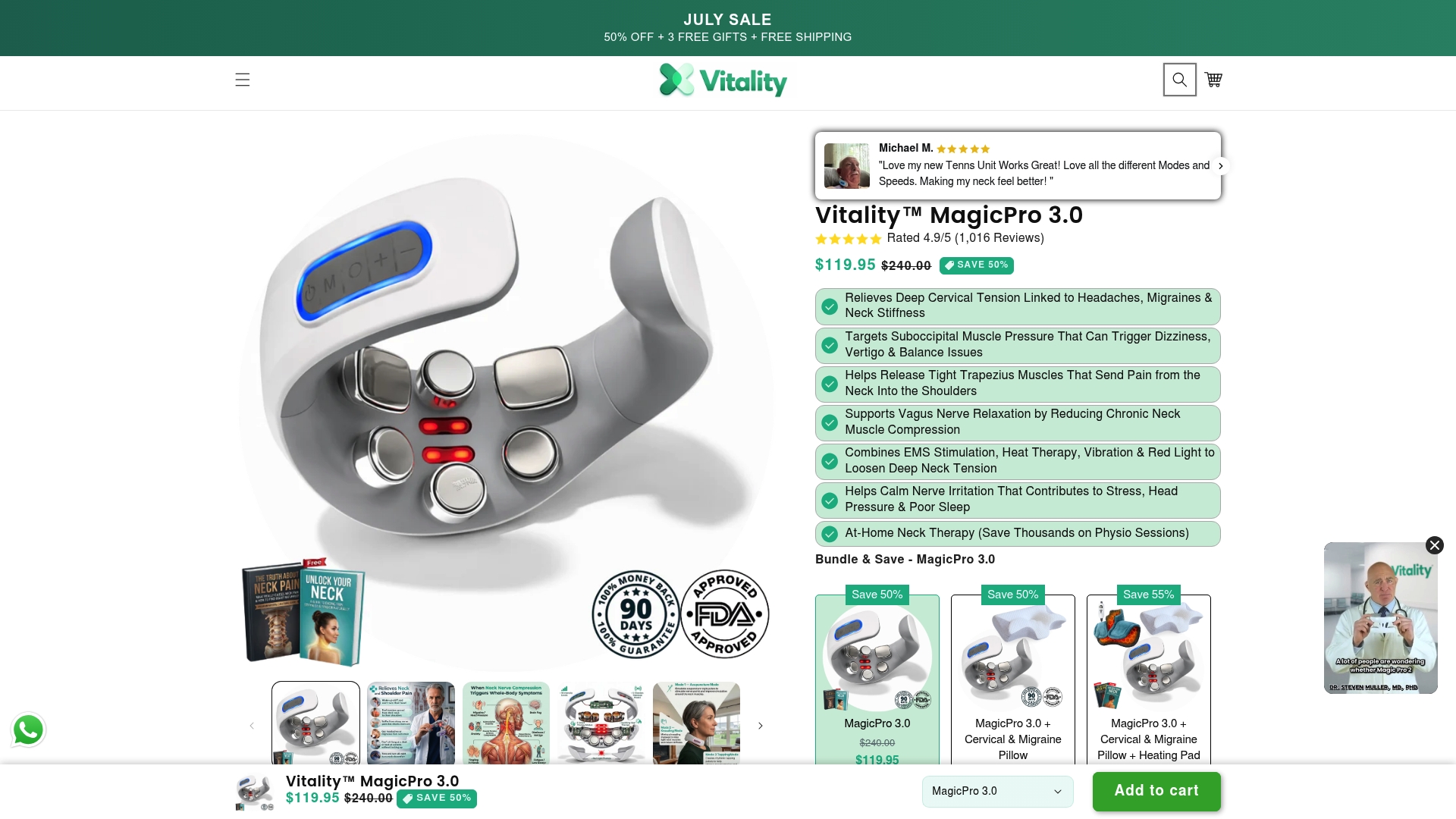
Vitalitytherapy’s MagicPro 2.0 combines electrical muscle stimulation, heat, and massage in one wearable device. It delivers targeted relief in 15 minutes per day, making it practical before a stretching session or after a strengthening workout. Doctor-recommended and designed for home, office, or travel use, it addresses the cervical tension that builds between exercise sessions. The full neck and nerve relief collection includes options for different recovery needs and pain profiles. If you are building a consistent active recovery routine, adding a device that manages daily tension between sessions makes the whole plan more effective.
FAQ
What is active recovery for neck pain?
Active recovery for neck pain is controlled, gentle movement, including stretching, isometric exercises, and posture correction, that reduces stiffness and rebuilds cervical muscle strength without aggravating symptoms.
How long does neck pain take to improve with active recovery?
Most mild to moderate neck pain improves within 2–3 weeks with consistent self-care. Sports-related soft tissue injuries may take 2–6 weeks depending on severity.
Should I use heat or ice for neck pain?
Use ice for the first 48 hours to control inflammation, then switch to low-level heat to relax muscles and improve blood flow before stretching or exercise.
Are isometric exercises safe for neck pain?
Isometric exercises are among the safest options for neck pain because they build muscle strength without moving the joint. Start at low resistance and increase gradually over 1–2 weeks.
When should I stop self-treating and see a doctor?
Seek professional evaluation if you experience arm numbness, grip weakness, pain after a significant impact, or no improvement after 3–4 weeks of consistent active recovery.