


EMS can reduce pain and improve function for many people with chronic nonspecific lower back pain, according to multiple systematic reviews. The typical trial-backed approach uses 20-minute sessions once weekly for multiple weeks, typically between two and four months. Producing modest but measurable improvements. It is not for everyone, though: anyone with an implanted electronic device or certain medical conditions should skip EMS until a clinician weighs in.
TL;DR:
- Weekly sessions of around 20 minutes over 8 to 16 weeks are optimal, with intensity set to a strong but comfortable contraction for best results.
- Most effective evidence comes from low-frequency whole-body EMS and clinic-grade local EMS, not consumer TENS devices.
- EMS-induced pain relief is mainly local and results vary between individuals, with an average reduction of about 0.87 points on a 10-point scale.
- Avoid EMS if you have implanted electronic devices, are pregnant, or have active infections, and consult a clinician before use if you have health concerns.
- Expect gradual improvements, with notable pain reduction around the 12-week mark, and red flags or no progress should prompt professional evaluation.
Table of Contents
- What The Research Says About EMS For Lower Back Pain
- How Does EMS Help Back Pain? The Physiology In Plain Terms
- WB-EMS, Local EMS, And TENS: Which One Matches Your Goal?
- How To Use EMS Safely: A Step-By-Step Protocol
- Who Should Avoid EMS For Back Pain
- A Realistic 8 To 16 Week EMS Program
- An Editorial Take On EMS And Back Pain Recovery
- Sources
What The Research Says About EMS For Lower Back Pain
The clinical evidence for EMS and lower back pain is more substantial than most people expect. A systematic review and meta-analysis of low-frequency whole-body EMS pooled results across multiple trials and found within-group pain reductions averaging around 0.87 points on a 0 to 10 pain scale, with functional improvement scores (SMD) near 0.84. Individual trials in that pool ranged from 0.60 to 1.58 points of pain reduction, telling you the effect is real but not uniform from person to person.
By the numbers: Trials in the meta-analysis used sessions lasting 20 minutes, delivered once weekly for multiple weeks, typically between two and four months, at stimulation frequencies in the low-frequency range commonly around 50 to 85 Hz with biphasic rectangular impulses.
A separate prospective clinical intervention study tracked patients through a weekly whole-body EMS program and reported an average 2-point drop on the pain scale alongside a substantial improvement on the Oswestry Disability Index, a standard measure of how much back pain limits daily life.
The evidence has real limits, though.
- Comparisons against active treatments (like supervised exercise) are more mixed than comparisons against passive controls, according to a systematic review of EMS, IFC, and TENS therapies.
- Sample sizes in several trials were small, which limits how confidently the results generalize.
- Long-term structural changes to spinal muscles remain uncertain even when patients report feeling better.
That last point deserves its own explanation, because it shapes how you should think about what EMS is actually doing.
How Does EMS Help Back Pain? The Physiology In Plain Terms
EMS works by triggering involuntary muscle contractions through electrical pulses delivered via skin electrodes. Those contractions can activate the multifidus and other deep stabilizing muscles along the spine, the same muscles that often become weak and inhibited after an episode of back pain. Repeated activation over weeks can reduce stiffness and rebuild some of that lost stability.
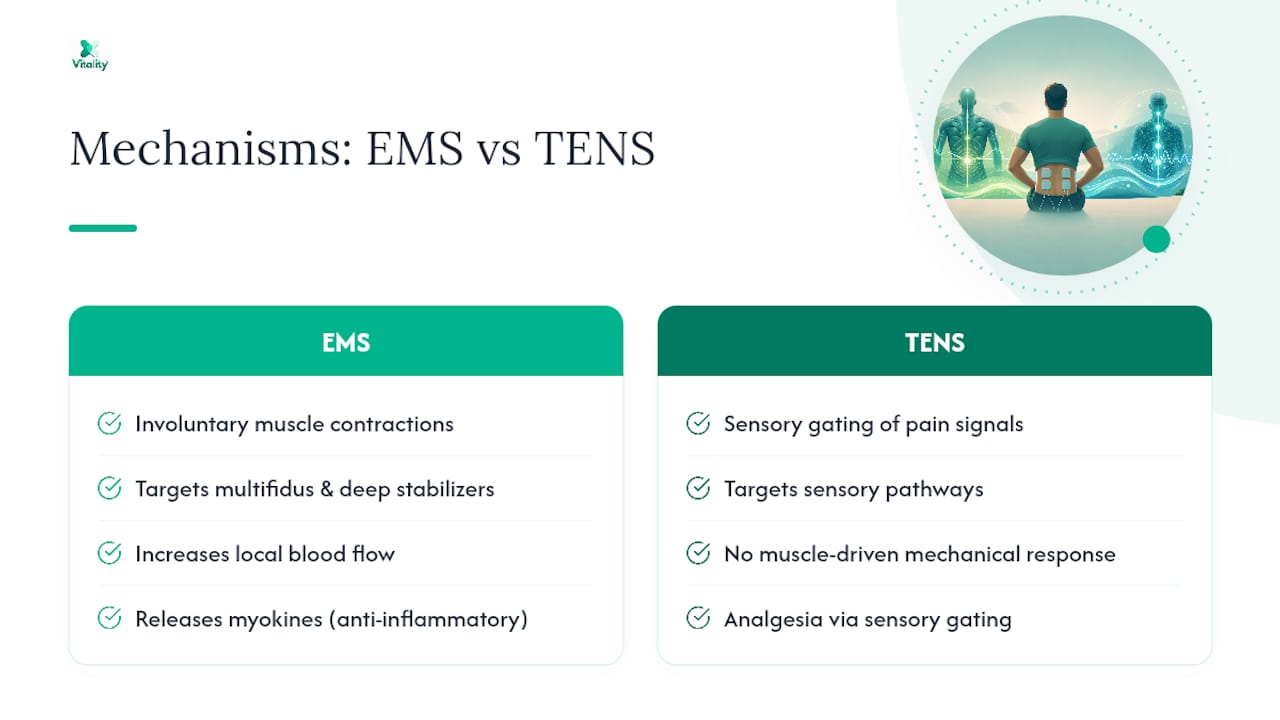
The contractions also increase local blood flow to the stimulated area. That circulation boost, paired with the release of myokines (signaling molecules produced by contracting muscle, some with anti-inflammatory effects), appears to contribute to pain relief. A study on EMS-induced analgesia found increases in pain thresholds concentrated at the stimulated site, not spread throughout the body. In other words, EMS analgesia tends to be local, not systemic. That is worth remembering before you expect it to fix pain somewhere it never touched.

This mechanism differs meaningfully from TENS, which primarily works through sensory “gating” of pain signals rather than driving a mechanical, muscle-based response.
WB-EMS, Local EMS, And TENS: Which One Matches Your Goal?
Not every device labeled “electrical stimulation” does the same job. Knowing which category you’re looking at prevents disappointment and misuse.
- WB-EMS (whole-body EMS): A suit or vest with multiple electrode zones that stimulates large muscle groups simultaneously, including the lower back, glutes, and core. Most of the low-frequency trials behind the pooled pain reduction figures generally used this format.
- Local EMS/NMES: Targeted pads placed directly over the paraspinal muscles beside the spine. This is the format most people picture for home use and what devices like My Vitality’s MagicPro line use for muscle-focused relief.
- TENS: Lower-intensity, sensory-level stimulation meant to interrupt pain signaling rather than contract muscle. Evidence for TENS against active treatments is more equivocal than for EMS.
- Medium-frequency/IFC devices: Often used in clinic settings; some penetrate tissue differently and may feel less intense on the skin even at higher output, which affects comfort during home use.
For lower back pain specifically, most of the strongest trial data comes from low-frequency WB-EMS and clinic-grade local EMS systems, not consumer TENS units.
How To Use EMS Safely: A Step-By-Step Protocol
Getting the settings right matters as much as choosing the right device. Here’s a protocol grounded in what the trials actually did.
- Match the dosing to the evidence. Aim for roughly 20-minute sessions, once weekly, sustained for 8 to 16 weeks. Shorter, more frequent sessions haven’t shown the same track record in trials.
- Set intensity by feel, not by dial position. You want a strong, visible contraction that stays comfortable, roughly a 5 to 7 out of 10 on a perceived-effort scale. Cranking intensity past comfort doesn’t speed up results and raises the risk of soreness.
- Use a duty cycle around 1:2. That means roughly twice as much rest as active contraction time within each cycle, which limits muscle fatigue.
- Place electrodes on the paraspinal muscles beside the spine, not directly over the spinal column itself. For vest-style WB-EMS, follow the marked electrode zones exactly.
- Pair stimulation with light, controlled movement when your device and program allow it. This isn’t required for every session, but many trial protocols built in some active movement alongside stimulation.
- Run a quick pre-session check every time: clean, dry skin; intact electrodes with no cracking or dried-out gel; a slow ramp-up from low intensity rather than jumping straight to your target setting.
Pro Tip: Start two or three sessions at a lower intensity than you think you need. Muscle responsiveness builds gradually, and easing in reduces next-day soreness far more than it slows your progress.
Mild soreness and temporary skin redness are the most common side effects, and both usually resolve within a day. If you notice unusual pain, numbness, or skin irritation that doesn’t fade, stop the session and reduce intensity next time, or skip a session to let skin recover.

Who Should Avoid EMS For Back Pain
EMS isn’t appropriate for every back pain case, and some situations call for a clinician’s input before you touch an electrode pad.
- Absolute no-gos: implanted electronic devices like pacemakers or defibrillators, use over the abdomen or pelvis during pregnancy, and active infection or malignancy in the treatment area.
- Use with caution, and only after talking to a clinician: uncontrolled cardiac conditions, epilepsy, and significant skin conditions in the treatment zone.
- Red flags that need urgent medical evaluation, not EMS: progressive leg weakness, new bowel or bladder dysfunction, severe pain that doesn’t ease at night, or back pain following recent trauma or alongside unexplained weight loss.
If you’re unsure whether your pain is muscular or something else, a resource like this guide on telling muscle pain from disc-related pain can help you figure out what you’re dealing with before starting any home therapy.
A Realistic 8 To 16 Week EMS Program
Results build gradually, and knowing what to expect at each checkpoint keeps you from quitting too early or pushing too hard.
- Weeks 1 to 4: One session weekly at low-to-moderate intensity. Track your pain on a 0 to 10 scale before and after each session.
- Weeks 5 to 8: Maintain weekly sessions; intensity should feel like a comfortably strong contraction by now. Watch for early improvement in daily tasks like standing from a chair or walking tolerance.
- Weeks 9 to 12: Continue weekly dosing. This is when trial data suggests measurable change becomes likely, in line with the pooled reduction of roughly 0.87 points on the pain scale seen across studies.
- Weeks 13 to 16: Reassess using the same pain scale and a simple functional check, like how many sit-to-stand repetitions you can do comfortably.
If you see little to no improvement by week 12, or if any red flags from the section above appear, that’s the signal to loop in a physical therapist or ask about imaging rather than continuing on your own.
An Editorial Take On EMS And Back Pain Recovery
The gap between what EMS promises and what it actually delivers comes down to expectations, not the technology itself. People often want EMS to replace exercise. The evidence doesn’t support that. It supports EMS as an adjunct, a way to activate stabilizing muscles when time, pain, or fatigue make a full exercise routine hard to sustain that week. Pairing EMS with the kind of guided movement in a resource like these lower back exercise routines tends to outperform either approach alone.
What gets underestimated is how much the local, not systemic, nature of EMS analgesia matters for setting realistic goals. Stimulate your lower back, and you may feel relief there. Don’t expect it to touch pain elsewhere. That distinction should guide where you place electrodes and how you judge whether a session worked.
Complex or long-standing cases deserve a conversation with a physical therapist before or alongside any home EMS program. For everyday muscle tension and stiffness that responds well to combined stimulation, heat, and massage, a device like the My Vitality MagicPro 2.0 gives you a practical, at-home entry point that follows the same dosing principles the research supports.
— Achraf
This article is general information, not a substitute for advice from a qualified doctor. Consult a qualified healthcare professional about your own circumstances before acting on anything here.