


Posture correction is defined as the deliberate realignment of the spine, head, and shoulders to restore natural musculoskeletal balance and reduce strain on soft tissues. For commuters and office workers, this realignment directly addresses the root cause of neck and back pain during prolonged sitting or travel. A cross-sectional study found that 91.4% of young adults show measurable forward head posture, a figure that reflects just how widespread this problem is among people who sit for hours each day. Understanding how posture correction reduces commute pain starts with knowing what goes wrong in the body when you hunch over a steering wheel or slump in a train seat. The good news is that targeted corrections, combined with ergonomic adjustments and movement breaks, produce real, lasting relief.
How does posture correction reduce commute pain?
Poor posture during a commute is not just uncomfortable. It is a biomechanical problem that progressively loads the cervical spine and surrounding muscles beyond their design limits.

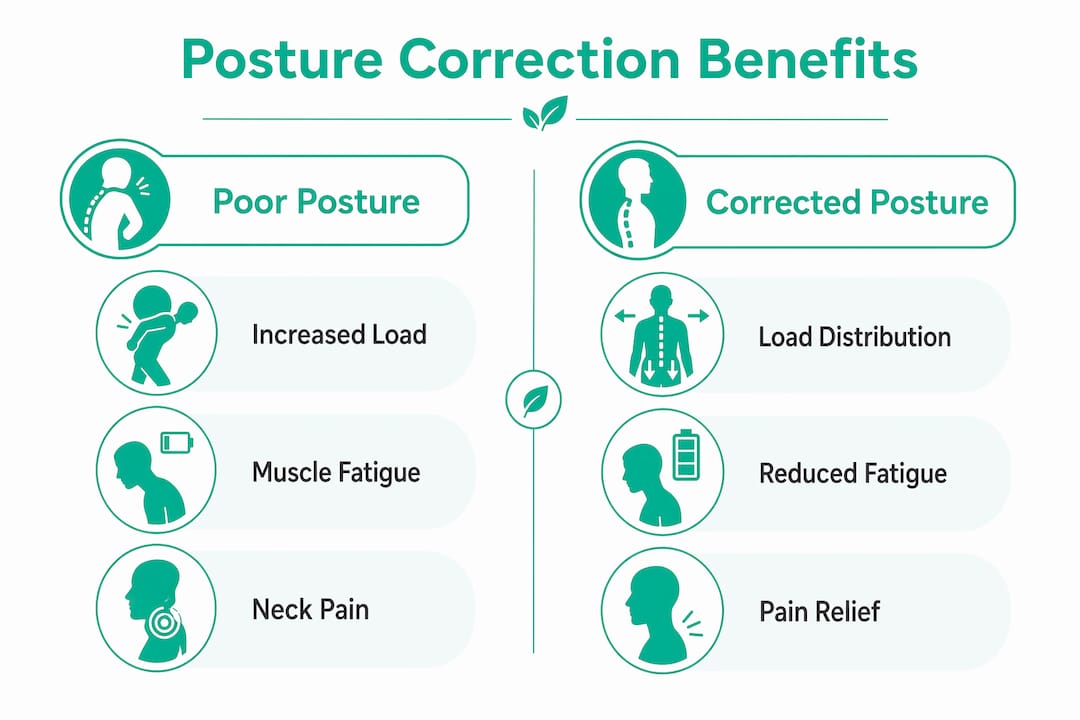
What happens to your spine in poor posture
Forward head posture shifts the head forward of the body’s center of gravity. For every inch the head moves forward, the effective load on the cervical spine increases substantially. This altered spinal loading disrupts the length-tension relationship of the neck muscles, meaning they work harder while producing less force. Proprioception, the body’s sense of joint position, also degrades. The result is a feedback loop where the muscles fatigue, the head drops further forward, and pain intensifies.
What corrected posture does differently
Corrected posture redistributes load across the entire spine rather than concentrating it at the cervical and upper thoracic segments. The deep neck flexors and thoracic extensors re-engage, sharing the mechanical burden. Scapular muscles stabilize the shoulder girdle, reducing the pull on the upper trapezius. This redistribution is the core mechanism behind commute pain relief from posture correction.
| Parameter | Poor posture | Corrected posture |
|---|---|---|
| Cervical spine load | Significantly elevated | Reduced and distributed |
| Upper trapezius activity | High, sustained | Moderate, intermittent |
| Deep neck flexor engagement | Low | Active and supportive |
| Proprioceptive accuracy | Reduced | Restored |
| Thoracic curve | Exaggerated kyphosis | Natural lordosis maintained |
Pro Tip: Correcting your posture once and holding it rigidly for an entire commute still causes muscle fatigue. Static loading, even in a “good” position, builds tension over time. The goal is frequent repositioning, not a fixed pose.
What does the science say about posture correction and pain relief?
The evidence on posture correction is encouraging but requires honest interpretation. Alignment improves reliably. Pain relief is less predictable.
A 2026 systematic review of 28 randomized controlled trials covering 901 participants found large improvements in forward head posture, rounded shoulders, and thoracic alignment from corrective exercises. Pain outcomes, however, were inconsistent across studies. This distinction matters. Better alignment does not automatically translate to less pain, especially if muscular endurance and neuromuscular control remain poor.
A separate 2026 meta-analysis in Scientific Reports focused specifically on sedentary workers and found that micro-exercises produced a neck pain effect size of g = −1.36. That is a clinically meaningful reduction. The same analysis reported a neck disability effect size of g = −0.45, indicating functional improvement alongside symptom relief.
Key evidence highlights from major studies:
- Corrective exercises reliably improve forward head posture, rounded shoulders, and thoracic alignment in Upper Crossed Syndrome.
- Pain relief from posture correction alone is inconsistent without adding endurance and neuromuscular control training.
- Micro-exercises reduce neck pain and disability in sedentary workers with moderate certainty.
- Corrective exercise alone often fails to sustain pain reduction unless combined with deep neck flexor and thoracic extensor endurance work.
- Integrated programs combining posture correction, movement breaks, and ergonomic adjustments produce the most consistent outcomes.
The takeaway is clear. Posture correction is foundational, but it is not a standalone solution. Commuters who add movement and ergonomic support to their posture practice see the most consistent pain reduction.
How to set up your commute environment for better posture
Ergonomic setup is the fastest way to support posture correction benefits without requiring constant conscious effort. The environment does part of the work for you.
Seat and headrest positioning
Clinical guidance from physiotherapy practice recommends a seat back angle of 100–110 degrees for drivers and commuters. This angle allows the lumbar spine to rest against the seat back without forcing the pelvis into a posterior tilt. The headrest should align with the center of the skull, not the neck. Arms should reach the steering wheel or armrests without the shoulders lifting or rounding forward.
Lumbar and spinal curve support
A lumbar roll or cushion placed at the lower back maintains the natural inward curve of the lumbar spine. Without this support, the pelvis tilts backward, which flattens the lumbar curve and forces the thoracic spine into a rounded position. That rounding then pushes the head forward. The Vitality™ Magic Seat Cushion is designed to address exactly this chain reaction by supporting the pelvis and lower back during extended sitting.
Ergonomic tips for commuters:
- Set the seat back to 100–110 degrees and avoid sitting bolt upright at 90 degrees.
- Align the headrest with the center of the back of your skull.
- Place a lumbar roll or cushion at the curve of your lower back.
- Position your arms so the elbows are slightly bent, not reaching or locked straight.
- Adjust the seat height so your hips are level with or slightly above your knees.
- Check your mirror positions after adjusting your seat so you cannot cheat back into a slump.
Pro Tip: After any ergonomic adjustment, drive or sit for 10–15 minutes and note where tension builds. Tension that disappears with the new setup confirms the change is working. Tension that shifts location signals a further adjustment is needed. Trialing ergonomic changes and observing your body’s response is one of the most reliable feedback tools available.
What role do movement and micro-exercises play in reducing commute pain?
Perfect posture held without movement is still a form of static loading. The body needs circulation, joint lubrication, and muscle activation variety to stay pain-free during long commutes.
Physical therapy research confirms that movement breaks every 30–45 minutes are more effective than maintaining any single posture for extended periods. This finding reframes the goal entirely. The target is not to find the perfect position and hold it. The target is to move frequently enough that no single position accumulates enough load to cause pain.
Micro-exercises are short, targeted movements performed during or between commute segments. They require no equipment and take under two minutes each. The evidence for micro-exercises in sedentary workers is strong enough to recommend them as a core component of any commute pain relief strategy.
Practical micro-exercises for commuters:
- Chin tucks. Pull the chin straight back without tilting the head. Hold for 5 seconds. Repeat 10 times. This directly counters forward head posture by activating the deep cervical flexors.
- Shoulder blade squeezes. Draw the shoulder blades together and slightly downward. Hold for 5 seconds. Repeat 10 times. This activates the mid-trapezius and rhomboids, which are chronically underactive in slumped postures.
- Neck side stretches. Tilt the ear toward the shoulder slowly. Hold for 20–30 seconds per side. This releases the upper trapezius and scalene muscles, which carry most of the tension from forward head posture.
- Thoracic extension over seat back. While seated, place both hands behind the head and gently extend the upper back over the top of the seat back. Hold for 10 seconds. This counters thoracic kyphosis directly.
- Seated hip flexor release. Shift to the edge of the seat and extend one leg back slightly, feeling the stretch at the front of the hip. Hold for 20 seconds per side. Tight hip flexors tilt the pelvis and drive the entire chain of poor spinal alignment.
Pro Tip: Set a phone timer for every 30 minutes during your commute or workday. When it goes off, complete two or three of the exercises above before resetting the timer. Consistency at low frequency beats intensity at high frequency for managing commute-related neck and back pain.
Key takeaways
Posture correction reduces commute pain most effectively when combined with ergonomic seat setup, frequent movement breaks, and targeted micro-exercises that build muscular endurance alongside alignment.
| Point | Details |
|---|---|
| Alignment alone is not enough | Corrective exercises improve posture reliably but require movement and endurance training for consistent pain relief. |
| Biomechanics drive the pain | Forward head posture increases cervical load and disrupts neuromuscular control, making correction a mechanical priority. |
| Ergonomics do part of the work | A seat angle of 100–110 degrees and a lumbar support reduce strain without constant conscious effort. |
| Micro-exercises are clinically proven | Research shows micro-exercises reduce neck pain with a meaningful effect size in sedentary workers. |
| Move every 30–45 minutes | Frequent repositioning outperforms any single static posture, however well-aligned it may be. |
What I have learned from watching commuters try to fix their posture
Most people approach posture correction the wrong way. They read about chin tucks, sit up straight for a week, feel no different, and give up. That pattern is predictable, and it comes from a misunderstanding of what posture correction actually does.
Alignment improvements show up quickly on a measurement tool. Pain relief takes longer and requires more than alignment. The clinical picture I see repeatedly is a person who has genuinely improved their forward head angle but still carries excessive tension because the thoracic extensors and deep neck flexors lack the endurance to hold that position under load. The posture looks better. The muscles are still overworked.
The other mistake is treating ergonomics as a one-time fix. You adjust the seat once, feel better for a day, and assume the problem is solved. Real ergonomic benefit comes from trialing a setup, observing where tension accumulates, and refining. That feedback loop is what separates commuters who get lasting relief from those who cycle through solutions without progress.
My honest recommendation is to start with the seat angle and lumbar support, add chin tucks and shoulder blade squeezes every 30 minutes, and give the process four to six weeks before judging results. Posture correction is not a quick fix. It is a gradual recalibration of how your body distributes load. Patience and consistency are the two variables that determine whether it works.
— Achraf
How Vitalitytherapy supports your posture correction efforts
Posture correction and ergonomic adjustments address the structural side of commute pain. Muscle tension and cervical stiffness that have built up over months often need direct therapeutic attention alongside those efforts.

Vitalitytherapy’s neck and nerve relief collection offers tools designed to complement posture work by targeting the muscular tension that alignment changes alone cannot fully resolve. The MagicPro 2.0 Wireless Neck Massager combines electrical muscle stimulation, heat, and massage in a single compact device, delivering therapeutic relief in 15 minutes. It is doctor-recommended and designed for use at home, at the office, or during travel. For commuters working through neck stiffness alongside a posture correction program, it provides the muscular reset that makes the next day’s efforts more effective.
FAQ
What is forward head posture and why does it cause commute pain?
Forward head posture is a position where the head sits in front of the body’s center of gravity rather than directly above the shoulders. It increases cervical spine load and disrupts muscle balance, causing the neck and upper back pain that commuters commonly experience during prolonged sitting.
How long does posture correction take to reduce neck pain?
Posture alignment improves relatively quickly with consistent corrective exercises, but pain relief typically develops over several weeks. A systematic review of 28 trials found reliable alignment improvements but inconsistent pain outcomes, confirming that muscular endurance training must accompany alignment work for sustained relief.
Are micro-exercises effective for commute-related neck pain?
Yes. A meta-analysis of sedentary workers found that micro-exercises reduced neck pain with an effect size of g = −1.36, which is a clinically meaningful result. Short movement breaks every 30–45 minutes are more effective than holding any single posture for extended periods.
What seat angle is best for driving posture?
A seat back angle of 100–110 degrees is the recommended range for drivers and commuters. This angle supports the lumbar spine naturally and reduces the tendency to round the thoracic spine and push the head forward.
Can posture correction alone eliminate commute pain?
Posture correction alone is unlikely to eliminate commute pain without additional support. Research confirms that corrective exercises improve alignment reliably but require integration with movement breaks, muscular endurance training, and ergonomic adjustments to produce consistent, lasting pain relief.