


Tension relief improves sleep by physically releasing muscle tightness and calming the nervous system, which together lower stress hormones and create the conditions your body needs for deep, restorative rest. When muscles stay contracted and the mind stays active at bedtime, the brain reads these signals as a threat and delays sleep onset. Understanding how tension relief improves sleep gives you a clear path forward. Techniques like Progressive Muscle Relaxation (PMR), somatic stretching, and Cognitive Behavioral Therapy for Insomnia (CBT-I) each address this cycle from a different angle. Vitalitytherapy’s approach to neck and nerve relief fits naturally into this framework.
How tension relief improves sleep: the physiology behind it
Physical tension and sleep are directly opposed states. When your skeletal muscles stay contracted, your sympathetic nervous system remains active. That activation keeps your heart rate elevated, your breathing shallow, and your brain alert. None of those conditions support sleep onset.
Cortisol raises alertness and physically delays sleep onset when stress persists without intervention. Resting alone does not reset elevated cortisol if the brain still perceives a threat. That distinction matters: passive rest and active tension relief are not the same thing.
Body temperature plays a key role too. The body needs to drop its core temperature to initiate sleep. Muscle tension slows that process by keeping circulation active in the wrong pattern. A room temperature around 68°F supports the temperature drop the body needs. A warm shower before bed accelerates the transition by pulling heat to the skin’s surface, where it dissipates quickly.

Tension also fragments sleep architecture. When the body stays in a low-grade state of arousal, it spends less time in slow-wave and REM sleep. Those are the stages where physical repair and memory consolidation happen. Losing them consistently leads to fatigue that compounds over time.
Key ways physical tension disrupts sleep:
- Sustained muscle contraction keeps the sympathetic nervous system active
- Elevated cortisol delays sleep onset and reduces sleep depth
- Impaired temperature regulation slows the body’s sleep signal
- Reduced slow-wave and REM sleep leaves the body under-recovered
Which tension relief techniques work best for sleep?
The most studied tension relief technique for sleep is Progressive Muscle Relaxation, or PMR. It works by systematically tensing and releasing muscle groups from the feet upward, teaching the nervous system to recognize the contrast between tension and release. PMR improves sleep quality with a standardized mean difference of -1.74 compared to control groups, based on a meta-analysis of 31 randomized controlled trials involving 2,277 patients. That effect size is clinically meaningful, not marginal.
CBT-I takes a broader approach. It combines sleep restriction, stimulus control, and cognitive restructuring with tension management components. CBT-I produces lasting sleep improvement for 70–80% of people within 6–8 weeks. Clinical guidelines position it as the first-line treatment for chronic insomnia, ahead of sleep medication.
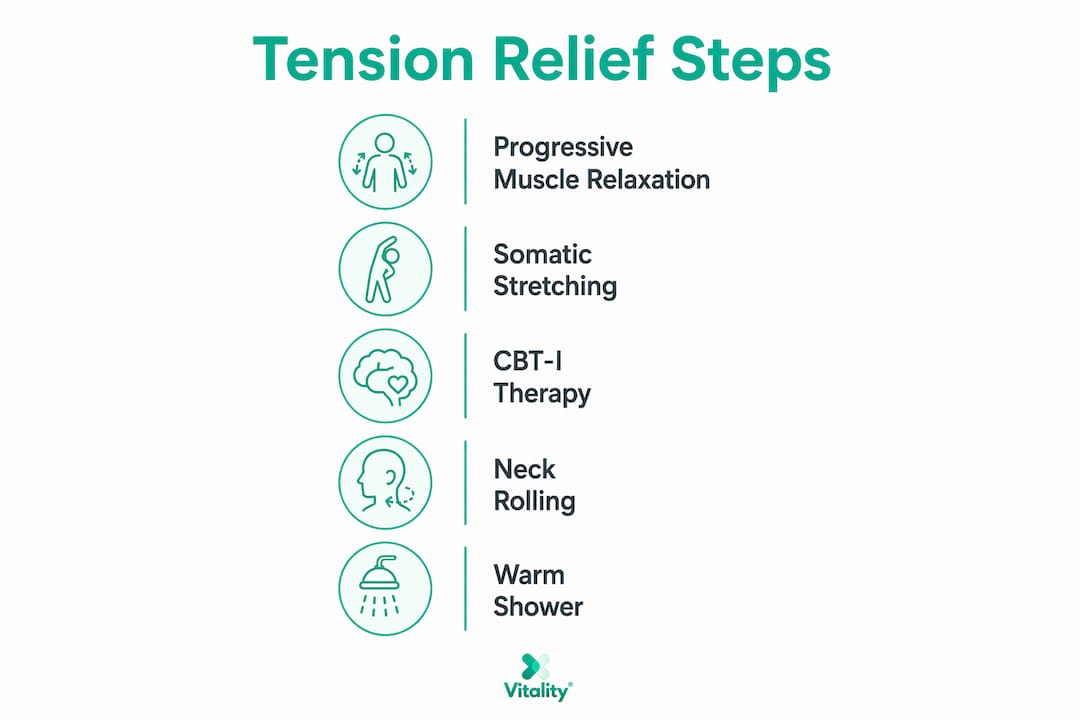
Somatic stretching targets the physical layer directly. Mindful neck rolling and spinal stretching for 1–2 minutes reduce alertness and prepare the nervous system for deep sleep. Breath is the mechanism: slow, deliberate breathing during movement activates the parasympathetic nervous system and signals safety to the brain.
| Technique | Primary mechanism | Time to effect |
|---|---|---|
| Progressive Muscle Relaxation (PMR) | Neuromuscular contrast and release | 2–4 weeks of consistent practice |
| CBT-I | Cognitive and behavioral restructuring | 6–8 weeks |
| Somatic stretching | Parasympathetic activation via breath | Immediate, cumulative with practice |
| Temperature regulation | Core temperature drop triggers sleep onset | Same night |
Pro Tip: Combine somatic neck stretching with a warm shower 60–90 minutes before bed. The shower raises skin temperature, the stretching activates the parasympathetic nervous system, and both work together to accelerate sleep onset.
How does mental tension affect sleep, and what helps?
Mental tension is a distinct layer from physical tension, and it requires its own approach. The brain cannot distinguish between a real threat and a replayed worry at bedtime. Both trigger the same alertness response. That is why emotional activation near bedtime directly delays sleep onset, regardless of how physically relaxed the body feels.
The “effort trap” makes this worse. Trying hard to fall asleep creates performance anxiety around sleep itself. The harder you try, the more alert you become. CBT-I specifically addresses this pattern by reframing sleep as a passive outcome of relaxation, not a goal to achieve through effort.
Practical strategies that reduce mental tension before bed:
- Worry journaling: Write down unresolved concerns and next-day tasks before leaving your workspace. Writing down worries offloads mental processing and prevents the brain from rehearsing problems in bed.
- Diaphragmatic breathing: A slow exhale (longer than the inhale) activates the vagus nerve and lowers heart rate within minutes.
- Stimulus control: Reserve the bed for sleep only. Working, scrolling, or problem-solving in bed trains the brain to associate the sleep environment with alertness.
- Screen cutoff: Bright screens suppress melatonin and carry emotionally activating content. A 60-minute cutoff before bed removes both triggers.
When the neck relaxes, the brain often follows. Physical and mental de-escalation reinforce each other, which is why combining somatic techniques with mental wind-down routines produces better results than either approach alone.
What practical steps integrate tension relief into a sleep routine?
A consistent pre-sleep routine is the delivery system for every tension relief technique. Without structure, even effective methods get skipped on the nights you need them most.
- Set a wind-down window. Begin your routine 60–90 minutes before your target sleep time. This window signals to the brain that the active part of the day is closing.
- Do a body scan. Lie down and mentally scan from your feet to your scalp. Notice where tension sits. Common sites include the jaw, tongue, forehead, and shoulders. Micro-tension in the jaw and forehead often persists after general relaxation attempts and requires a focused scan to release.
- Practice PMR for 10–15 minutes. Work through major muscle groups, tensing each for 5 seconds and releasing for 30. Start at the feet and finish at the face.
- Add somatic neck stretching. Slow neck rolls and gentle cervical stretches for 1–2 minutes release tension in the muscles that connect the skull to the spine. This area holds significant stress for most people who sit at desks or look at screens.
- Control your environment. Set the room to around 68°F. Use a sleep mask to block light. Dim overhead lights 90 minutes before bed to support melatonin production.
- Apply the 20-minute rule. If sleep does not come within 20–30 minutes, leave the bed and do a low-stimulation activity in dim light. Return only when drowsy. This prevents the bed from becoming associated with wakefulness.
Pro Tip: Anchor your routine to a consistent sensory cue, such as a specific scent, a particular playlist at low volume, or dim lighting in one lamp. Repeated pairing conditions the brain to associate that cue with relaxation, making sleep onset faster over time.
When tension is concentrated in the neck and cervical muscles, targeted physical therapy devices can accelerate the release that stretching alone may not fully achieve. Vitalitytherapy’s MagicPro devices combine electrical muscle stimulation, heat, and massage to address that specific area in 15 minutes per session.
Key Takeaways
Tension relief improves sleep by breaking the cortisol-arousal cycle through targeted physical and mental relaxation, making sleep onset faster and sleep depth greater.
| Point | Details |
|---|---|
| Cortisol is the core obstacle | Elevated stress hormones delay sleep onset; passive rest alone does not reset them. |
| PMR has strong clinical evidence | A meta-analysis of 2,277 patients shows PMR significantly improves sleep quality. |
| CBT-I addresses the full cycle | It produces lasting improvement in 70–80% of people within 6–8 weeks. |
| Mental and physical tension require separate strategies | Journaling offloads worry; somatic stretching releases muscle tension. Both are needed. |
| Consistency builds a conditioned response | Repeated routines with sensory anchors train the brain to associate cues with sleep. |
What I’ve learned about tension and sleep that most articles miss
By Achraf
Most sleep advice focuses on what to stop doing: stop caffeine, stop screens, stop worrying. That framing misses the point. The body needs an active signal to shift from arousal to rest. Removing stimulants creates space, but it does not fill that space with relaxation.
The insight that changed how I think about this is the distinction between resting and releasing. You can lie still for an hour and remain physiologically tense. The nervous system does not respond to stillness alone. It responds to contrast, which is exactly what PMR provides. Tensing a muscle group before releasing it teaches the body what “released” actually feels like.
The other thing most people underestimate is micro-tension. The jaw, the tongue pressed against the roof of the mouth, the subtle furrow in the forehead. These small contractions keep the nervous system slightly activated. A full-body scan that ends at the face, not the shoulders, catches what most relaxation attempts leave behind.
The effort trap is real and underappreciated. I have seen people build elaborate sleep rituals and then lie awake monitoring whether the ritual is working. That monitoring is itself a form of arousal. The goal is to create conditions and then let go of the outcome. That shift in orientation, from achieving sleep to allowing it, is where most of the lasting improvement actually comes from.
— Achraf
Vitalitytherapy’s approach to neck tension and sleep
Neck tension is one of the most common physical barriers to sleep, and it is also one of the most overlooked. Tight cervical muscles restrict blood flow, compress nerve pathways, and keep the upper body in a low-grade state of contraction that resists sleep onset.
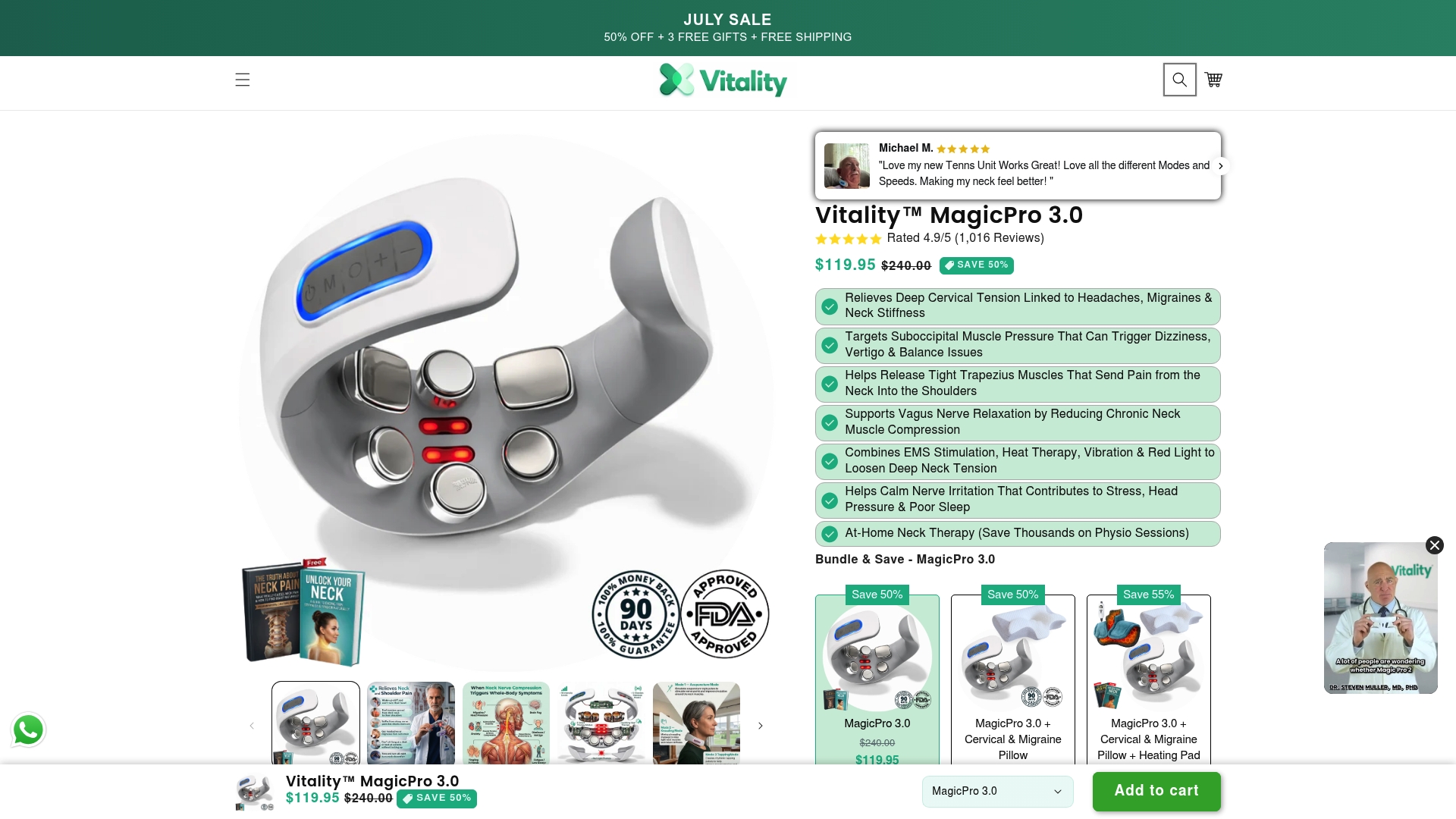
Vitalitytherapy’s neck and nerve relief collection addresses this directly. The Vitality™ MagicPro 3.0 combines electrical muscle stimulation, targeted heat, and massage in one device, delivering clinically supported relief in 15 minutes per session. It is doctor-recommended and designed for use at home, at a desk, or while traveling. For people whose tension concentrates in the cervical spine and upper shoulders, the MagicPro 3.0 offers a non-pharmacological option that fits naturally into a pre-sleep routine.
FAQ
What is the fastest tension relief technique for sleep?
Somatic neck rolling and diaphragmatic breathing produce immediate parasympathetic activation, making them the fastest options for reducing tension before bed. PMR takes 10–15 minutes but delivers deeper muscular release.
How does cortisol affect sleep quality?
Cortisol raises alertness and delays sleep onset. Without active tension relief, the body cannot reset elevated cortisol levels, which reduces both sleep depth and total sleep time.
What is CBT-I and does it help with tension-related insomnia?
CBT-I is Cognitive Behavioral Therapy for Insomnia, the first-line clinical treatment for chronic insomnia. It improves sleep for 70–80% of people within 6–8 weeks by addressing both behavioral patterns and tension-related arousal.
Why does trying hard to sleep make it worse?
Effort creates performance anxiety, which triggers alertness. CBT-I addresses this by reframing sleep as a passive outcome of relaxation rather than a goal to force, which breaks the arousal cycle.
Can neck tension specifically disrupt sleep?
Yes. Tight cervical muscles restrict circulation, compress nerve pathways, and maintain sympathetic nervous system activation. Releasing neck tension through stretching or targeted therapy devices directly supports sleep onset.