


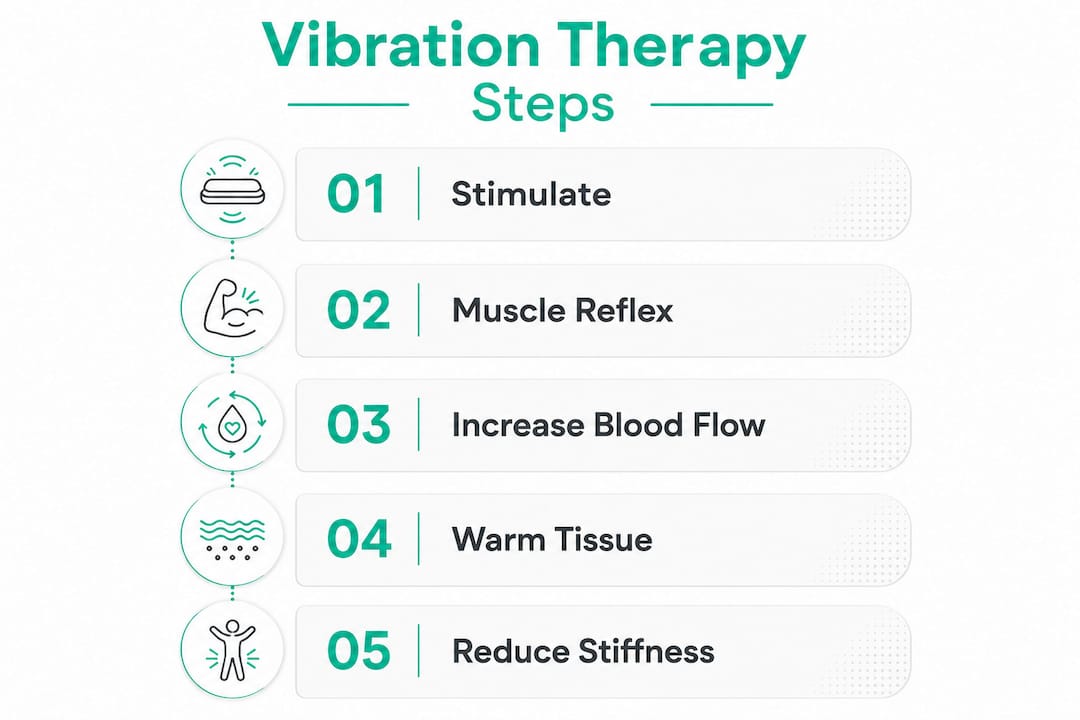
Vibration therapy reduces stiffness by triggering the tonic vibration reflex, a neurological response that causes muscle fibers to relax almost immediately upon contact with a vibrating surface. This reflex activates muscle spindles in the cervical muscles, signaling the nervous system to release chronic tension and increase local blood circulation. Clinical research confirms that daily vibration sessions over two weeks significantly improve range of motion and reduce pain at a statistically significant level (p<0.001). If your neck feels locked up every morning or tightens after hours at a desk, understanding this mechanism is the first step toward doing something about it.
How does vibration therapy physiologically reduce muscle stiffness?
Vibration therapy works by stimulating the tonic vibration reflex, which forces muscle spindles to fire repeatedly and then relax. This rapid cycling of contraction and release loosens the muscle fibers that hold chronic tension in the cervical region. The result is a measurable drop in muscular resistance, often felt within the first 30 seconds of application.
Beyond the reflex response, vibration increases local blood flow and warms the surrounding tissue. Research shows that vibration maintains skin temperature during stretching, preventing the temperature decline that causes muscles to stiffen again after passive treatment. Warmer tissue is more pliable, which means the fascia, the connective tissue wrapped around every muscle, becomes easier to move and stretch.
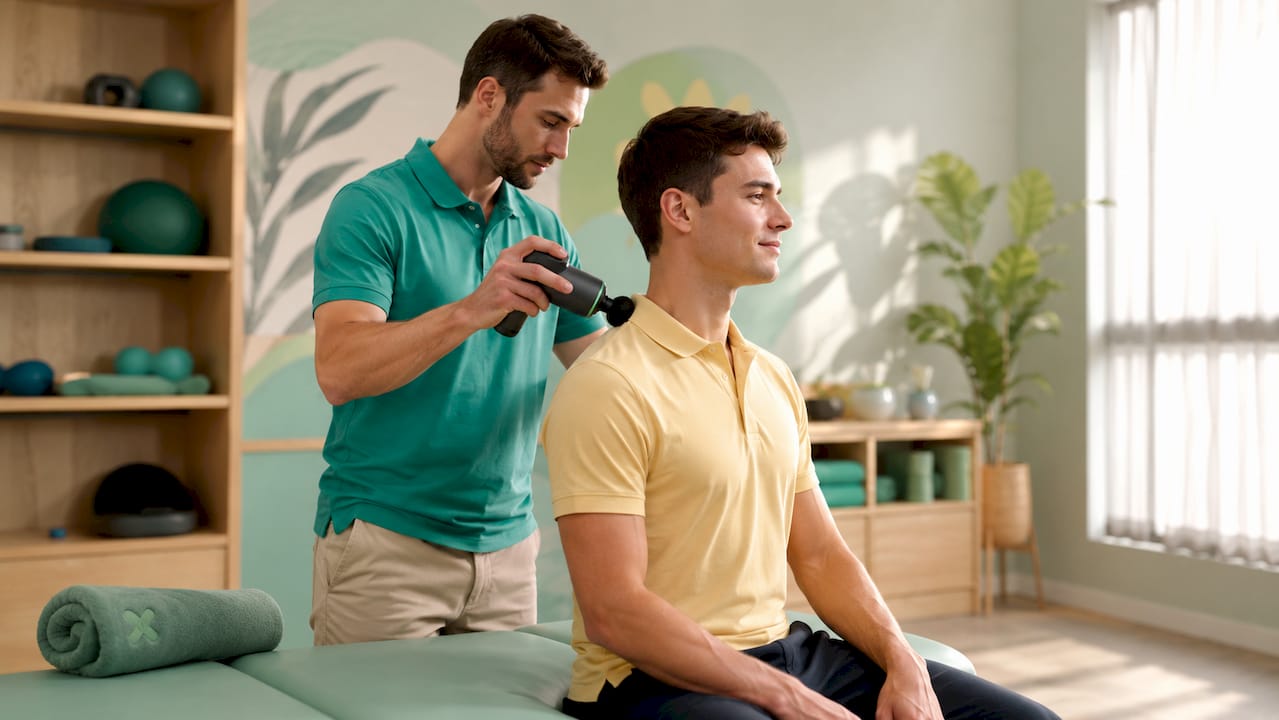
Vibration also moderates the viscoelastic properties of muscles and fascia. Viscoelasticity refers to how tissue behaves like both a liquid and a solid, resisting sudden force but yielding to sustained, gentle pressure. Vibration applies that sustained mechanical input at a frequency the tissue responds to, reducing resistance without requiring the person to exert large muscle forces.
Key physiological effects of vibration on stiff neck muscles:
- Tonic vibration reflex activation: Muscle spindles fire and reset, releasing chronic holding patterns in the cervical muscles.
- Increased circulation: Blood flow rises in the treated area, delivering oxygen and clearing metabolic waste that contributes to soreness.
- Tissue warming: Local temperature stays elevated, keeping fascia pliable during and after the session.
- Viscoelastic modulation: Mechanical vibration softens the resistance properties of muscle and connective tissue without painful pressure.
Pro Tip: Localized vibration devices induce the tonic vibration reflex more precisely than whole-body platforms, making them the better choice for targeting neck stiffness specifically.
What does clinical research say about vibration therapy’s effectiveness?
The clinical evidence for vibration therapy is specific and measurable. A controlled study comparing vibration therapy to cross-friction massage found that vibration outperformed manual techniques on both pain reduction (p=0.001) and swelling reduction (p<0.001) after two weeks of daily sessions. Hip flexion improved at p=0.046 and extension at p=0.008, confirming that the benefits extend to joint mobility, not just surface-level comfort.
Range of motion improvements are equally striking. Bouts of 30–60 seconds of vibration produce large effect sizes for ROM improvement, ranging from d=1.23 to d=3.16 (p<0.05). Effect sizes in that range are considered large in clinical research, meaning the improvement is not subtle. These numbers outperform traditional warm-up methods on both tissue warming and blood flow metrics.
Vibration also beats non-vibration foam rolling on biomechanical outcomes. A separate study found that vibration reduced muscle stiffness more effectively than standard foam rolling, with a statistically significant result (p=0.002). That finding matters because foam rolling is already widely recommended for stiffness relief, yet vibration produces superior acute effects on muscle properties.
“Using vibration on warm muscle tissue produces longer-lasting reductions in stiffness than applying it to cold or unprepared tissue. The sequencing of vibration before active mobility work is what separates short-term relief from structural improvement.” — Effects of vibration therapy with neck mobility exercises
| Outcome | Vibration therapy result | Comparison method |
|---|---|---|
| Pain reduction | p=0.001 (significant) | Cross-friction massage |
| Swelling reduction | p<0.001 (highly significant) | Cross-friction massage |
| Range of motion (ROM) | Effect size d=1.23–3.16 | Traditional warm-up |
| Muscle stiffness (knee extensor) | p=0.002 (significant) | Non-vibration foam rolling |
| Hip flexion improvement | p=0.046 (significant) | Manual therapy |
How to correctly use vibration therapy to reduce neck stiffness
Applying vibration therapy correctly matters as much as using it at all. The neck contains sensitive cervical muscles and nerve pathways, so the settings and sequencing you choose directly affect both comfort and results.
-
Start with short intervals. Apply vibration for 30–60 seconds per muscle group, then rest before repeating. Brief targeted bursts outperform prolonged continuous sessions in both efficacy and comfort. Longer continuous vibration can overstimulate nerves and cause discomfort rather than relief.
-
Use lower frequency and amplitude settings for the neck. Practitioners recommend lower amplitude for sensitive areas like the cervical region. High amplitude can feel painful on neck tissue and may cause the muscles to guard rather than relax. An adjustable device is not optional for neck work. It is necessary.
-
Apply vibration before active mobility exercises, not after. Research confirms that vibration as a primer loosens fascial tissue before active mobilization, producing deeper and longer-lasting stiffness reductions. Think of it as softening the tissue so your stretches can actually reach the structures that need to change.
-
Maintain a consistent schedule. Six sessions per week over two weeks produced the significant improvements seen in clinical trials. Occasional use produces occasional relief. Consistent use produces structural change.
-
Avoid bony prominences and the spine itself. Direct vibration over vertebrae or the base of the skull is uncomfortable and unnecessary. Target the muscle bellies on either side of the cervical spine, the upper trapezius, and the levator scapulae.
Pro Tip: Pair your vibration session with stretching for stiffness relief immediately after. The tissue is warm, pliable, and ready to respond. That window is when stretching produces its best results.
What are the benefits and limitations of vibration therapy for neck stiffness?
Vibration therapy delivers real, measurable benefits for people dealing with neck stiffness. The effects are not placebo. They are grounded in neuromuscular physiology and confirmed by controlled trials. That said, knowing what vibration therapy does well, and where it falls short, helps you use it wisely.
Benefits:
- Pain relief: Vibration therapy reduces pain signals by interrupting the tension-pain cycle in cervical muscles. The tonic vibration reflex resets the nervous system’s holding pattern, providing relief that goes beyond surface-level massage.
- Improved flexibility: Short vibration bouts produce large improvements in active range of motion, making it easier to turn your head, look over your shoulder, and move without guarding.
- Enhanced blood flow: Circulation increases in the treated area, which accelerates recovery from muscle fatigue and reduces the metabolic buildup that causes soreness.
- Accessibility for deconditioned individuals: Vibration activates muscles without requiring strenuous effort, making it particularly useful for people who cannot perform traditional neck rehabilitation exercises due to pain, injury, or limited mobility.
- Faster warm-up: Vibration warms tissue more efficiently than static stretching alone, reducing the time needed to prepare the neck for movement.
Limitations:
- Vibration therapy does not repair structural damage. Torn ligaments, herniated discs, or severe nerve compression require medical intervention first.
- The effects are most pronounced when vibration is used alongside active exercise. Vibration should complement stretching and mobility work, not replace it.
- People with acute inflammation, open wounds, or active infections in the neck area should avoid vibration therapy until those conditions resolve.
- Results vary based on device quality. A device without adjustable frequency and amplitude settings cannot be properly calibrated for neck tissue, limiting both safety and effectiveness.
For people with chronic neck stiffness who are otherwise healthy, vibration therapy is one of the most accessible and evidence-backed tools available. Pairing it with active recovery strategies produces results that neither approach achieves alone.
Key Takeaways
Vibration therapy reduces neck stiffness by triggering the tonic vibration reflex, warming tissue, and improving circulation, with the strongest results occurring when used consistently before active mobility exercises.
| Point | Details |
|---|---|
| Core mechanism | The tonic vibration reflex relaxes muscle spindles and releases chronic cervical tension immediately. |
| Optimal session length | Use 30–60 second intervals per muscle group; longer continuous vibration overstimulates nerves. |
| Settings matter | Lower frequency and amplitude settings are required for sensitive neck tissue to avoid guarding. |
| Sequence for best results | Apply vibration before stretching or mobility exercises to warm fascia and deepen structural improvement. |
| Adjunct, not standalone | Vibration therapy works best alongside consistent stretching and active mobility work, not as a replacement. |
What I’ve learned from watching people use vibration therapy wrong
Most people who try vibration therapy and quit do so because they used it incorrectly. They applied it too long, at too high an intensity, directly over the spine, and then wondered why their neck felt worse. That is not a failure of the therapy. It is a failure of application.
The insight that changed how I think about vibration for neck stiffness is sequencing. Vibration is a primer, not a treatment in itself. When you apply it before movement, you are preparing tissue that has been locked in a holding pattern for hours or days. The vibration loosens the fascia, warms the muscle, and resets the nervous system’s tension response. Then, when you move, the tissue actually responds. Without that primer, stretching a stiff neck often just pulls against resistance.
The other mistake I see constantly is expecting vibration therapy to work in isolation. Chronic neck stiffness has multiple contributors: posture, stress, sleep position, and muscle imbalance. Vibration addresses the neuromuscular and circulatory components well. It does not fix a forward head posture or a weak deep cervical flexor. Those require deliberate exercise. Vibration gets you to a state where that exercise is possible and productive.
Device quality is also not a minor detail. A device without adjustable settings cannot be calibrated for the neck. The neck is not the quadriceps. It needs lower amplitude, shorter intervals, and precise placement. If your device has one setting, it was not designed for neck work.
My honest recommendation: use vibration for 30–60 seconds on each side of the cervical spine, then move immediately into gentle neck rotations and chin tucks. Do that six days a week for two weeks. The clinical data supports exactly that protocol, and the people who follow it consistently report real improvement.
— Achraf
Vitalitytherapy’s approach to neck stiffness relief
Neck stiffness responds best to therapy that combines multiple mechanisms in one session. Vitalitytherapy’s MagicPro™ 2.0 integrates electrical muscle stimulation, heat, and massage into a single device designed specifically for the cervical region. Each of those modalities targets a different layer of the stiffness problem: EMS resets the neuromuscular pattern, heat warms the fascia, and massage increases local circulation.
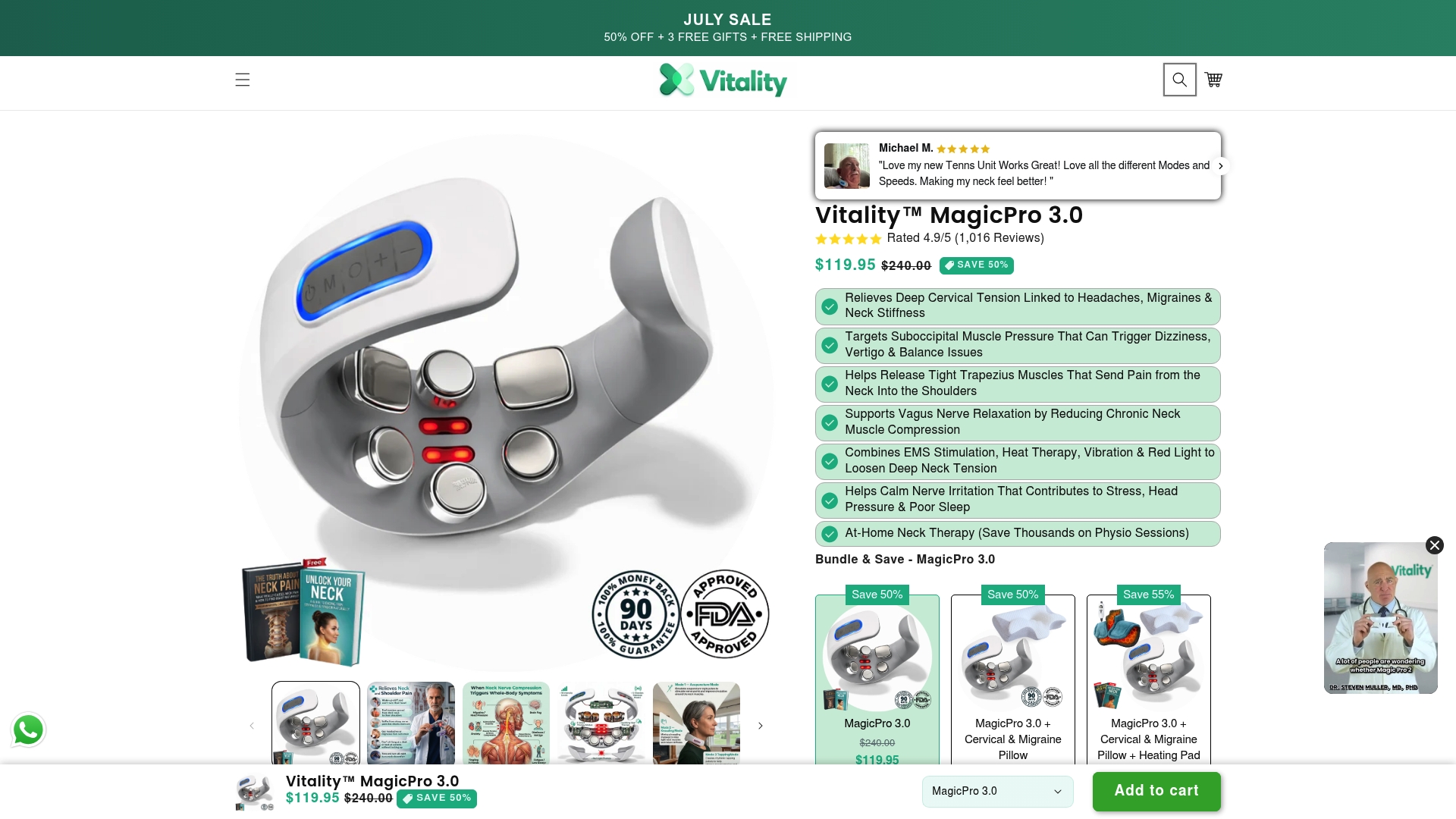
The device is compact enough to use at a desk, on a commute, or at home, and sessions take 15 minutes. For people who need targeted, adjustable therapy without a clinic visit, the full neck and nerve relief collection at Vitalitytherapy offers doctor-recommended options built around the same physiological principles covered in this article.
FAQ
What is the tonic vibration reflex and why does it matter?
The tonic vibration reflex is a neurological response where muscle spindles fire repeatedly when exposed to vibration, then relax. This reflex is the primary mechanism by which vibration therapy reduces muscle stiffness.
How long should a vibration therapy session last for neck stiffness?
Research supports 30–60 second intervals of targeted vibration per muscle group, with rest between applications. Continuous sessions longer than that can overstimulate nerves and cause discomfort rather than relief.
Does vibration therapy work better than massage for stiffness?
Clinical trials show vibration therapy produces greater short-term pain and stiffness relief than cross-friction massage, with statistically significant improvements in both pain (p=0.001) and swelling (p<0.001) after two weeks.
Can vibration therapy help if I cannot exercise due to pain?
Yes. Vibration activates the neuromuscular system without requiring large muscle forces, making it particularly useful for deconditioned individuals or those with pain-limited mobility who cannot perform standard rehabilitation exercises.
Should I use vibration therapy before or after stretching?
Apply vibration before stretching. Using vibration as a primer loosens fascial tissue and warms the cervical muscles, allowing stretches to reach deeper structures and produce longer-lasting reductions in stiffness.