

Most cordless neck massagers need about 3 to 5 hours for a full charge and deliver roughly 50 minutes to 2 hours of runtime per session, depending on settings. Heat and higher intensity drain the battery fastest, sometimes cutting runtime in half compared to a low, no-heat setting. Some devices stretch to 2 to 3 hours on light modes.
TL;DR:
- Most cordless neck massagers take 3 to 5 hours to charge and provide between 50 minutes and 3 hours of use, depending on settings.
- Manufacturer claims about battery life often refer to specific conditions, like low heat and intensity, not typical everyday use.
- Heat and high-intensity modes can cut runtime by half or more, so check for separate runtime estimates per mode before buying.
- Using a device while charging varies by model; always consult the manual to avoid damaging the battery or voiding warranty.
- Proper maintenance, storage, and recycling practices can extend battery life and minimize environmental impact over the device’s lifespan.
Table of Contents
- Understanding Neck Massager Battery Life Claims
- What Manuals and Tests Actually Report for Charge and Runtime
- How Heat and Intensity Settings Cut Into Runtime
- Charging Rules, Car Adapters, and Using It While Plugged In
- Getting the Most Out of Your Battery Over Time
- A Quick Checklist for Comparing Battery Specs Before You Buy
- Session Length, Battery Drain, and When to Stop
- Fifteen Minutes a Day: What Actually Matters for Battery and Therapy
- Why MagicPro’s Battery Design Fits a Daily Relief Routine
- Where to Verify Battery Specs for Your Exact Model
- Sources
Understanding Neck Massager Battery Life Claims
Manufacturers rarely mean the same thing when they print “battery life” on a box. Some list continuous run time, the number of minutes a device operates nonstop before needing a recharge. Others report cycle-based numbers, like “6 x 15-minute sessions,” which adds up to 90 minutes but isn’t meant to run that long in one stretch.
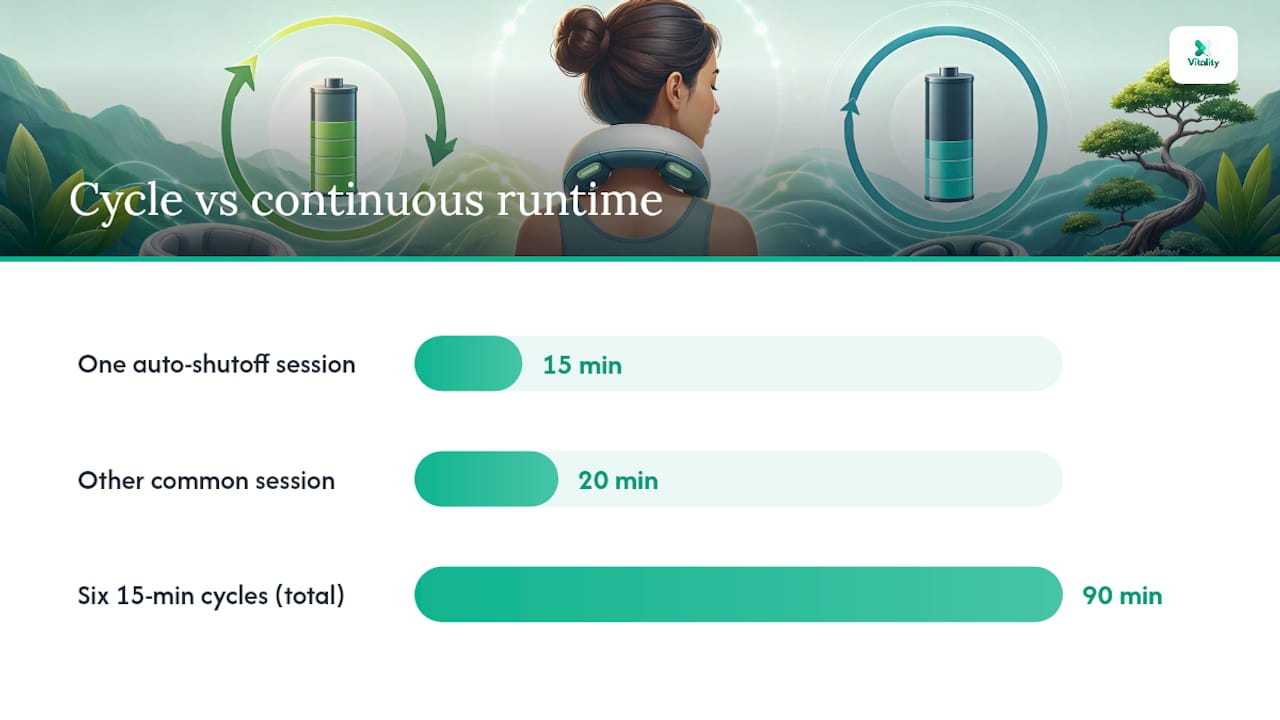
This distinction matters more than it seems. A shopper comparing two neck massagers might see “90 minutes” on one box and “6 cycles” on another and assume they’re equal. They’re not necessarily. The cycle-based model may auto-shutoff after each 15-minute block, requiring you to restart it, while the continuous model just keeps running until the battery dies.
Auto-shutoff timers also shape how manufacturers report their numbers. Many neck massagers default to 15 or 20-minute sessions before powering down automatically, a built-in safety feature that also happens to conserve battery. If a spec sheet advertises “up to 2 hours of use,” that figure often assumes you’ll manually restart the device after each auto-shutoff cycle rather than run it in one uninterrupted block.
Here’s why reading the actual manual or spec sheet beats trusting the marketing bullet points on a retail page:
- Retail listings often round up battery figures to the most flattering number, while manuals list conditions (heat on/off, intensity level) that produce that number.
- Cycle-based claims can be misread as continuous runtime, leading to disappointment when the device shuts off sooner than expected.
- Auto-shutoff defaults vary by brand, so “battery life” printed on packaging may reflect a specific session length rather than total charge capacity.
- Some brands report runtime only at the lowest intensity setting, which inflates the number compared to how most people actually use the device.
The Terraillon help center notes that its neck massager’s battery life depends heavily on massage speed and whether the heat function is active, a caveat worth checking on any product you’re considering. Before you buy, look for a spec sheet that separates runtime by mode. If a listing only gives one vague number, treat it as a best-case estimate rather than a guarantee.
What Manuals and Tests Actually Report for Charge and Runtime
The numbers hold up fairly consistently across brands once you dig into the manuals instead of the marketing copy. A full charge typically takes 3 to 5 hours, and runtime on a single charge falls somewhere between 50 minutes and 3 hours depending on heat and intensity settings.
By the numbers: A full charge on a typical cordless neck massager takes about 4 hours and delivers roughly 90 minutes of runtime, according to one manufacturer’s help center. Editorial testing from Forbes Vetted finds wearable, collar-style models commonly run 60 to 90 minutes per charge, with premium units stretching closer to 3 hours.
That range isn’t arbitrary. Different manuals confirm the pattern from different angles:
- The Etekcity EM-SN8S user manual lists a charge time of up to 5 hours and battery life of 2 to 3 hours, depending on heat level and massage speed.
- The Terraillon help center reports roughly 90 minutes of runtime after a 4-hour charge, with heat and speed settings as the main variables.
- Independent editorial testing from Forbes Vetted generally finds shorter real-world runtimes than manufacturer claims once heat and high intensity enter the picture, a useful reality check when you’re comparing spec sheets.
Why the spread? Battery capacity, motor efficiency, and how aggressively a brand tunes its device for power all play a role. A neck massager built around a small, lightweight collar design typically carries a smaller battery than a bulkier wraparound unit, which trades portability for runtime. If you want a device you can wear through a full workday of intermittent use, check whether the manual specifies runtime at your preferred settings, not just the best-case scenario at the lowest intensity with heat off.
One more pattern worth flagging: manuals that separate “with heat” and “without heat” runtime numbers tend to be more transparent overall. If a spec sheet gives you just one number with no breakdown, that’s often a sign it’s citing the most favorable condition rather than typical use.
How Heat and Intensity Settings Cut Into Runtime
Turning on the heat function is the single biggest drain on a neck massager’s battery. Manufacturer documentation for one digital massager model shows that activating heat can reduce runtime to about 50 minutes, compared to significantly longer sessions with heat switched off. That’s not a small dip. Depending on the model, heat alone can cut usable runtime by half or more.
Higher motor speeds work the same way. A neck massager set to its strongest vibration or kneading intensity pulls more current continuously, which shortens the window before the battery needs a recharge. Combine heat with a high-intensity massage mode, and you’re looking at the shortest runtime a device can offer, often in the 45 to 60-minute range even on models that advertise 2 or more hours at lower settings.
A few practical patterns show up across most cordless models:
- Heat plus high intensity produces the shortest runtime, frequently near the 50-minute mark cited in manufacturer manuals.
- Vibration-only or pulse modes without heat tend to run the longest, sometimes reaching 2 to 3 hours on a single charge.
- Mid-range intensity with heat on typically lands somewhere in between, though the exact number depends on the model’s battery capacity.
- Devices with multiple massage heads or rotating nodes generally draw more power than simple vibration units, shortening runtime further.
Pro Tip: If you plan to use heat regularly, look for a spec sheet that lists runtime separately for “heat on” and “heat off.” A device that only advertises one blended number is usually hiding a much shorter heat-enabled runtime.
If your priority is a long, uninterrupted relaxation session, prioritize models that publish per-mode runtimes rather than a single headline figure. A device that lists 3 hours “at low intensity, no heat” but doesn’t mention its heat-on number is telling you something by omission. Look instead for transparent breakdowns, or for higher battery capacity ratings measured in mAh, which generally correlate with longer runtime across all modes.
Charging Rules, Car Adapters, and Using It While Plugged In
Whether you can use your neck massager while it charges depends entirely on the model, and manufacturers disagree on this point. Some manuals explicitly warn against it, while others, like the Etekcity EM-SN8S manual, state plainly that certain models allow use while charging. That inconsistency means you should always check your specific device’s manual rather than assume it behaves like a similar-looking product.
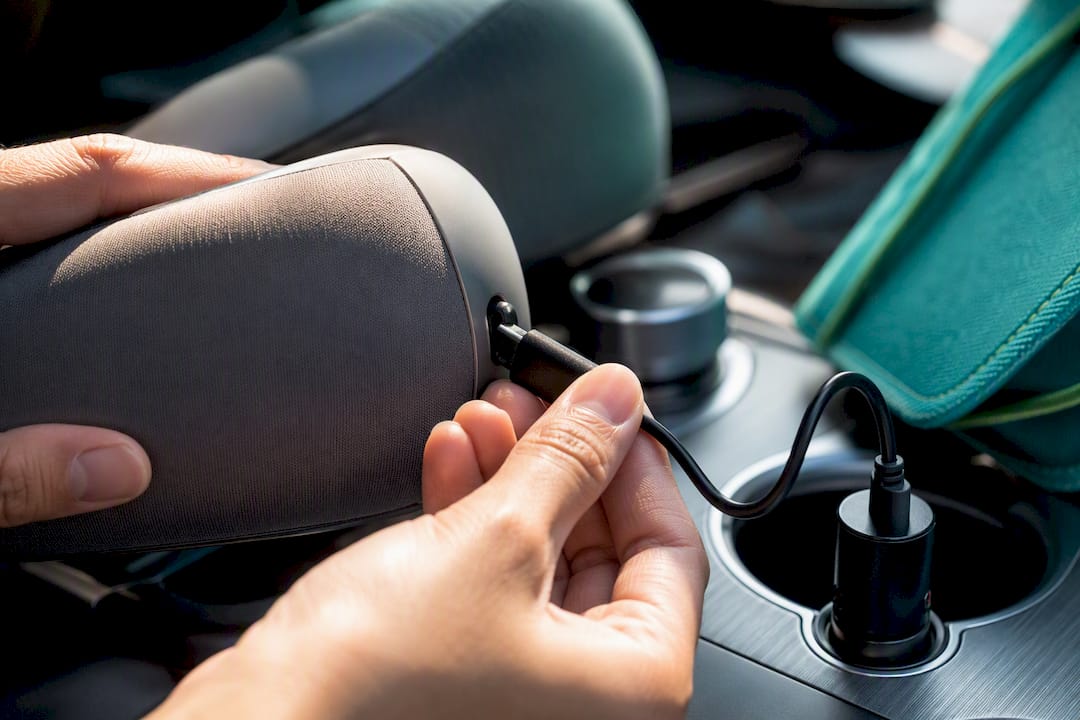
Using a device while it charges, even when permitted, can affect long-term battery health or void a warranty on some models. If your manual doesn’t explicitly say it’s safe, don’t risk it.
Charger specifications matter more than most buyers realize. A HoMedics instruction manual for a portable neck massager recommends a specific charger output to hit its stated 4-hour charge time and roughly 2-hour runtime. Swapping in a generic or mismatched adapter can throw off both numbers:
- A USB-C charger rated at 5V and 2A is a common baseline for cordless neck massagers, though the exact spec varies by model.
- Using a lower-output charger (say, 5V 1A instead of 5V 2A) typically extends charge time well beyond the manufacturer’s stated window.
- Using an incompatible high-voltage charger risks damaging the battery or internal circuitry, even if the connector physically fits.
- Car adapters (12V DC) work with some models but not others; check the manual before assuming your device is compatible with in-vehicle charging.
If you’re someone who wants to top off your neck massager during a commute, this is worth confirming before you buy. A device advertised as “portable” doesn’t automatically mean it supports every charging method you’d want on the go.
Getting the Most Out of Your Battery Over Time
A lithium battery doesn’t fail all at once. It loses capacity gradually, and how you charge and store the device has a real effect on how long that decline takes. The habits that protect a neck massager’s battery are the same ones that protect any lithium-powered device you own.
Battery care basics: Storing a lithium battery at roughly 40 to 60% charge, in a moderate temperature, slows capacity loss far more effectively than storing it fully charged or fully drained.
If you’re setting your neck massager aside for a few weeks or months, don’t let it sit at 0%. Deep discharge accelerates permanent capacity loss, meaning the battery holds less charge over time even after a full recharge. The same guidance that applies to cordless tool batteries applies here: charge it periodically, about once a month, if it’s going into storage for an extended stretch.
A few habits make a measurable difference:
- Avoid letting the battery drain to zero repeatedly; partial discharges are gentler on lithium cells.
- If storing the device for more than a month, aim for a 40 to 60% charge rather than full or empty.
- Keep the device away from extreme heat or cold, both of which accelerate capacity loss.
- Unplug it once it reaches full charge rather than leaving it connected indefinitely, when your manual allows.
When a neck massager’s battery finally reaches the end of its useful life, disposal matters. Most cordless models use non-removable lithium batteries, which means you can’t simply pop one out and recycle it separately. The EPA advises recycling these devices through e-waste or battery-specific programs rather than tossing them in regular trash, since lithium batteries pose fire and environmental risks in standard landfills. Check with your local municipality or a certified e-waste recycler for drop-off locations before discarding an old unit.
A Quick Checklist for Comparing Battery Specs Before You Buy
Shopping for a cordless neck massager gets a lot easier once you know exactly what to look for on the product page. Run through this list before adding anything to your cart:
- Check for separate runtime numbers. Look for distinct figures for heat versus no-heat, and low versus high intensity, rather than one blended claim.
- Note the charge time. Most models fall in the 3 to 5-hour range; anything significantly longer may signal an older or lower-quality battery.
- Look for battery capacity in mAh or Wh. Higher capacity generally, though not always, correlates with longer runtime across settings.
- Confirm use-while-charging policy. Some manuals permit it, others don’t. Don’t assume; check the specific model.
- Match runtime to your actual use pattern. A 15-minute desk break needs far less battery than a long relaxation session before bed.
- Consider charger type and replaceability. USB-C chargers are common and convenient, but confirm the output spec matches the manufacturer’s recommendation.
- Factor in warranty and e-waste terms. Non-removable batteries mean the whole device typically needs replacing at end of life, so warranty length matters more than it might for a removable-battery device.
A device that checks every box on runtime but skimps on warranty coverage isn’t necessarily the better buy once you account for total cost over a few years of use.
Session Length, Battery Drain, and When to Stop
Most manufacturers default their neck massagers to 10 to 20-minute sessions, and that’s not an arbitrary number, as explained in detail in what actually happens during a session. Starting with shorter, lower-intensity sessions gives your neck and shoulders time to adjust to electrical stimulation, heat, or deep massage pressure before you commit to longer use. It also happens to be gentler on the battery, which is a reasonable place to compromise: shorter sessions extend both your comfort margin and your charge cycle count over the device’s lifespan.
Clinical guidance on neck massagers generally echoes this approach. Starting at low intensity and short duration, then increasing gradually only if your body tolerates it well, is the safer path.
Guidance from health sources emphasizes starting with low intensity and short sessions, and stopping immediately if symptoms worsen rather than pushing through discomfort.
Watch for these signs that it’s time to stop and consult a doctor:
- Dizziness or lightheadedness during or after a session
- Increasing pain rather than relief, especially if it persists after you turn the device off
- Numbness or tingling that spreads beyond the treated area
- Muscle weakness that wasn’t present before you started using the device
Vitality Therapy’s approach to neck relief follows this same logic. The MagicPro devices are built around short, focused sessions rather than marathon use, aligning with the session-length guidance most manufacturers and clinicians recommend.
Fifteen Minutes a Day: What Actually Matters for Battery and Therapy
Most people don’t need hours of runtime from a neck massager. They need reliable performance for a short, consistent session, and that’s a different design problem than building a device meant to run continuously for half a day.
If your routine is a 15-minute session during a lunch break or before bed, a device with a 50-minute heat-on runtime charges once and covers three sessions before it needs to go back on the charger. That’s plenty for daily maintenance. Where longer continuous runtime actually matters is for people using a neck massager during travel, on long flights, or for extended relaxation sessions where recharging mid-use isn’t practical.
The mistake I see buyers make is chasing the highest runtime number on the spec sheet without asking whether they’ll ever use that much in one sitting. A device that runs for 3 hours straight sounds impressive, but if your actual use pattern is short daily sessions, you’re paying for capacity you’ll rarely tap. Match the battery to your routine, not the other way around, and always follow the session-length guidance in your specific product’s manual rather than pushing a device past what it’s designed for.
— Achraf
Why MagicPro’s Battery Design Fits a Daily Relief Routine
If you’re comparing battery specs because you want a device that fits into a real daily routine rather than sitting in a drawer between rare use, that’s exactly the use case Vitality Therapy’s MagicPro devices are built around.
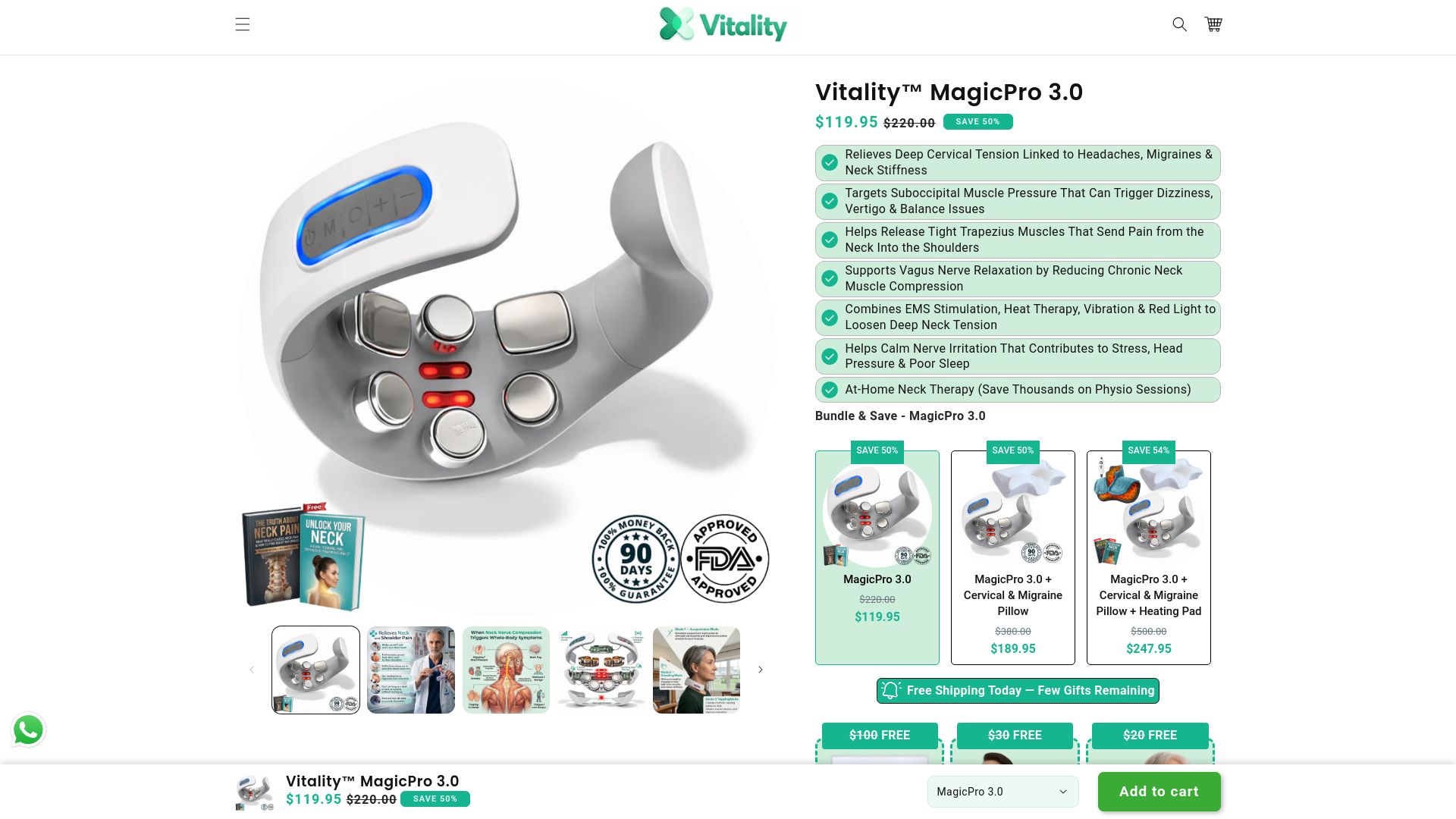
The MagicPro 2.0 and MagicPro 3.0 combine electrical muscle stimulation, heat, and massage into sessions designed to run around 15 minutes a day, the same range clinical guidance points to for safe, effective use. Because the therapy window is intentionally short, the battery doesn’t need to stretch across hours of continuous operation the way a general-purpose massager might. That means fewer compromises between heat intensity and runtime, and a recharge cycle that fits naturally into a daily habit: use it in the morning, plug it in overnight, and it’s ready again the next day. The compact, cordless design also means you can bring it to work or use it during travel without hunting for an outlet mid-session.
If daily 15-minute sessions sound like the routine you’re after, take a look at the MagicPro 2.0 or browse the full lineup of Vitality devices to find the fit that matches your relief needs.
Where to Verify Battery Specs for Your Exact Model
Battery behavior varies enough between brands that the manual for your specific device is always the final word, not a general guide like this one. A few reliable places to check before you buy or troubleshoot:
- Manufacturer manuals and spec sheets list exact charge times, runtime by mode, and whether use-while-charging is permitted for your model.
- Brand help centers, like the Terraillon support page, often answer battery questions in plainer language than the printed manual.
- Independent editorial reviews provide real-world runtime testing that can confirm or challenge a manufacturer’s stated numbers.
- EPA recycling resources explain how to responsibly dispose of a device once its non-removable battery reaches end of life.
Cross-checking two or three of these sources before you buy takes a few extra minutes and saves you from guessing when your new neck massager’s battery doesn’t match your expectations.
This article is general information, not a substitute for advice from a qualified doctor. Consult a qualified healthcare professional about your own circumstances before acting on anything here.
Sources
- Neck massager - What is the battery life? – TERRAILLON Help Center
- Etekcity EM-SN8S Wireless Shiatsu Neck & Shoulder Massager user manual
- SLNKMSG120 digital massager manual
- EPA — Recycle used household batteries