


Neck mobility exercises for seated workers are movements designed to reduce cervical stiffness, restore range of motion, and relieve the tension that builds from hours of desk work. Physical therapy guidelines recommend performing a targeted neck routine 1–2 times daily, with micro-movements every 20–30 minutes to counter forward head posture. The good news is that none of these exercises require equipment, a gym, or even standing up. You can do every one of them at your desk, right now.
Why neck mobility exercises matter for seated office workers
Prolonged sitting locks the cervical spine into one position for hours. The result is a predictable pattern of dysfunction: the head drifts forward, the upper trapezius muscles tighten, and the deep cervical flexors weaken. Clinicians call this Upper Crossed Syndrome, and it is the structural root of what most people call “tech neck.”
The consequences go beyond discomfort. Tight cervical muscles compress local nerves and restrict blood flow, which dulls concentration and increases fatigue. Common signs include:
- A persistent ache at the base of the skull
- Shoulder tension that worsens by mid-afternoon
- Reduced ability to rotate the head fully left or right
- Headaches that start at the neck and radiate forward
Long-term relief requires three things working together: workstation ergonomics, frequent movement, and targeted strengthening. Perfect posture alone does not undo the damage of sitting still for six hours. Movement is the active ingredient, and the exercises below deliver it in a format that fits a real workday.
Reviewing your office posture problems alongside a mobility routine gives you a complete picture of what to fix and why.
Essential seated neck stretches you can do at your desk
These four exercises cover the full range of cervical motion. Perform them in sequence for a complete routine that takes under ten minutes.
1. Chin tuck
Sit tall with your feet flat on the floor. Without tilting your head up or down, glide your chin straight back, as if making a double chin. Hold for 3–5 seconds, then release. Repeat 10 times. This movement directly counters forward head posture by reactivating the deep cervical flexors.
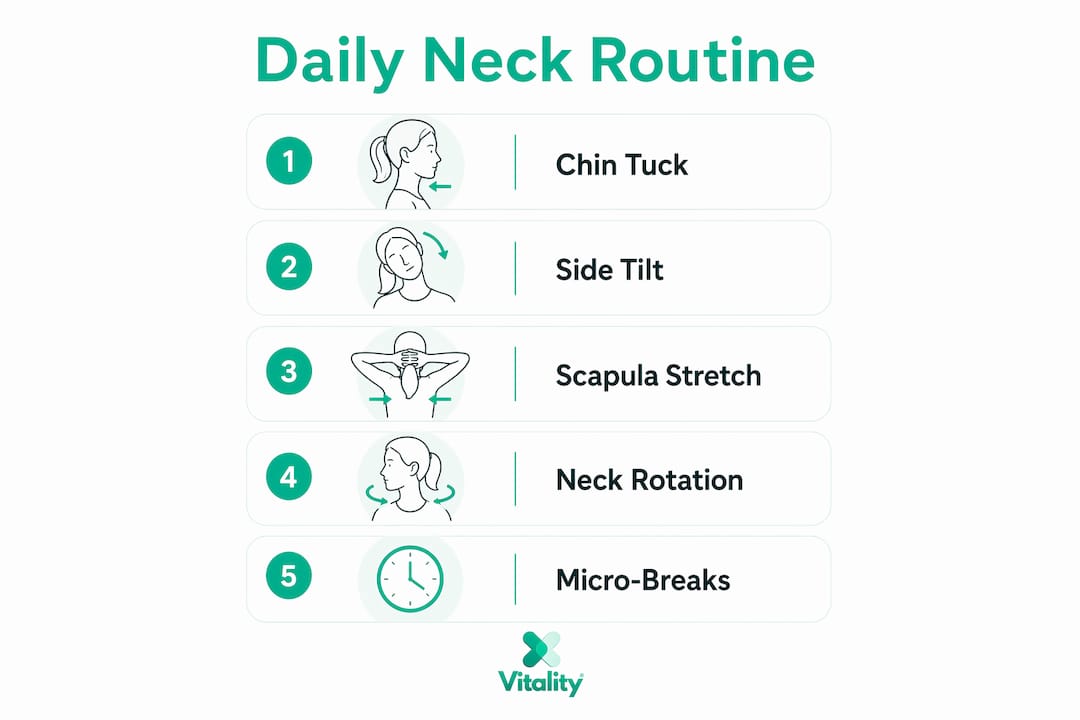
2. Side tilt (lateral flexion)
Drop your right ear toward your right shoulder. Keep your left shoulder pressed down and relaxed. Hold for 20–30 seconds per side, or up to 60 seconds if you carry chronic stiffness. Switch sides. Do 2–3 repetitions on each side.

Pro Tip: Place your opposite hand under your thigh or grip the seat edge to prevent the shoulder from rising. This isolates the stretch to the neck muscles and makes it significantly more effective.
3. Levator scapulae stretch
Turn your head 45 degrees away from the side you want to stretch, then lower your chin toward your armpit. You will feel a deep pull along the back corner of your neck. Hold for 20–30 seconds per side. This targets the levator scapulae, a muscle that is almost always overloaded in desk workers.
4. Neck rotation
Slowly rotate your head to look over your right shoulder. Pause for 3–5 seconds at the end of your comfortable range. Return to center and repeat on the left. Do 5 slow rotations per side. Never force the rotation past the point of comfort.
Pro Tip: Pair neck rotations with a slow exhale as you turn. Releasing breath reduces muscular guarding and lets you access a slightly greater range of motion without forcing.
Preventing shoulder elevation during lateral stretches is the single most common technique correction physical therapists make. Stabilize the shoulder with hand placement every time.
How to build a daily neck mobility routine at work
Consistency produces results. Desk workers who commit to ergonomics, movement breaks, and daily neck exercises see meaningful improvement within 4–6 weeks. That timeline is realistic only if the routine fits your actual schedule.
A practical structure looks like this:
- Morning (before screens): Full 4-exercise sequence, 8–10 minutes
- Midday (lunch break): Repeat the full sequence or focus on whichever area feels tightest
- Every 20–30 minutes throughout the day: One set of chin tucks or a single side tilt per side
The micro-break rule is the most important habit to build. Micro-breaks of 1–2 minutes every 20–30 minutes benefit tissue health more than a single long session after hours of inactivity. Set a phone timer or use a browser extension to prompt you.
Workspace setup determines whether your routine sticks. A monitor positioned at eye level removes the constant forward pull on the cervical spine. A chair with proper neck support setup reduces baseline muscle load before you even begin exercising.
| Routine element | Recommended frequency | Time required |
|---|---|---|
| Full mobility sequence | 1–2 times daily | 8–10 minutes |
| Micro-movement breaks | Every 20–30 minutes | 1–2 minutes |
| Levator scapulae stretch | Daily, both sides | 2–3 minutes |
| Chin tuck holds | Every micro-break | 30–60 seconds |
Pro Tip: Anchor your morning routine to an existing habit, such as your first cup of coffee. Habit stacking removes the decision-making friction that causes most people to skip.
Advanced tips: combining strengthening with mobility for lasting relief
Stretching relieves tension in the short term. Strengthening prevents it from returning. Tech neck involves weak deep cervical flexors alongside tight upper trapezius muscles, so addressing only one side of that imbalance produces temporary results at best.
Add these strengthening moves to your weekly routine:
- Chin tuck holds: Perform the chin tuck and hold for 10 seconds instead of 3–5. Do 3 sets of 10. This builds endurance in the deep cervical flexors, the muscles most responsible for holding your head in a neutral position.
- Wall angels: Stand with your back flat against a wall, arms bent at 90 degrees. Slowly slide your arms up the wall and back down without losing contact. This activates the lower trapezius and rhomboids, which support the upper back and reduce the load on the neck.
- Prone Y-T-W raises: Lie face down on a mat or firm surface. Raise your arms into Y, T, and W shapes, squeezing the shoulder blades together at the top of each position. These movements build the posterior shoulder muscles that pull the head back into alignment.
Strengthening the deep neck muscles and upper back creates a structural foundation that makes your mobility routine more effective. Think of mobility as clearing the path and strengthening as paving it.
What mistakes should you avoid during seated neck exercises?
The most common error is forcing range of motion. The goal of neck mobility during work is restoring motion, not achieving the deepest possible stretch. Pushing into pain activates a protective muscle response that tightens the very muscles you are trying to release.
Scaling back intensity when one side feels tighter or unsteady is not a sign of weakness. It is the correct clinical response. Asymmetry between sides is normal and resolves gradually with consistent practice. Forcing symmetry too quickly increases injury risk.
Three other mistakes to watch for:
- Shoulder shrugging during side tilts. The shoulder rises to compensate when the neck muscles resist. Press the shoulder down actively or grip the seat edge.
- Holding your breath. Breath-holding increases muscle tension throughout the cervical region. Breathe steadily through every stretch.
- Rushing through repetitions. Slow, controlled movement activates the target muscles more effectively than fast, bouncy repetitions.
Gradual progress is the only reliable path. If you feel sharp pain, tingling, or numbness during any exercise, stop and consult a physical therapist before continuing.
Key Takeaways
Consistent neck mobility exercises, combined with micro-breaks every 20–30 minutes and targeted strengthening, produce lasting relief for seated workers within 4–6 weeks.
| Point | Details |
|---|---|
| Micro-breaks beat long sessions | Move for 1–2 minutes every 20–30 minutes rather than stretching once after hours of sitting. |
| Four core exercises cover all motion | Chin tucks, side tilts, levator scapulae stretches, and rotations address every major cervical movement pattern. |
| Strengthening prevents recurrence | Chin tuck holds and wall angels build the deep cervical flexors that keep the head in a neutral position. |
| Technique errors reduce results | Shoulder shrugging and breath-holding are the two most common mistakes that limit stretch effectiveness. |
| Improvement takes 4–6 weeks | Workers who combine ergonomics, movement breaks, and daily exercises see consistent progress within that window. |
What I’ve learned from watching office workers actually do these exercises
By Achraf
Most people who try a neck mobility routine quit within two weeks. Not because the exercises are hard, but because they treat the routine as an event rather than a behavior. They block out 15 minutes on their calendar, do it twice, and then forget it exists.
The workers I have seen maintain real, lasting improvement do something different. They shrink the routine down to its smallest useful form and attach it to something they already do. One chin tuck set while the computer boots. A side tilt while reading an email. A levator scapulae stretch during a phone call. These are not compromises. They are the actual mechanism of change.
The other thing I have noticed is that people underestimate how much their workspace fights against their exercises. You can do perfect chin tucks every 20 minutes and still lose ground if your monitor sits six inches below eye level. The exercises and the ergonomics have to work together. Fixing one without the other is like bailing water without plugging the hole.
My honest recommendation: start with just the chin tuck and one side tilt. Do them every time you refill your water glass. Build from there. Complexity is the enemy of consistency, and consistency is the only thing that actually works.
— Achraf
Vitalitytherapy: supporting your neck health between exercises
Exercise builds the foundation. Recovery fills the gaps. Vitalitytherapy’s MagicPro 3.0 combines electrical muscle stimulation, heat, and massage into a single wearable device that delivers targeted cervical relief in 15 minutes. It is designed to be used at your desk, on a commute, or at home, making it a natural complement to the seated mobility routine described above.
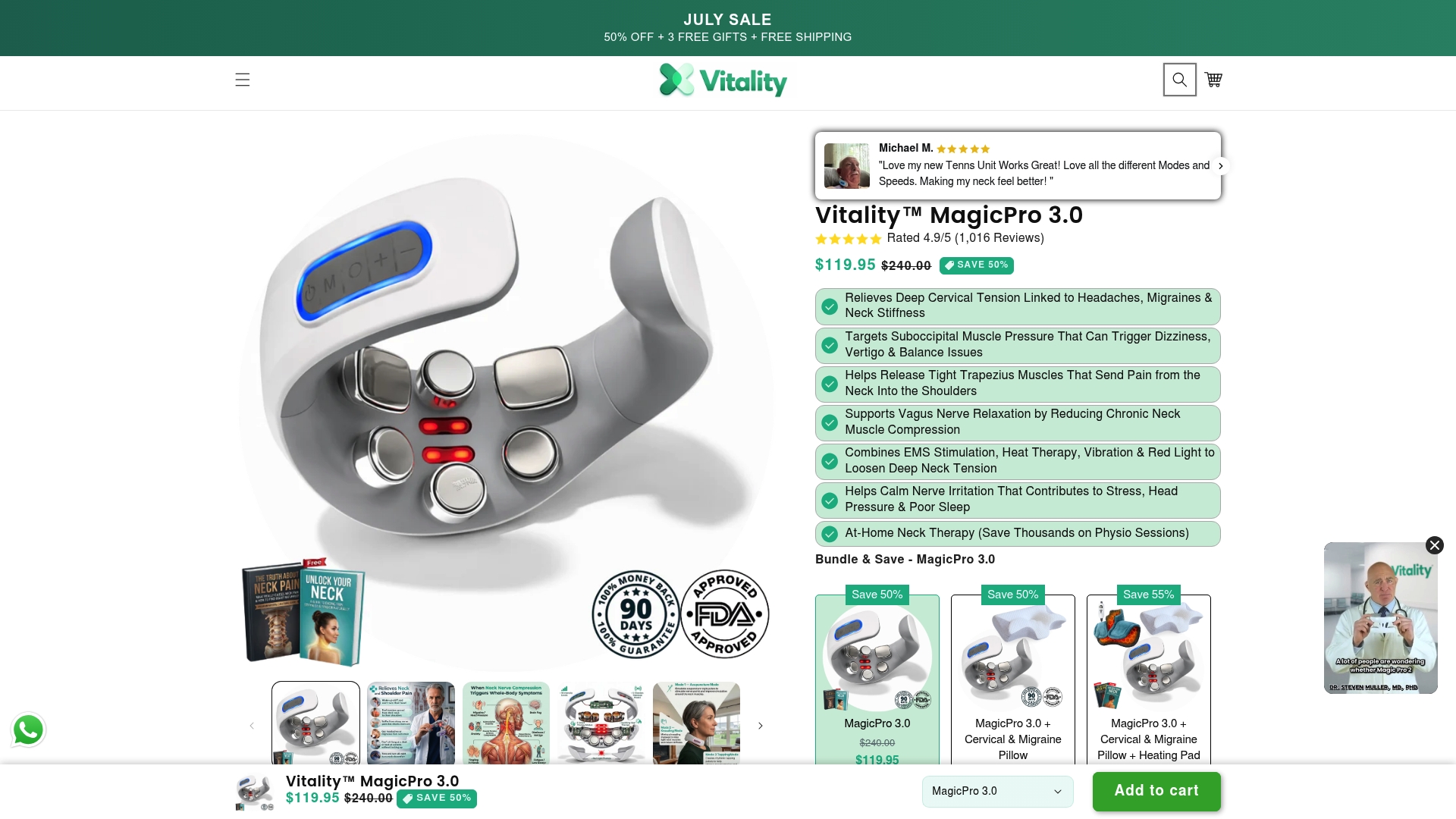
For workers dealing with persistent stiffness that exercises alone do not fully resolve, the full neck and nerve relief collection offers doctor-recommended options that address both muscle tension and nerve discomfort. These devices do not replace movement. They accelerate recovery between sessions so your next routine starts from a better baseline.
FAQ
How often should seated workers do neck mobility exercises?
Perform a full routine 1–2 times daily and add brief micro-movements, such as chin tucks, every 20–30 minutes throughout the workday.
How long should you hold a neck stretch?
Hold each stretch for 20–30 seconds per side as a standard. For chronic stiffness, extending to 60 seconds per side produces better results.
What is the best single exercise for office worker neck pain?
The chin tuck is the most effective starting point. It directly counters forward head posture by reactivating the deep cervical flexors that prolonged sitting weakens.
Is it safe to stretch a stiff neck at work?
Yes, as long as you stay within a comfortable range of motion. Avoid forcing stretches past the point of pain, and scale back intensity if one side feels significantly tighter than the other.
How quickly can neck mobility exercises reduce stiffness?
Most workers notice reduced tension within the first week of consistent practice. Structural improvement in posture and pain levels typically develops over a 4–6 week period with daily adherence.