

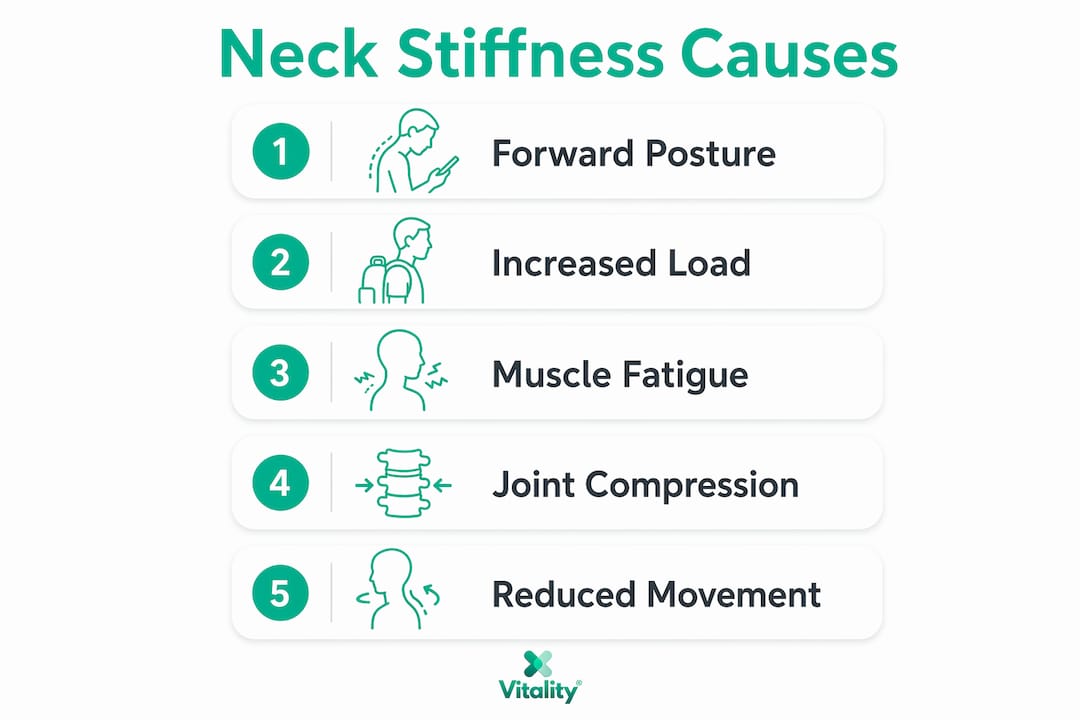
Neck stiffness from desk work is defined as cervical muscle fatigue and joint irritation caused by sustained forward head posture during prolonged sitting. The condition is not simply a result of a bad chair or a crooked monitor. The real driver is mechanical load. A head tilted just 5 centimeters forward roughly doubles the load on the cervical spine, triggering rapid muscle fatigue and joint irritation. Understanding this mechanism is the first step toward doing something about it. The good news is that desk work neck pain responds well to targeted therapy, smarter movement habits, and a few workstation adjustments.
What causes neck stiffness from desk work?
Neck stiffness from desk work is a mechanical problem before it is a pain problem. When you sit at a desk, your head tends to drift forward toward the screen. That forward shift changes the physics of your entire cervical spine.
The human head weighs roughly 10–12 pounds in a neutral position. At 45 degrees of forward tilt, that load increases to approximately 50 pounds on the cervical spine. That is the equivalent of a child sitting on your neck for eight hours. Your cervical muscles, particularly the suboccipital group at the base of the skull and the upper trapezius across the shoulders, work continuously to hold that load. Sustained contraction without rest causes the muscles to fatigue, and fatigued muscles become tight and painful.

The joints between the cervical vertebrae, called facet joints, also bear more compression under forward head posture. Prolonged compression irritates the joint lining and reduces mobility. That combination of muscle fatigue and joint irritation is what most office workers recognize as neck stiffness. Tension headaches that start at the base of the skull are often a direct extension of the same process, as the suboccipital muscles refer pain upward into the head.
| Posture position | Approximate cervical load |
|---|---|
| Neutral (ears over shoulders) | 10–12 lbs |
| 15° forward tilt | ~27 lbs |
| 30° forward tilt | ~40 lbs |
| 45° forward tilt | ~50 lbs |
Pro Tip: Set a phone alarm every 45 minutes as a posture reset cue. Stand up, retract your chin gently, and roll your shoulders back twice. That 20-second reset interrupts the load cycle before fatigue sets in.
Why stretching alone won’t fix desk neck pain
Stretching is the most common self-treatment for desk-related neck stiffness, and it does provide temporary relief. The problem is that stretching reduces muscle tension temporarily but does not build endurance, so the pain returns as soon as you sit back down.
The deeper issue is what happens to your deep cervical flexor muscles, the small stabilizing muscles that run along the front of the cervical spine. Prolonged static posture causes these muscles to become inhibited and weak. When they stop doing their job, the superficial muscles, including the sternocleidomastoid and upper trapezius, take over. Those larger muscles are not designed for sustained stabilization. They fatigue faster and generate more tension, which is why the pain keeps coming back even after stretching.
Building lasting relief requires what clinicians call capacity building. That means:
- Deep cervical flexor activation: Low-load chin tuck exercises that target the longus colli and longus capitis muscles, not just the superficial neck muscles
- Endurance training: Holding positions for time rather than just moving through a range of motion
- Scapular stability work: Strengthening the mid-trapezius and serratus anterior to reduce the load transferred to the neck
- Progressive loading: Gradually increasing the challenge over 8–12 weeks so the muscles adapt to the demands of desk work
Pro Tip: The chin tuck exercise is the single most effective starting point for deep cervical flexor activation. Sit tall, gently draw your chin straight back without tilting your head, and hold for 5 seconds. Repeat 10 times. It feels subtle, but it directly targets the muscles that desk work weakens most.
Stretching still has a role. It reduces acute tension and improves short-term comfort. But without the endurance component, you are managing symptoms rather than solving the problem. Think of stretching as pain management and capacity building as the actual fix.
How to set up your workstation to reduce neck strain
Ergonomics is not about achieving a perfect posture and holding it all day. Holding a rigid “perfect” posture for hours locks muscles into continuous isometric contraction and causes fatigue. The goal of a good workstation setup is to reduce the baseline load on your cervical spine so that fatigue accumulates more slowly.
Follow these workstation setup steps to reduce cervical load:
- Raise your monitor to eye level. The top third of your screen should sit at or just below eye level. If you use a laptop, a separate keyboard and a laptop stand are not optional. Laptop screens force your head down by design.
- Position your keyboard and mouse close to your body. Your elbows should rest at roughly 90 degrees with your forearms parallel to the floor. Reaching forward for the keyboard pulls your shoulders forward and increases neck load.
- Check your chair height. Your feet should rest flat on the floor, and your hips should sit at or slightly above knee level. A chair that is too low forces a posterior pelvic tilt, which collapses the lumbar curve and pushes the head forward. A proper office chair neck support setup makes a measurable difference.
- Move every 30–45 minutes. Raising the monitor, positioning the keyboard correctly, and taking regular movement breaks reduce accumulated cervical load substantially. A brief walk to refill your water bottle counts. The movement does not need to be structured exercise.
- Use micro-exercises at your desk. A meta-analysis of 11 studies shows that micro-exercises during the workday significantly reduce neck and shoulder pain in sedentary workers. Shoulder rolls, chin tucks, and gentle cervical rotations take under two minutes and reset muscle tension between tasks.
For a full library of neck mobility exercises designed specifically for seated workers, Vitalitytherapy’s 2026 guide covers evidence-based routines you can do without leaving your desk.
What does manual therapy actually do for desk neck pain?
Manual therapy is the most direct way to address joint stiffness and muscle trigger points that have built up from sustained desk posture. Joint mobilization and trigger point treatment produce immediate improvements in mobility and pain, and many people feel significantly better after a single session.
The mechanism is straightforward. Specific mobilization techniques applied at cervical levels C2 to C5 restore movement that compression has restricted. Trigger point release in the suboccipital and upper trapezius muscles reduces the referred pain that causes tension headaches. Cervicogenic headaches associated with desk neck pain often resolve faster than neck stiffness itself when these techniques are applied.
Manual therapy works best as part of a three-part approach:
- Joint mobilization to restore cervical range of motion and reduce facet joint irritability
- Deep cervical flexor rehabilitation to rebuild the stabilizing muscles that static posture has weakened
- Postural modification to change the habits and workstation setup that created the problem
This three-pronged approach produces meaningful improvement in 4–6 sessions over 3–6 weeks. That timeline is realistic and worth knowing before you start, because many people expect instant results and stop treatment too early. The rehabilitation phase, which targets deep cervical flexor endurance, typically continues for 8–12 weeks to achieve lasting stability.
Manual therapy alone does not prevent recurrence. Combining it with specific rehabilitation prevents pain from returning in a way that therapy alone cannot. The joint work creates the window of comfort. The exercise work keeps it open.
Key Takeaways
Neck stiffness from desk work is a mechanical problem driven by forward head posture, muscle fatigue, and joint compression, and it requires both load reduction and capacity building to resolve.
| Point | Details |
|---|---|
| Forward head posture doubles load | A 5 cm forward head shift roughly doubles cervical spine load, accelerating muscle fatigue. |
| Stretching is not enough | Stretching eases tension temporarily but does not build the endurance needed to prevent recurrence. |
| Ergonomics reduces baseline load | Monitor height, keyboard position, and movement breaks lower the rate at which fatigue accumulates. |
| Manual therapy gives fast relief | Joint mobilization at C2–C5 and trigger point release improve mobility and reduce pain rapidly. |
| Rehab takes 8–12 weeks | Deep cervical flexor training over 8–12 weeks builds the stability that prevents pain from returning. |
What I’ve learned after years of watching desk workers manage neck pain
The most common mistake I see is treating neck stiffness as a posture problem. People buy standing desks, memorize the “90-90-90” rule, and sit rigidly upright for as long as they can tolerate it. Then the pain comes back, and they assume they failed at posture.
The real issue is movement variability. Sitting perfectly still in a perfect position is almost as fatiguing as sitting badly. Your muscles need to shift load, change angles, and rest in different positions throughout the day. Frequent low-level movement is better for neck health than maintaining a rigid posture for hours. That insight changes everything about how you approach a workday.
The second mistake is skipping the strength work. Stretching feels productive because you feel the release immediately. Chin tucks and scapular exercises feel like nothing is happening. But those low-load activation exercises are what actually change the trajectory of the problem. The 8 common office posture problems that lead to neck pain almost all trace back to weak deep cervical flexors and overworked superficial muscles.
My honest recommendation: spend less time worrying about your posture and more time building the capacity to tolerate whatever posture you end up in. Get your cervical joints assessed if stiffness has lasted more than two weeks. Start the deep flexor work. Move more often. The combination works. The posture obsession alone does not.
— Achraf
Vitalitytherapy’s approach to neck pain relief at home
Therapy sessions and workstation upgrades address the root causes of desk neck pain. Between sessions, consistent daily relief matters just as much.
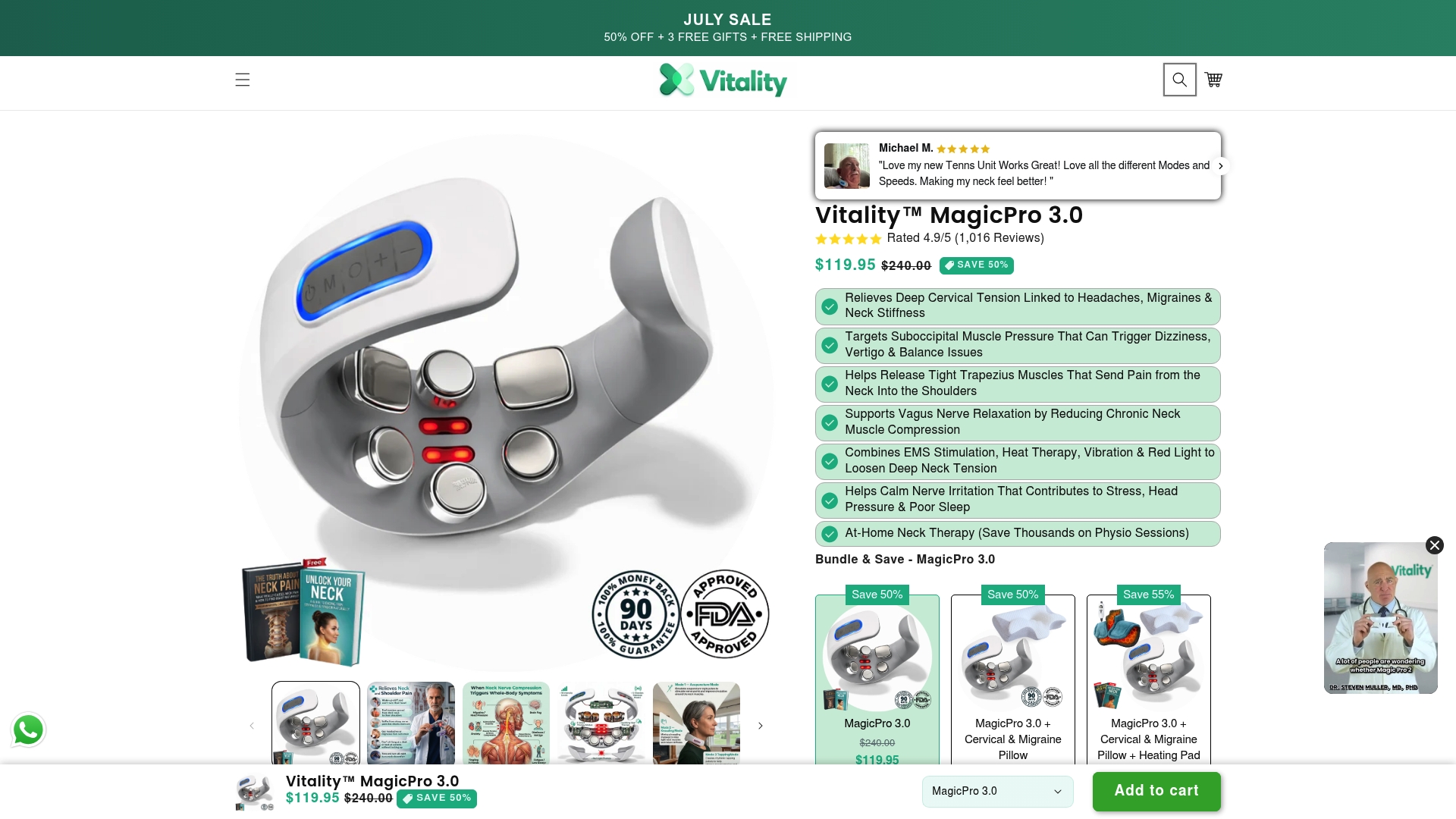
Vitalitytherapy’s Neck & Nerve Relief collection brings together devices that combine electrical muscle stimulation, heat, and massage into one compact tool. The MagicPro™ 2.0 and MagicPro™ 3.0 are doctor-recommended and designed to deliver relief in 15 minutes per day, whether you are at your desk, on the couch, or traveling. Electrical muscle stimulation works by sending gentle nerve signals that interrupt the pain cycle and encourage blood flow to fatigued cervical muscles. That process complements manual therapy and rehabilitation rather than replacing it. For office workers who cannot get to a clinic every week, it fills a real gap in the recovery routine.
FAQ
What is the main cause of neck stiffness from desk work?
Forward head posture is the primary cause. A head tilted just 5 centimeters forward roughly doubles the mechanical load on the cervical spine, causing the surrounding muscles to fatigue and the facet joints to become irritated.
How long does it take to fix desk-related neck stiffness?
Meaningful improvement typically occurs within 4–6 sessions of manual therapy over 3–6 weeks. Full stability through deep cervical flexor rehabilitation takes 8–12 weeks of consistent exercise.
Does stretching help neck stiffness from sitting?
Stretching provides temporary relief by reducing muscle tension, but it does not build the endurance needed to prevent stiffness from returning. Pairing stretching with deep cervical flexor strengthening produces lasting results.
What workstation changes reduce neck pain the most?
Raising the monitor to eye level, positioning the keyboard close to the body, and taking a movement break every 30–45 minutes are the three changes with the greatest impact on accumulated cervical load.
Can micro-exercises at a desk actually reduce neck pain?
A meta-analysis of 11 studies confirms that micro-exercises during the workday significantly reduce neck and shoulder pain in sedentary workers, with improvements exceeding clinically meaningful thresholds.