


The top alternatives to originaldesigntherapeutics.com approach are the Vitality™ MagicPro 3.0 and Vitality™ MagicPro 2.0, both sold by My Vitality. Each combines EMS, heat, and massage/vibration in a single portable device designed for 15-minute daily sessions at home, at work, or while traveling. If you want a multi-therapy neck device that you can actually use every day without rearranging your schedule, these two are the clearest place to start.
Both devices carry doctor-recommended positioning and are built around the same clinical logic: passive therapies like heat, massage, and electrical muscle stimulation can reduce pain enough to let you move more freely. Mayo Clinic guidance confirms that passive treatments work best when paired with stretching, strengthening, and postural adjustments. That pairing is what separates short-term relief from lasting improvement.
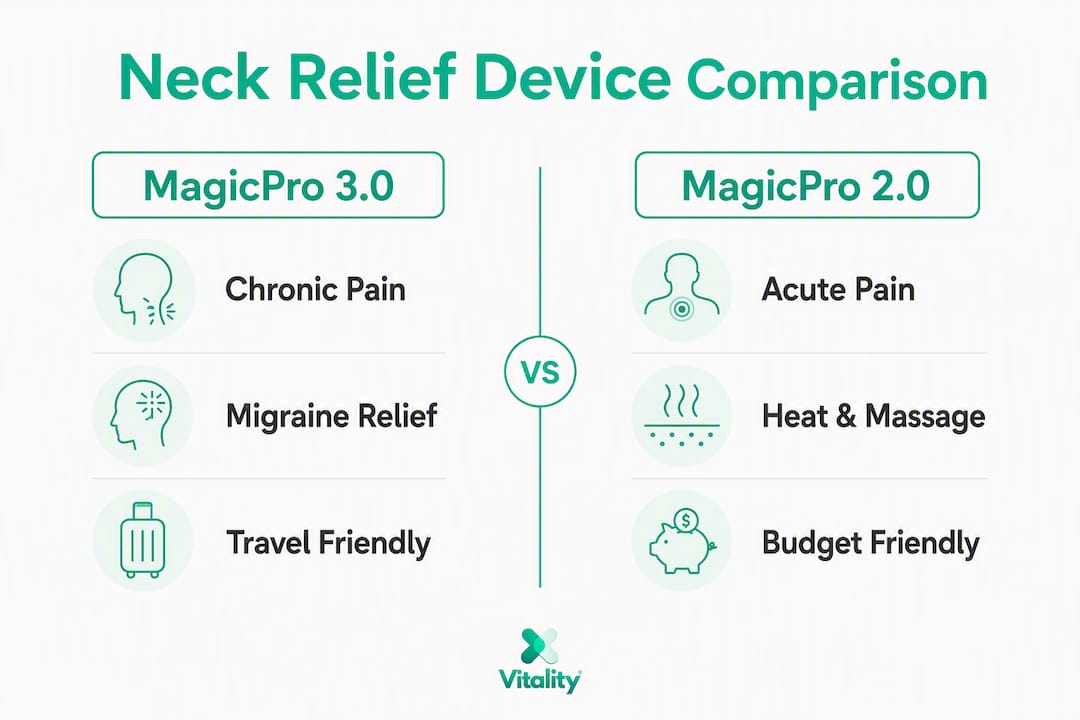
- Vitality™ MagicPro 3.0 — multi-therapy (EMS + heat + massage + vagus nerve support), best for chronic pain, migraines, and travel
- Vitality™ MagicPro 2.0 — EMS + heat + massage, best for routine stiffness relief and home use
Table of Contents
- How do the Vitality™ MagicPro 3.0 and 2.0 compare side by side?
- How do you choose the right portable neck-relief device?
- What safety rules apply when using a portable neck device?
- Which device should you actually buy?
- Key Takeaways
- A note on how these devices are positioned
- Ready to try the MagicPro? Here’s what My Vitality offers
- Useful sources and further reading
How do the Vitality™ MagicPro 3.0 and 2.0 compare side by side?
| Feature | Vitality™ MagicPro 3.0 | Vitality™ MagicPro 2.0 |
|---|---|---|
| Therapy modes | EMS + heat + massage/vibration + vagus nerve support | EMS + heat + massage/vibration |
| Best for | Chronic neck pain, migraines, travel use | Routine stiffness, home use |
| Session time | 15 minutes/day | 15 minutes/day |
| Portability | Compact, wireless, rechargeable | Compact, wireless, rechargeable |
| Price / warranty | Premium tier; warranty included | Mid tier; warranty included |
| Clinical evidence | Doctor-recommended; multi-therapy design | Doctor-recommended; established model |
| Ease of use | Adjustable fit, preset modes | Straightforward controls, comfortable fit |
MagicPro 3.0 standout details:
- Adds vagus nerve stimulation support alongside the core EMS/heat/massage stack, making it the stronger pick for migraine sufferers and people with stress-related neck tension
- Preset intensity levels reduce setup time; the compact form factor fits in a carry-on or desk drawer
MagicPro 2.0 standout details:
- Delivers the same core three-therapy combination at a lower price point
- Accessories and replacement pads are available through My Vitality’s store, which matters for long-term cost of ownership
Price callout: Portable multi-therapy neck devices in this category typically range from mid to premium price tiers. Both MagicPro models include a warranty and a return window. Checking return policy terms before purchase is worth the two minutes it takes — especially for wearable devices where fit and comfort are personal.
How do you choose the right portable neck-relief device?
Understanding the therapy types
Each mode targets a different mechanism of pain:
- EMS (electrical muscle stimulation) / TENS — sends low-level electrical pulses through electrode pads to interrupt pain signals and reduce muscle spasm. Useful for both acute stiffness and chronic tension.
- Heat therapy — relaxes tight muscles and improves local circulation. Mass General Brigham recommends applying heat for no longer than 15 minutes at a time, with a barrier to prevent skin irritation.
- Massage/vibration — mechanical stimulation that loosens connective tissue and reduces perceived tightness. Particularly useful before or after a workday.
- Red light therapy — uses low-wavelength light to support tissue recovery at a cellular level; included in select devices for users focused on longer recovery timelines.
Practical selection criteria
Before you buy, check these dimensions:
- Modes and intensity range — more modes give you flexibility as your symptoms change
- Fit and comfort — neck circumference and adjustability matter; a device that slips during a session is useless
- Battery life and charge time — for travel use, look for at least a full day’s sessions per charge
- Material and skin contact — silicone and medical-grade pads are gentler on sensitive skin
- Session timers and presets — built-in timers prevent overuse; presets reduce friction so you actually use the device daily
- Certifications and clinical evidence — doctor-recommended claims and published clinical rationale carry more weight than marketing language alone
- Warranty and return policy — a 30-day return window is a reasonable baseline for wearable devices
- U.S. availability and customer support — confirm the seller ships domestically and has a reachable support channel
Neck stiffness from desk work often involves both muscle fatigue and postural load, so a device that addresses multiple mechanisms simultaneously tends to outperform single-mode options.
Questions to ask the seller before buying
- What clinical evidence or doctor recommendation supports this device?
- What is the recommended session length and daily frequency?
- What is the return policy if the fit or intensity doesn’t work for me?
- What warranty coverage is included, and what does it cover?
- Are replacement pads or accessories available, and at what cost?
Pro Tip: If your primary goal is short-term pain relief (stiffness after a long workday), prioritize heat and massage modes. If you’re managing chronic pain or migraines, look for EMS plus vagus nerve support and pair device sessions with active recovery exercises to build on the temporary relief the device creates.
Exercise therapy is the mainstay treatment for chronic neck pain across pain types. A device that reduces pain enough to let you exercise consistently is doing its most important job.
What safety rules apply when using a portable neck device?
Safety checklist before every session
- Check the skin contact area for cuts, rashes, or active irritation — do not apply EMS or heat over broken skin
- Remove metal jewelry from the neck and upper chest area
- Do not use EMS or electrical stimulation if you have a pacemaker, implanted metal, or are pregnant
- Avoid use over active infections, tumors, or areas of reduced sensation
- Consult a physician before starting if you have a diagnosed cervical condition, recent surgery, or uncontrolled blood pressure
Step-by-step safe session sequence
- Clean and dry the skin at the contact area
- Position the device so it sits evenly on both sides of the neck
- Start at the lowest intensity setting
- Run a session of 15 minutes or less; do not exceed the device’s recommended duration
- Allow adequate rest between sessions before repeating
Mass General Brigham notes that heat should never be applied for more than 15 minutes at a time, and a barrier between the heat source and skin prevents burns. The same logic applies to heated wearable devices.
What timeline can you realistically expect?
| Timeframe | What to expect |
|---|---|
| First session (minutes to hours) | Temporary muscle relaxation, reduced immediate stiffness |
| 1–2 weeks (daily use) | Noticeable reduction in baseline tension with consistent sessions |
| 4 weeks (device + exercise) | Meaningful improvement in pain and function when paired with active routines |
| Beyond 4 weeks | Seek medical evaluation if symptoms are not improving or are worsening |
Home exercise programs work best when sessions start short (5–10 minutes) several times daily rather than long, intense sessions. The same principle applies to device use: start low, build gradually.
Integration note: Use your device session to reduce pain, then immediately follow with 5–10 minutes of gentle mobility or scapular activation exercises. Mid-back and shoulder stabilizer weakness often drives cervical load; addressing both gives you a much better outcome than passive relief alone.
Which device should you actually buy?
For most buyers, the Vitality™ MagicPro 3.0 is the stronger choice. It covers more symptoms (stiffness, chronic pain, migraines) in a single portable device, and the vagus nerve support feature makes it meaningfully different from basic EMS collars. If you travel frequently or deal with tension headaches alongside neck pain, the 3.0 is built for that profile.
The Vitality™ MagicPro 2.0 is the right call if your needs are simpler: routine morning or post-work stiffness, home use, and a lower upfront cost. The core EMS + heat + massage combination handles the most common complaints without the added complexity.
- Frequent traveler or migraine sufferer → Vitality™ MagicPro 3.0; multi-therapy + vagus support in a carry-on-friendly form
- Daily home user with routine stiffness → Vitality™ MagicPro 2.0; straightforward, effective, and well-supported
- Chronic pain with active recovery goal → either device, paired with daily mobility work and mid-back strengthening
- Budget-conscious buyer → MagicPro 2.0 delivers the core therapy stack at a lower price point
Key Takeaways
The Vitality™ MagicPro 3.0 and MagicPro 2.0 are the leading portable multi-therapy alternatives for neck pain relief, combining EMS, heat, and massage in a single device designed for daily 15-minute sessions.
| Point | Details |
|---|---|
| Top picks | MagicPro 3.0 suits chronic pain, migraines, and travel; MagicPro 2.0 suits routine stiffness and home use. |
| Safety first | Avoid EMS over broken skin, near pacemakers, or during pregnancy; always start at the lowest intensity. |
| Pair with active care | Use device sessions to reduce pain, then follow immediately with 5–10 minutes of mobility or scapular exercises. |
| Warranty matters | Confirm return policy and warranty terms before purchase; a 30-day return window is a reasonable baseline. |
| My Vitality | Both MagicPro devices are available at My Vitality’s store with warranty coverage and U.S. availability. |
A note on how these devices are positioned
The devices featured here are sold by My Vitality, the publisher of this article. That is a commercial relationship worth stating plainly. The MagicPro line is presented as a leading alternative because it combines multiple therapy modes in a portable form, carries doctor-recommended claims, and is backed by a warranty and accessible customer support — not simply because My Vitality sells it.
That said, no device replaces a clinical evaluation if your neck pain is severe, progressive, or accompanied by neurological symptoms like numbness or arm weakness. Compare warranty and return terms across any devices you consider, and ask sellers directly about the clinical evidence behind their products before purchasing.
This article provides general information, not medical advice. Consult a qualified healthcare professional for personalized guidance on managing neck pain.
Ready to try the MagicPro? Here’s what My Vitality offers
Neck pain that interrupts your workday, your sleep, or your focus deserves a real solution, not another single-mode gadget. My Vitality’s MagicPro devices deliver EMS, heat, and massage in one compact unit, with sessions that fit into 15 minutes of your day.
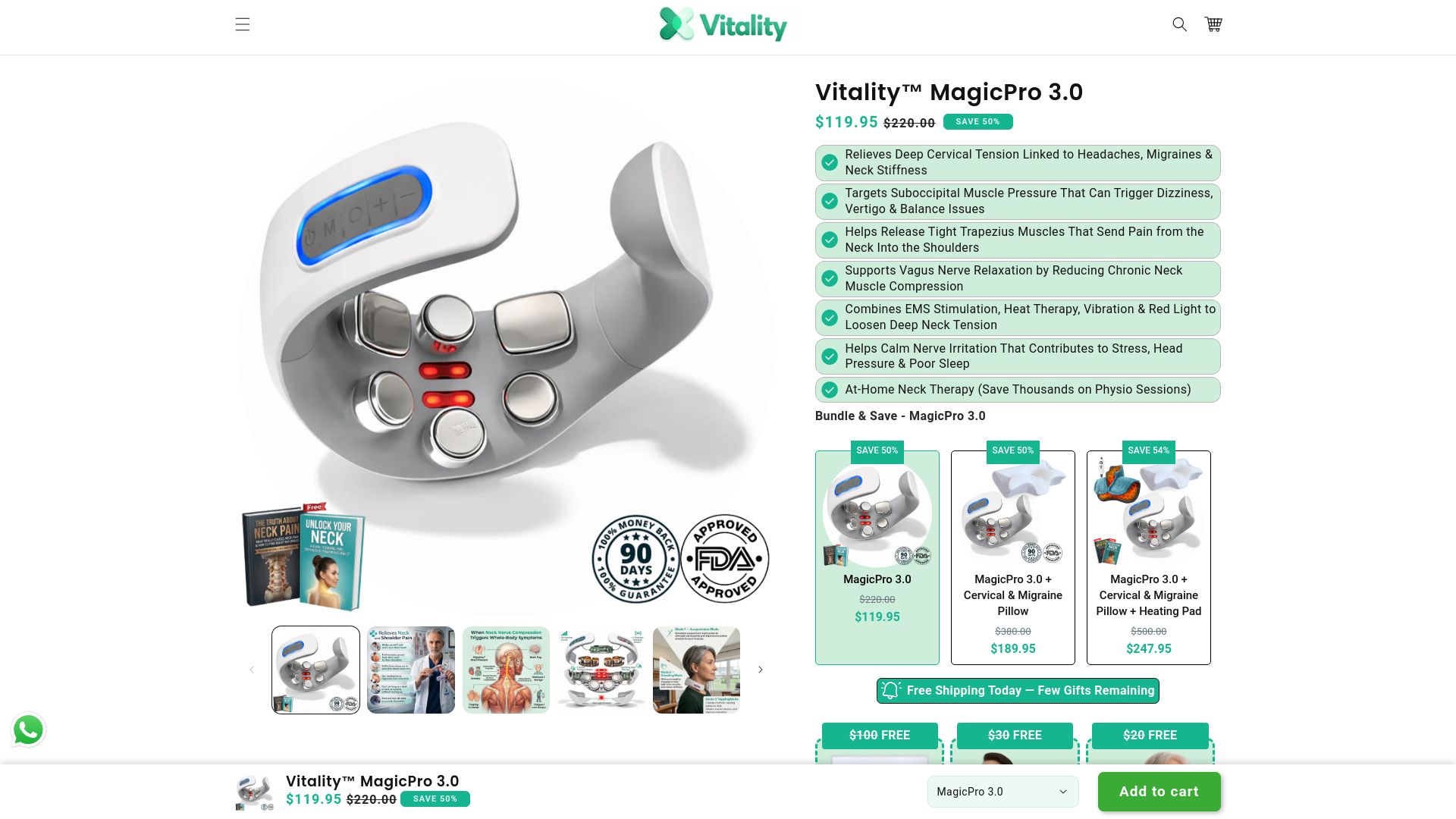
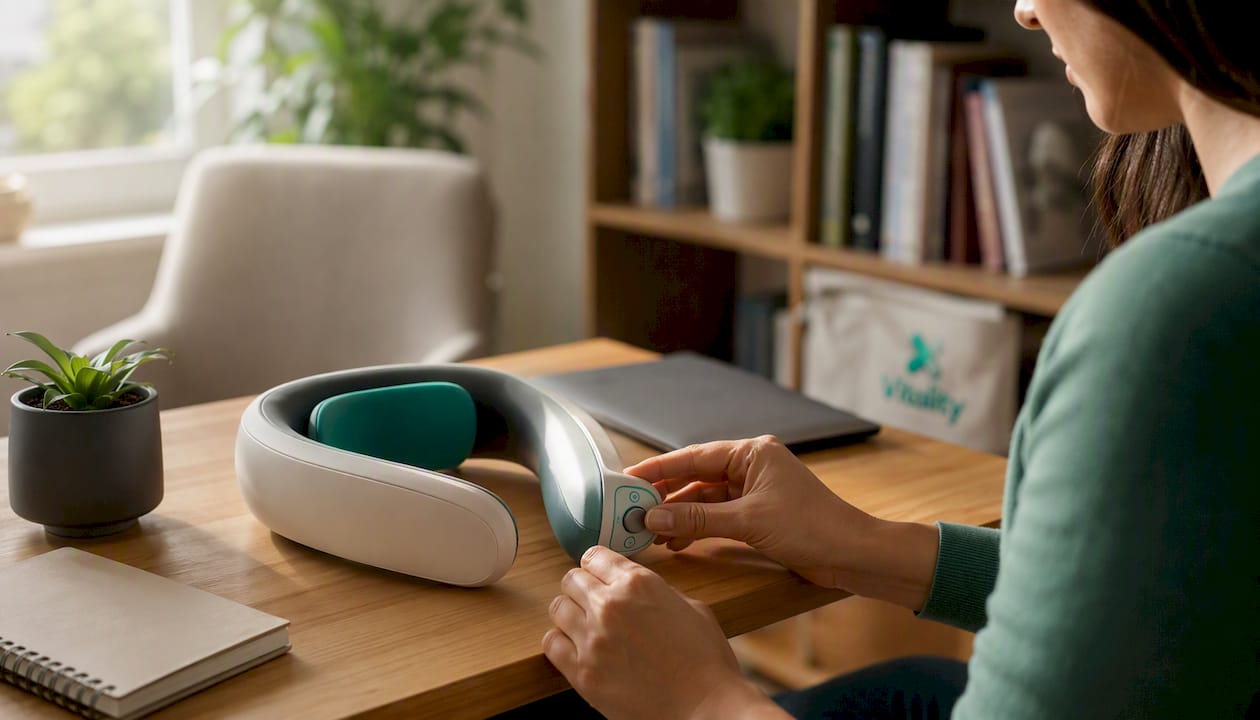
Both the Vitality™ MagicPro 3.0 and the Vitality™ MagicPro 2.0 ship within the U.S., include warranty coverage, and come with a return window so you can confirm fit and comfort before committing. Replacement pads and accessories are available directly through the store. Browse the full Vitality™ device lineup to compare models, check current pricing, and review return terms before you order.
Useful sources and further reading
The claims in this article draw on the following sources. Each is worth reading if you want to go deeper on the evidence.
- Exercise Therapy for Chronic Neck Pain: Tailoring Person-Centred Approaches — PMC review establishing exercise as the primary evidence-based treatment for chronic neck pain; supports the recommendation to pair device use with active routines.
- Effectiveness of Self-Care Education for Chronic Neck Pain — meta-analysis showing that combining self-care education with exercise produces better disability outcomes than passive approaches alone.
- Stiff Neck Remedies — Mass General Brigham — clinical guidance on heat, massage, and the importance of pairing passive relief with active recovery.
- Neck Pain: Diagnosis and Treatment — Mayo Clinic — authoritative overview of conservative neck pain treatment, including passive and active modality recommendations.
- Home Exercise Program Guidance — ANTHC (2025) — practical session-length guidance for home programs; supports the 5–10 minute session recommendation.
- Chronic Neck Pain Rehab Program — Landstuhl — rehabilitation protocol emphasizing mid-scapular strengthening to reduce cervical load.
If your symptoms are severe, progressive, or include neurological signs, consult a licensed physical therapist or physician before starting any device-based program.