

Red and near-infrared light therapy shows real, if measured, promise as a preventive adjunct for migraine, not an emergency escape hatch from an attack in progress. The evidence sits in the 630 to 940 nanometer wavelength band, where several small randomized trials report fewer monthly migraine days. Certainty remains low because the trials are small. If you have retinal disease, are pregnant, or experience retinal migraine, talk to a clinician before starting, and know that green light currently has stronger data supporting acute tolerance.
TL;DR:
- Red and near-infrared light therapy may reduce migraine days over several weeks, but current evidence is limited and low in certainty due to small trials.
- Wavelengths between 630 to 670 nanometers (red light) and 810 to 940 nanometers (near-infrared) are most supported, with combined use potentially more effective.
- People with retinal disease, pregnancy, retinal migraines, or on photosensitizing medications should consult a healthcare professional before trying red light therapy.
- During an active migraine attack, green light may be better tolerated and reduce photophobia compared to red or blue light.
Table of Contents
- What Red Light Therapy for Migraines Actually Does to Your Cells
- Does Red Light Help Migraines? What the Clinical Trials Show
- Wavelengths, Session Length, and How to Read a Device Spec Sheet
- Safety First: Who Should Skip Red Light Therapy, and When Green Light Wins
- Building a Realistic Trial Plan for Non-Invasive Migraine Relief
- Where My Vitality Devices Fit Into a Preventive Light Routine
- The Line Between Promising and Proven
- A Preventive Routine Built Around Consistency, Not Guesswork
- Sources
What Red Light Therapy for Migraines Actually Does to Your Cells
Photobiomodulation is the clinical term for what most people call red light therapy or LED therapy. It uses specific wavelengths of red and near-infrared light, delivered through LED panels or low-level lasers, to trigger biological responses inside cells rather than heating tissue the way infrared saunas or heating pads do. The light doesn’t numb pain on contact. It works several layers below the skin, in the mitochondria, the structures inside your cells that produce energy.
When red or near-infrared photons reach mitochondria, they get absorbed by an enzyme called cytochrome c oxidase. That absorption boosts ATP production, the cellular fuel your neurons run on. Migraine research has long pointed to mitochondrial dysfunction and energy deficits in the brains of people prone to attacks. That’s a big part of why photobiomodulation for headaches is being studied at all. It’s not a random wellness trend borrowing a trendy wavelength. It’s targeting a documented weak spot in migraine biology.
Three mechanisms show up consistently in the research:
- Mitochondrial support. Increased ATP availability may raise the energy threshold your brain needs before it tips into a migraine cascade.
- Anti-inflammatory signaling. Red and near-infrared light appear to reduce local neuroinflammatory markers, which matters because inflammation around the trigeminal nerve is closely tied to migraine pain generation.
- Neural excitability modulation. Some researchers believe photobiomodulation dampens the kind of cortical hyperexcitability that primes migraine-prone brains to overreact to normal stimuli, though this pathway is less firmly mapped than the first two.
There’s a reason this matters for how you should think about treatment. These mechanisms build slowly. They raise your baseline resistance to migraine over repeated sessions rather than shutting down a headache that’s already underway. That’s why red light therapy for migraines gets framed as a preventive tool, not an abortive one. An ice pack or a triptan works on the timescale of minutes. Photobiomodulation works on the timescale of weeks, because it’s asking your cells to recalibrate their energy output and inflammatory tone, not blocking a pain signal outright.
Does Red Light Help Migraines? What the Clinical Trials Show
The honest answer is: probably, for some people, under specific conditions, and the evidence isn’t as deep as most readers would like. Here’s what actually exists.
A 2024 randomized controlled trial tested 810 nanometer laser acupuncture against a sham treatment, delivering eight sessions over 28 days. The active-treatment group saw a significant drop in monthly migraine days and a meaningful reduction in how often participants reached for acute medication, compared with the sham group. That’s a clean, well-structured protocol: a defined wavelength, a defined session count, a defined outcome measure. It’s one of the better-designed pieces of evidence in this space.
What the numbers actually say: An 810 nm laser protocol run over eight sessions across 28 days reduced both monthly migraine days and acute-medication use versus sham. A separate systematic review pooling four RCTs and 174 participants found photobiomodulation produced clinically meaningful pain reductions for primary headache overall, but graded the certainty of that evidence as low.
That “low certainty” label isn’t a technicality. It reflects small sample sizes, inconsistent protocols across studies, and a real risk of bias in how some trials were designed and reported. When a review says an effect is “clinically important” but “low certainty,” it means the direction of benefit looks real, but the confidence interval around how large that benefit is stays wide. Researchers aren’t yet sure whether they’re looking at a strong effect measured sloppily, or a modest effect that looks bigger in small trials than it will in large ones.
This is also why major headache societies haven’t issued broad endorsements of light therapy migraine treatment. Guideline bodies tend to wait for:
- Multiple large, well-powered trials with standardized dosing.
- Consistent wavelength and session protocols across studies, so results can be compared directly.
- Independent replication outside the original research groups.
None of those boxes are checked yet. That doesn’t mean the treatment doesn’t work. It means the field hasn’t reached the evidence bar that changes formal clinical guidance. If you’re the kind of person who wants a treatment fully proven before trying it, wait. If you’re comfortable trying a low-risk, non-invasive migraine relief option with promising but incomplete data behind it, the current research gives you a reasonable, cautious green light.
Wavelengths, Session Length, and How to Read a Device Spec Sheet
If you’re going to trial this at home, the numbers on the box matter more than the marketing copy around it. Two wavelength ranges keep showing up across the research: red light around 630 to 670 nanometers, and near-infrared light around 810 to 940 nanometers. Red penetrates shallower tissue more efficiently; near-infrared reaches deeper structures. Studies on wavelength ranges in headache research suggest both bands play a role, which is why some devices combine them rather than relying on just one.
Published protocols vary, but a few patterns recur:
- Session length. Many trial protocols run sessions for several minutes, depending on the device’s power output and treatment area.
- Frequency. Preventive protocols in the literature typically call for multiple sessions per week, sustained over several weeks, not one-off exposures.
- Placement. Common target areas include the forehead, temples, and the back of the head near the upper neck, where trigeminal and occipital nerve pathways run close to the skin.
When you’re shopping for a device, ignore vague “full-spectrum” claims and look for three numbers: the wavelength (should sit inside that 630 to 940 nanometer window), the irradiance or fluence (how much light energy actually reaches your skin, usually measured in milliwatts per square centimeter), and the treatment area size. A device that doesn’t list wavelength at all isn’t giving you enough information to know whether it resembles anything tested in a clinical trial.
Pro Tip: Keep the device at the manufacturer’s specified distance from your skin. Standing too far away drops the effective dose far more than people expect, and it’s the single most common reason at-home users report “no effect” after weeks of use.
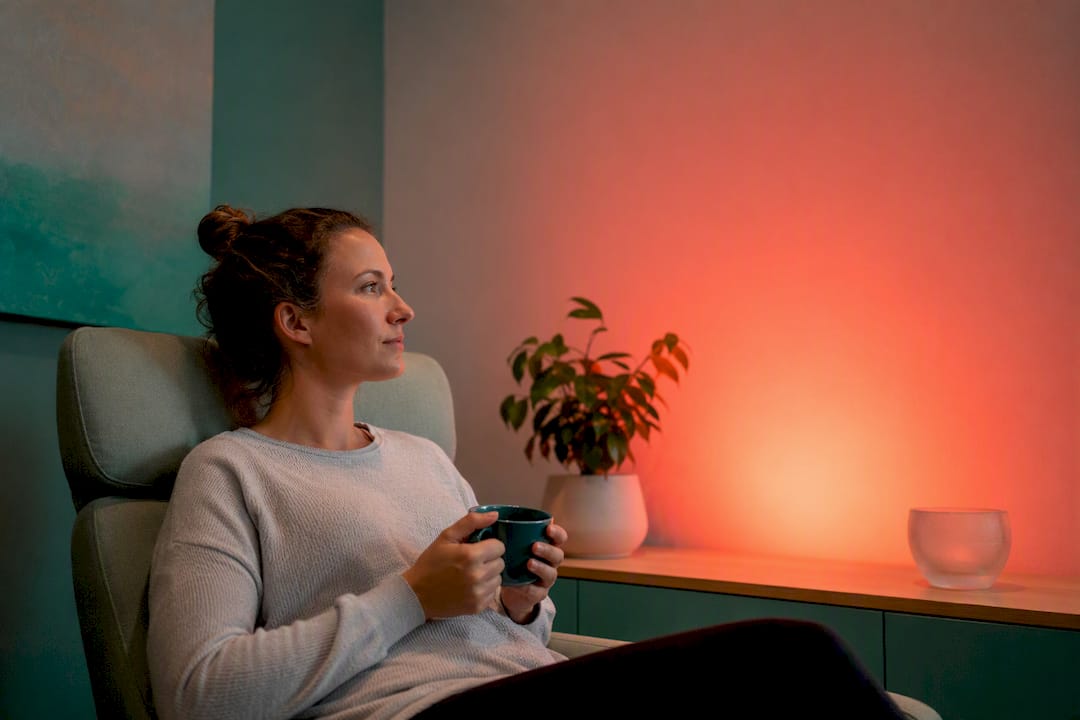
If light sensitivity is a concern for you day to day, using red light indirectly, as ambient room lighting rather than a direct facial treatment, can lower sensory load without triggering the same discomfort brighter white or blue light causes.
Safety First: Who Should Skip Red Light Therapy, and When Green Light Wins
Photobiomodulation has a strong safety profile overall, but “generally safe” isn’t the same as “safe for everyone, every time.” A few groups need to check with a clinician first:
- Pregnant individuals, since most trials exclude pregnancy and safety data specific to that population doesn’t exist yet.
- People with retinal disease or a history of retinal migraine, where any light-based intervention near the eyes carries added risk.
- Anyone on photosensitizing medications, including certain antibiotics and acne treatments, which can amplify skin or eye sensitivity to light exposure.
Eye safety deserves its own line of attention regardless of your health history. Never stare directly into an LED panel or laser device. Most manufacturers specify a safe distance and duration precisely because direct, prolonged exposure to concentrated light close to the eyes can cause damage that has nothing to do with migraine treatment at all. If your device sits close to your face, protective eyewear designed for red light exposure is a reasonable precaution, not an overreaction.
Here’s where the color distinction really matters. Red and near-infrared light are being studied for prevention. Green light has a different, better-established job during an actual attack. Research out of the University of Arizona found that one to two hours of daily narrow-band green light exposure reduced headache days in a preventive protocol, and separate reports describe improvement in roughly 55% of tracked attacks when green light was used acutely.
A study published in Brain found that green light activates thalamic pain pathways less than blue, white, or red light, which is why many migraine patients tolerate it better during an active attack, when almost every other light source makes photophobia worse.
The practical takeaway: use red or near-infrared photobiomodulation as a steady, preventive habit between attacks. If a migraine is actively underway and light sensitivity spikes, green light or simple darkness is the better acute choice, and neither should ever replace medication your doctor has prescribed for abortive treatment. Light therapy for headaches works best as an addition to your care plan, never as a substitute for it.
Building a Realistic Trial Plan for Non-Invasive Migraine Relief
Think of red light therapy as a preventive habit you’re testing, not a switch you flip during a headache. That mindset alone prevents most of the disappointment people report.
- Track a 4-week baseline first. Log migraine days, severity, and how often you use acute medication before you start light therapy, so you have something real to compare against.
- Commit to 6 to 12 weeks of consistent sessions. Because the mechanism works through gradual mitochondrial and inflammatory change, most people who notice benefit see it emerge between two and eight weeks in, not after the first session.
- Measure the same two numbers each week. Monthly migraine days and acute-medication days are the two outcomes the clinical trials themselves tracked, so they’re the fairest yardstick for your own results.
- Know when to stop or escalate. No measurable change after a full 12-week trial, worsening frequency, or any red-flag neurological symptom means it’s time to loop in your doctor rather than extend the experiment further.
Keep it paired with the fundamentals: consistent sleep, trigger tracking, stress management, and any medication your physician has already prescribed. Photobiomodulation adds to that foundation. It doesn’t replace it, and expecting it to work like a same-day painkiller is the single most common reason people quit before giving it a fair trial.
Where My Vitality Devices Fit Into a Preventive Light Routine
My Vitality’s device line was built around the same preventive logic this research supports: consistent, low-effort sessions that fit into a daily routine rather than a clinic visit. The MagicPro lineup combines red light therapy with electrical muscle stimulation, heat, and massage, targeting the neck and upper back tension that so often travels alongside migraine.
- Doctor-recommended design combining red light with muscle stimulation, heat, and massage in one device.
- Built for short daily sessions, around 15 minutes, which lines up with the session lengths seen in published photobiomodulation protocols.
- Portable enough to use at a desk, at home, or during travel, supporting the consistency that preventive light therapy depends on.
- Customers report noticeable improvement in neck tension and general comfort with regular use.
When you’re evaluating any device for this purpose, check its wavelength range and session guidance against the parameters covered above rather than relying on marketing language alone.
The Line Between Promising and Proven
The research supports a specific, narrow claim: red and near-infrared light therapy has plausible biological mechanisms and a few well-designed trials showing reduced migraine days. It does not support treating it as an abortive treatment, and it doesn’t yet support the kind of confident guarantee some wellness marketing implies.
Conventional advice on this topic tends to blur two entirely different tools. Green light for acute photophobia and red or near-infrared light for baseline prevention address different problems through different mechanisms, and treating them as interchangeable is where most people go wrong. Prioritize consistency over intensity. A modest daily dose used for eight weeks straight will teach you more about whether this works for your body than a single dramatic session ever will. Track your migraine days before you start, and let the numbers, not the sales copy, tell you if it’s working.
— Achraf
A Preventive Routine Built Around Consistency, Not Guesswork
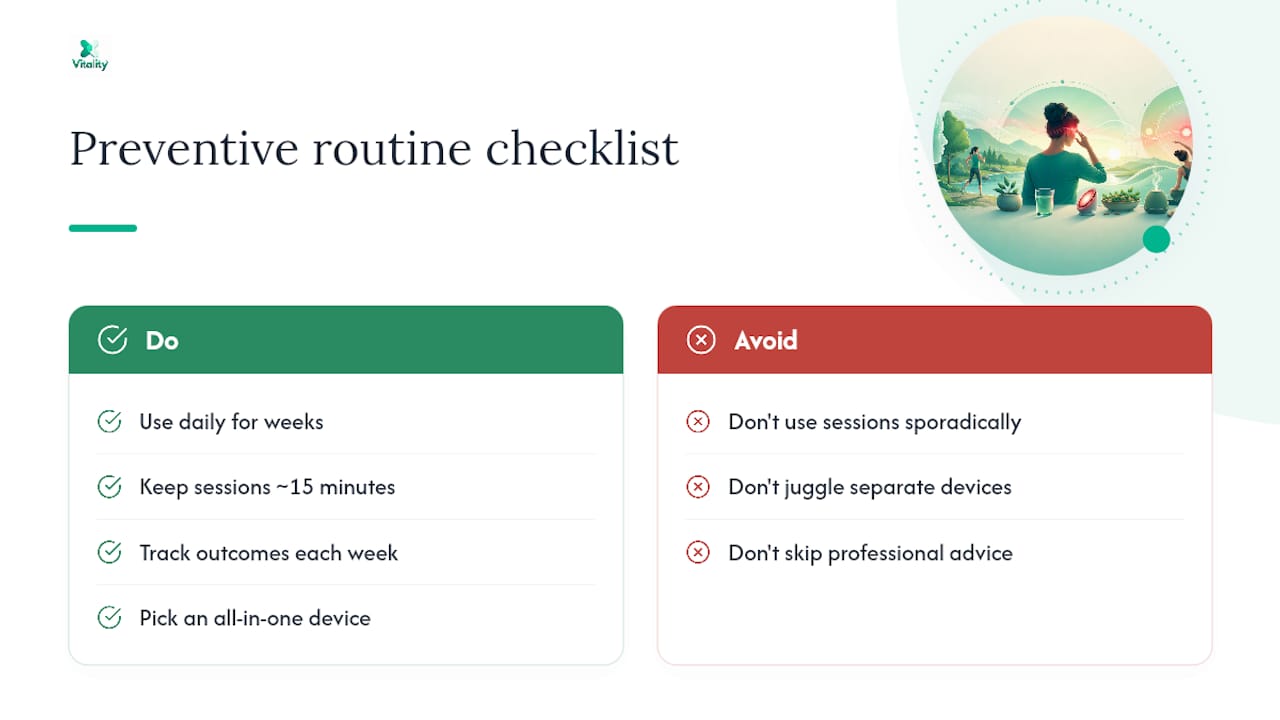
Photobiomodulation research keeps circling back to one requirement: consistent daily use over weeks, not sporadic sessions. My Vitality’s MagicPro 2.0 is built specifically for that kind of routine, combining red light therapy with electrical muscle stimulation, heat, and massage in a device small enough to use at your desk, in the car, or on the couch in 15 minutes flat.
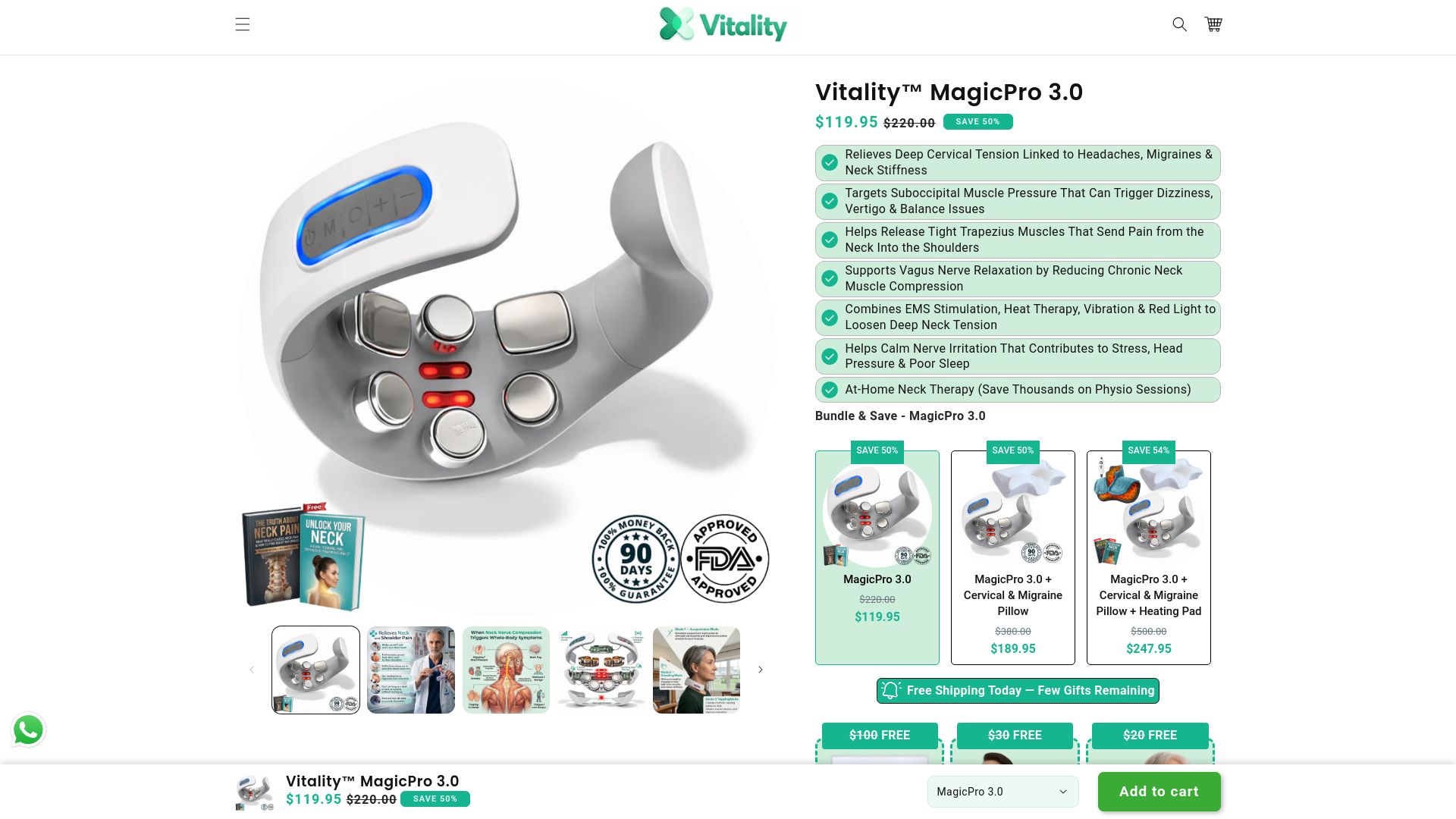
That combination matters because neck tension and migraine frequency are closely linked for a lot of people, and treating both at once, rather than juggling a separate red light panel and a separate massager, is what actually makes a daily habit stick. If you’ve read this far because you’re serious about giving preventive light therapy a fair trial, start where the evidence points: consistent sessions, tracked outcomes, and a device that fits into your day instead of demanding a new one. Check out the full Vitality device lineup or go straight to the MagicPro 2.0 product page to see the specs for yourself and decide if a 12-week trial makes sense for your migraine pattern.
This article is general information, not a substitute for advice from a qualified doctor. Consult a qualified healthcare professional about your own circumstances before acting on anything here.
Sources
The 810 nm laser acupuncture RCT offers the clearest single-protocol evidence for red light therapy migraines management. The PMC systematic review gives the fairest overall certainty assessment. For acute-attack light sensitivity, the Arizona green light research and the Brain study on light color explain why color choice changes everything mid-attack. For broader non-drug strategies, see how cold therapy fits into acute migraine relief and how sleep-focused support rounds out a prevention plan. If contraindications are a concern, this clinical rundown of red light therapy contraindications is worth a careful read before you start.
- Randomized controlled trial (2024) — 810 nm laser acupuncture reduced monthly migraine days
- Systematic review — photobiomodulation for primary headache (PMC8781567)
- University of Arizona summary — green light therapy reduces migraine frequency/intensity
- Brain (Noseda et al.) study on light color and migraine photophobia