


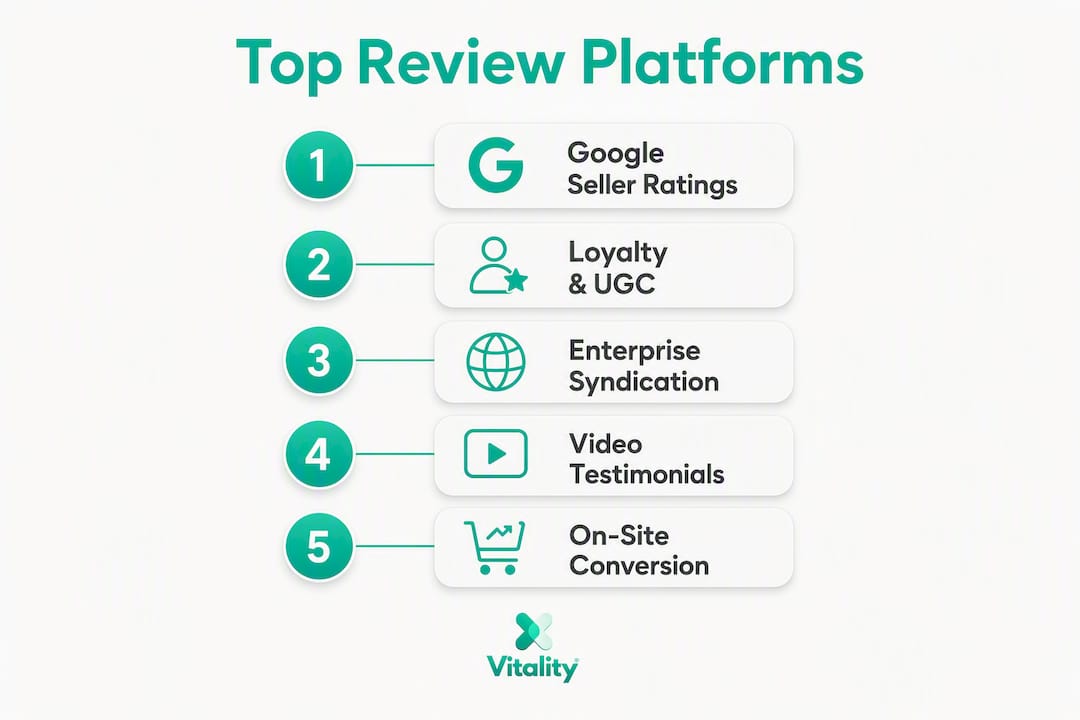
The strongest Trustpilot alternatives for most businesses are Reviews.io (Google Seller Ratings), Yotpo (reviews plus loyalty in one stack), Bazaarvoice or PowerReviews (enterprise retail syndication), and Birdeye or Podium (multi-location local services). Each solves a different problem, and picking the wrong one costs you more than the subscription fee.
| Best For | Representative Platform | Pricing Shape | Moderation Model |
|---|---|---|---|
| Google Seller Ratings / paid search | Reviews.io | Entry paid tier | Closed (verified purchase) |
| Integrated UGC + loyalty | Yotpo | Free tier + paid | Open + verified options |
| Enterprise retail syndication | Bazaarvoice / PowerReviews | Custom enterprise | Closed / moderated |
| Multi-location local services | Birdeye / Podium | Entry paid tier | Open with moderation |
| Shopify merchants (budget) | Stamped / Loox | Free tier + paid | Closed (purchase-gated) |
| B2B SaaS discovery | G2 / Capterra | Free listing + paid | Verified user |
| SMB reputation management | ReviewTrackers / NiceJob | Entry paid tier | Open with monitoring |
TL;DR:
- Paid-search-first businesses must use a Google-approved review partner to unlock Seller Ratings in Google Ads.
- Shopify merchants get the best value from native apps like Stamped or Loox before scaling to Yotpo.
- Multi-location service brands need directory optimization, not just review collection.
- Plan for a few weeks to a couple of months to stabilize review velocity after migrating from Trustpilot.
Table of Contents
- What are the best Trustpilot.com alternatives in 2026?
- How to choose the right Trustpilot alternative for your business
- How we selected and evaluated these alternatives
- Key takeaways
- What the review platform market gets wrong
- My Vitality offers a different kind of trust signal
- Sources and further reading
What are the best Trustpilot.com alternatives in 2026?
The 41 platforms below cover every major use case. Pricing and features are drawn from published documentation; verify current terms directly with vendors before purchasing.
E-commerce and UGC platforms
Reviews.io collects verified-purchase reviews and feeds them into Google Seller Ratings, making it the clearest paid-search play among mid-market e-commerce brands. Pricing is transparent and published; entry tiers are accessible without a sales call. Reviews are exportable, which protects your data if you ever switch.

Yotpo bundles reviews, loyalty programs, SMS marketing, and visual UGC into one platform. That bundled approach increases the ways you can reuse review content for retention campaigns. A free tier exists; advanced syndication and API access sit behind higher-paid plans.
Stamped (Stamped.io) is built for Shopify merchants who want automated review collection and photo UGC without enterprise pricing. The free tier is functional, and the Shopify integration is native. Migration from Trustpilot is straightforward because reviews export in standard CSV format.
Loox takes a photo-first approach, displaying visual reviews in widgets optimized for Shopify storefronts. It suits brands where product aesthetics drive purchase decisions. Entry pricing is low, and setup takes under an hour for most Shopify stores.
Growave combines reviews, loyalty rewards, wishlists, and social proof in one Shopify-focused suite. It scores highly among small-to-mid Shopify merchants who want a single app rather than multiple integrations.
Bazaarvoice is the enterprise standard for brands that sell through major retailers. Its syndication network pushes reviews to retailer product pages at scale. Pricing is custom and enterprise-only; the onboarding process reflects that complexity.
PowerReviews competes directly with Bazaarvoice at the enterprise level, with strong product-level analytics and retailer syndication. Both platforms syndicate to top retailers and Google Shopping, while niche vendors focus on on-site display only.
ResellerRatings focuses on merchant and product reviews for retailers, with public-facing visibility that helps brands appear in comparison shopping searches.
Walmart Aspectiva is a retailer-integrated review and Q&A system for brands selling on large marketplace platforms. It is not a standalone tool; access depends on your retailer relationship.
Feefo operates a closed, verified-purchase-only model, meaning only confirmed buyers can leave a review. That restriction reduces fake feedback and suits premium brands where trust is a core value proposition.
BDX TrustBuilder focuses on embeddable testimonial widgets and trust pages for on-site conversion. It is lighter than enterprise platforms but effective for brands that want social proof displayed on landing pages.
Kudowall aggregates testimonials and social proof into embeddable walls. Simple setup, no complex integrations required.
WiserReview gives brands full ownership and control of on-site reviews, with flexible display options. Review portability is a stated feature, which matters if you want to avoid locking brand equity on a third-party domain.
Experify measures review-driven conversion lifts, making it useful for e-commerce teams that want to tie review activity to revenue metrics directly.
Vyrill captures video testimonials and provides analytics on video UGC performance. Video-first review content tends to perform well in social ad formats.
B2B and software review platforms
G2 is the dominant B2B software review marketplace. Buyer intent signals and product comparison pages drive organic traffic for SaaS vendors. A free listing is available; paid tiers unlock intent data and lead generation features.
Capterra operates similarly to G2 within the Gartner ecosystem. For B2B SaaS companies, visibility on both platforms is often more valuable than a general consumer review site like Trustpilot.
Sitejabber provides public-facing consumer review visibility and handles consumer complaints. It suits brands that want a presence on general review sites alongside more specialized platforms.
TrustFinance serves finance-related vendors seeking niche review visibility in financial services contexts.
Consumer Reports offers third-party editorial testing credibility. Brands cannot purchase placement; the value comes from independent validation.
Local and multi-location service platforms
Birdeye is purpose-built for multi-location businesses. It optimizes Google Maps listings and directory profiles alongside review collection, which is the combination local service brands actually need. Clinics, franchises, and field-service companies are its core market.

Podium leads with messaging. Review invitations go out via SMS, and the platform manages customer conversations alongside reputation workflows. Local service businesses that rely on phone and text contact find this model natural.
Broadly automates review acquisition and response workflows for local service providers. Setup is faster than Birdeye for single-location businesses.
Weave combines phone, SMS, and messaging tools with review invitation workflows. It suits local businesses where the front desk drives customer contact.
NiceJob focuses on referral-driven review automation for small service businesses. The platform generates inbound leads through review sharing, not just collection.
ReviewTrackers aggregates reviews from multiple sites into one dashboard, with reporting tools suited to SMBs managing several locations.
ReviewInc covers collection, monitoring, and publishing in one tool for SMBs that want an integrated approach without enterprise complexity.
Experience.com targets healthcare and service brands, with features built around patient experience measurement and reputation management.
CRM, support, and feedback platforms
Zendesk Suite integrates review signals into support ticketing workflows. Support-led organizations can route negative reviews directly to resolution queues.
Zoho CRM centralizes review and customer feedback data inside CRM records, useful for sales and account management teams that want context alongside contact data.
Freshdesk routes customer feedback into support operations, connecting review signals with ticket resolution.
LiveAgent combines helpdesk functions with feedback capture for small-to-mid-size teams that want both in one tool.
XM for Customer Experience (Qualtrics XM) is the enterprise standard for CX measurement at scale. It goes well beyond review collection into full experience analytics, making it appropriate for large organizations with dedicated CX teams.
Optimizely integrates customer feedback signals into experimentation and personalization workflows. It suits teams that want to test how review content affects on-site conversion.
Lucky Orange uses session replay and behavior analytics to show how social proof and reviews influence on-site behavior. It is a diagnostic tool rather than a review collection platform.
Survey and structured feedback tools
SurveyMonkey collects structured feedback and NPS scores rather than public reviews. It suits teams that need closed, internal feedback loops alongside public review collection.
Typeform builds conversational surveys and testimonial capture forms. Response quality tends to be higher than standard forms because the experience feels more like a dialogue.
Jotform offers highly customizable form-based feedback capture. It adapts to almost any feedback workflow without requiring developer resources.
SurveySparrow provides conversational NPS and feedback surveys with a clean interface. It works well alongside a public review platform rather than replacing one.
Survicate targets on-site survey placement and segmentation, letting teams trigger feedback requests based on user behavior.
SmartCustomer offers simple review collection workflows for small e-commerce stores that need straightforward forms without complex configuration.
Broadly (also listed under local platforms) handles review acquisition and response for local service providers with minimal setup.
Verified-purchase badges lift purchase likelihood by approximately 15%, according to Spiegel Research Center findings cited in industry roundups. Closed platforms that restrict reviews to confirmed buyers deliver that signal more reliably than open platforms.
How to choose the right Trustpilot alternative for your business
Start with your primary acquisition channel. Paid-search-first businesses must confirm Google Seller Ratings eligibility with any vendor before signing. Non-eligible platforms cannot feed star ratings into Google Ads, regardless of how many reviews you collect.
Evaluation checklist:
- Google Seller Ratings eligibility confirmed with vendor
- Verified-purchase moderation policy (open vs. closed)
- Review export available in standard format (CSV or JSON)
- Shopify, WooCommerce, or Magento integration native or via API
- Invite volume limits at your expected monthly order count
- API access included at your target pricing tier
- Multi-location support if you operate more than one site
- Contract terms: month-to-month vs. annual-only
Four-step trial plan:
- Run 30 days of review invitations at your actual order volume to test deliverability and moderation.
- Verify syndication by checking whether reviews appear in Google Shopping or target retailer pages within two weeks.
- Export a sample of collected reviews to confirm portability before committing to an annual contract.
- Measure conversion rate and ad click-through rate before and after activating Seller Ratings.
Red flags to avoid:
- Reviews hosted exclusively on the vendor’s domain with no export option
- API access locked behind custom enterprise pricing when your integration needs it at launch
- Annual-only contracts with no trial period
- Vague answers about Google partnership status
Cost model: Calculate total cost of ownership by adding monthly subscription fees, per-invite overage charges (common above certain volume thresholds), syndication fees (often separate from base pricing), and setup or onboarding costs. Many platforms reserve advanced analytics and API access for higher tiers, so the entry price rarely reflects what a growing business actually pays at scale.
Pro Tip: If paid search drives more than half your revenue, treat Google Seller Ratings eligibility as a hard requirement, not a nice-to-have. A platform that cannot feed star ratings into your Google Ads account will cost you more in lost ad performance than it saves in subscription fees.
How we selected and evaluated these alternatives
Selection criteria:
- Use case fit across e-commerce, local services, B2B SaaS, and enterprise retail
- Google Seller Ratings eligibility and syndication network reach
- Moderation model: open (anyone can review) vs. closed (verified purchasers only)
- Integration coverage: Shopify, WooCommerce, Magento, major CRMs, Google
- Review export and ownership policy
- Pricing transparency at entry and enterprise tiers
- Support quality and SLA documentation
Research drew on published pricing pages, product documentation, industry roundups, and platform comparison data from G2 and Capterra. Where vendor pricing is custom or unpublished, that is noted in the descriptions above.
“Audit technical requirements — API access, webhooks, and invite volumes — before selecting a vendor. Many platforms reserve the critical features you need for higher-priced tiers, and discovering that after signing an annual contract is an expensive lesson.” — WiserNotify
Limitations: Pricing and platform features change frequently. Some vendors declined to publish full pricing publicly, and a handful of platforms in this list have limited independent review data. Verify current Google partnership status, contract terms, and API access directly with each vendor before purchasing.
Key takeaways
The clearest rule in choosing among review platforms like Trustpilot is this: match the platform to your acquisition channel first, then evaluate moderation model, integrations, and total cost of ownership.
| Point | Details |
|---|---|
| Paid search priority | Confirm Google Seller Ratings eligibility before signing; non-eligible platforms cannot feed star ratings into Google Ads. |
| Shopify merchants | Stamped or Loox offer the best entry value; scale to Yotpo when loyalty and SMS become priorities. |
| Multi-location services | Birdeye and Podium combine review collection with directory optimization, which local SEO requires. |
| Enterprise syndication | Bazaarvoice and PowerReviews syndicate to major retailers; on-site-only platforms cannot match that reach. |
| My Vitality | For wellness brands selling direct-to-consumer, pairing a verified-purchase platform with product pages such as the MagicPro devices builds the trust signals that convert health-conscious shoppers. |
What the review platform market gets wrong
The conventional advice is to pick the platform with the most integrations and the highest review volume. That framing misses the real decision.
Review volume on an open platform is not the same as trust. An open system where anyone can post, verified or not, creates a moderation burden that grows with your brand’s visibility. The brands that benefit most from review platforms are the ones that treat verified-purchase signals as a product feature, not a marketing checkbox. A closed platform with 200 authentic reviews from confirmed buyers will outperform an open platform with 2,000 mixed-quality reviews in almost every conversion context.
The second mistake is treating Google Seller Ratings as optional. For any business where paid search is a meaningful acquisition channel, Seller Ratings are a direct performance variable. Choosing a platform that cannot feed those ratings into Google Ads is choosing to pay more per click for less visibility. That is a structural cost, not a preference.
The third mistake is ignoring portability. Some platforms host reviews on their own domain, which means the SEO value and the review content stay with the vendor if you cancel. Read the export terms before you sign, not after you have two years of reviews on a platform you want to leave.
My Vitality offers a different kind of trust signal
The platforms compared above help businesses collect and display customer feedback. My Vitality takes a different route to the same goal: building trust through clinically supported product performance that customers experience directly.
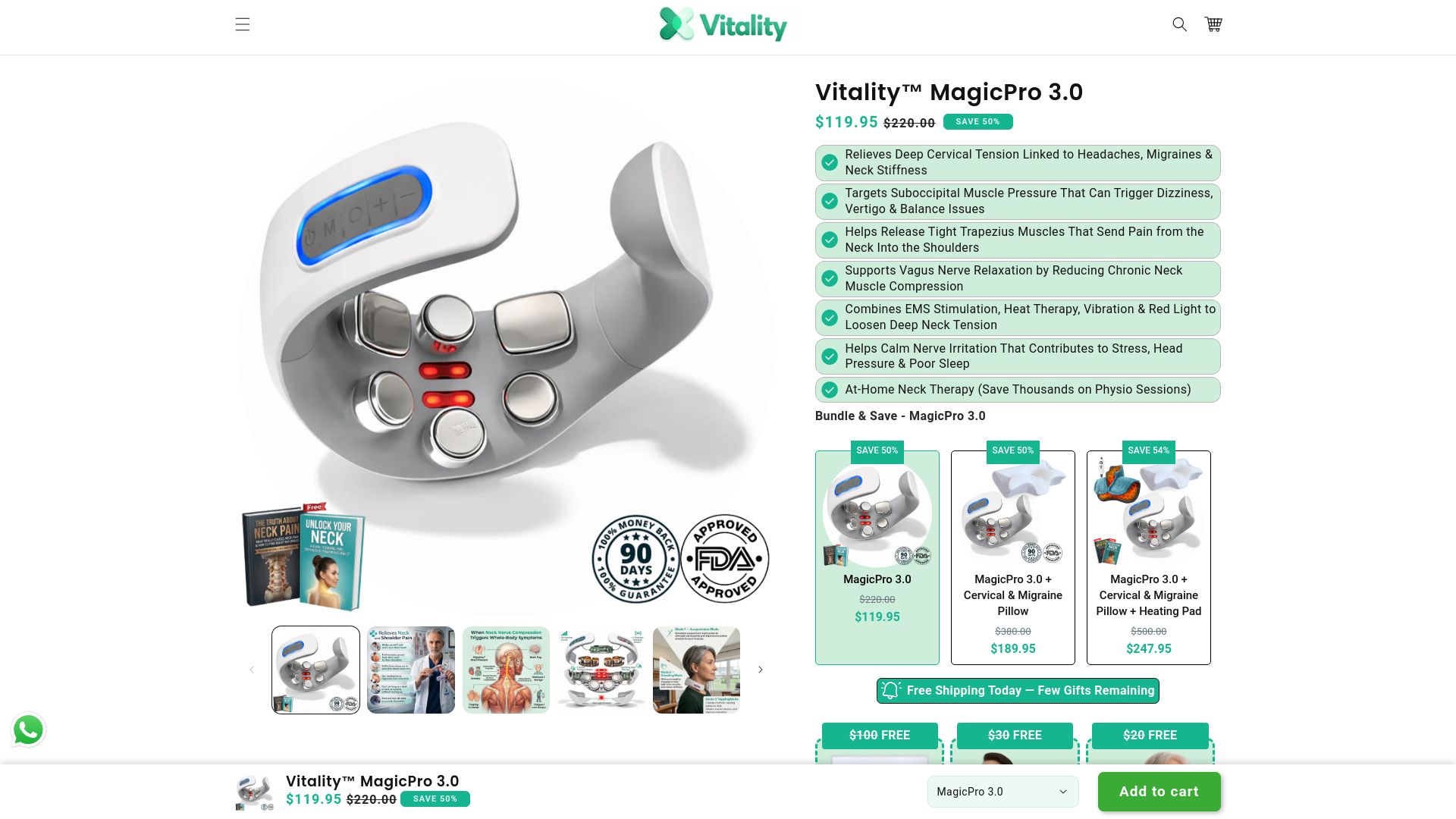
The MagicPro™ therapy devices combine electrical muscle stimulation, heat, and massage into a single at-home device that delivers relief in 15 minutes. For wellness brands and health-conscious shoppers, that kind of tangible, repeatable result generates the authentic reviews that any platform can then amplify. If you are evaluating review platforms for a wellness or direct-to-consumer health product, the strongest foundation is a product that earns its reviews. Browse the MagicPro collection to see how My Vitality pairs product quality with a satisfaction-driven design that gives customers something worth writing about.
Sources and further reading
Verify current Google partnership status and contract terms directly with each vendor before purchasing. Pricing pages and platform features change; the links below reflect research conducted for this article.
- Top 10 Trustpilot Alternatives & Competitors in 2026 — G2
- Best Trustpilot Alternatives 2026 — Capterra
- 11 Best Trustpilot Alternatives — WiserNotify
- Trustpilot Pricing — business.trustpilot.com