


Vibration is a direct mechanical stressor on the cervical spine, and its role in travel neck pain is more significant than most travelers realize. Every road bump, engine tremor, and turbulence jolt forces your neck muscles to make constant micro-adjustments. Over time, whole-body vibration triggers cervical dysfunction, causing muscle fatigue and early degenerative changes in the spine. The good news is that understanding this mechanism gives you real tools to fight back. Combining movement breaks, correct posture, and targeted vibration therapy for pain relief can make a measurable difference on any trip.
How does vibration affect cervical spine health during travel?
Vibration acts as a persistent mechanical stressor. It does not simply cause discomfort. It alters the way your cervical spine functions at a structural level.
When your body absorbs continuous vibration during travel, the extensor muscles along the back of your neck work overtime to stabilize the spine. These muscles were not designed for sustained, low-frequency mechanical input. They fatigue quickly, and once fatigued, they lose their ability to protect the cervical vertebrae from compression and shear forces.

The body responds to this instability with a protective mechanism: muscle spasms lock down spinal segments as a systemic alarm response. This involuntary contraction protects the spine in the short term. The cost is rigidity, restricted movement, and the deep aching pain most travelers feel after a long car ride or flight.
Vibration also causes constant low-frequency micro-adjustments in neck muscles, which leads to premature muscle fatigue far faster than static sitting alone would. Think of it like holding a glass of water with a shaking hand. Your muscles never fully rest, even when you feel like you are sitting still.
Key physiological effects of vibration on the cervical spine include:
- Extensor muscle overload: Neck extensors compensate for vibration-induced instability, leading to rapid fatigue.
- Spinal segment locking: Protective spasms restrict normal cervical motion, creating stiffness that persists after travel.
- Disc compression: Repeated vibration cycles increase compressive load on cervical discs, accelerating wear over time.
- Nerve irritation: Compressed or misaligned cervical structures can irritate nearby nerves, producing radiating pain into the shoulders and arms.
Pro Tip: If your neck feels stiff within the first hour of a road trip, vibration fatigue has already started. Shifting your seat position slightly every 20 minutes interrupts the fatigue cycle before it locks in.
Does posture make vibration-related neck pain worse?
Posture and vibration do not act independently. They compound each other, and the combination is far more damaging than either factor alone.
Looking down at a mobile device for more than 20 minutes adds 40 to 60 pounds of force on the cervical spine. That number assumes a stable environment. Add vehicle vibration, and the mechanical load on your neck muscles increases further with every jolt. Travelers who scroll through their phones on bumpy roads are stacking two major stressors simultaneously.
Seat headrests create a less obvious problem. Many headrests push the head slightly forward, creating a forward head posture that loads neck muscles equivalent to supporting a 32-pound weight when the head is displaced just two inches. Most travelers attribute this fatigue to general tiredness rather than a mechanical cause. Recognizing it as a structural problem is the first step toward fixing it.
Common postural pitfalls during travel include:
- Leaning the head against a window: This creates lateral cervical flexion under vibration load, straining the muscles on one side of the neck unevenly.
- Looking down at a lap-held device: The forward head angle multiplies cervical load dramatically, especially on bumpy roads.
- Sleeping with the head unsupported: The neck drops into flexion or lateral tilt, and vibration continues to stress unprotected muscles.
- Resting against a headrest that pushes the head forward: This mimics the mechanical load of carrying a heavy object on your forehead for hours.
Correcting these habits reduces the amplifying effect of vibration on cervical discomfort. Keeping your screen at eye level, supporting the natural cervical curve, and avoiding asymmetric head positions all lower the total mechanical load your neck absorbs during travel.
What are the best practices for neck pain relief during travel?
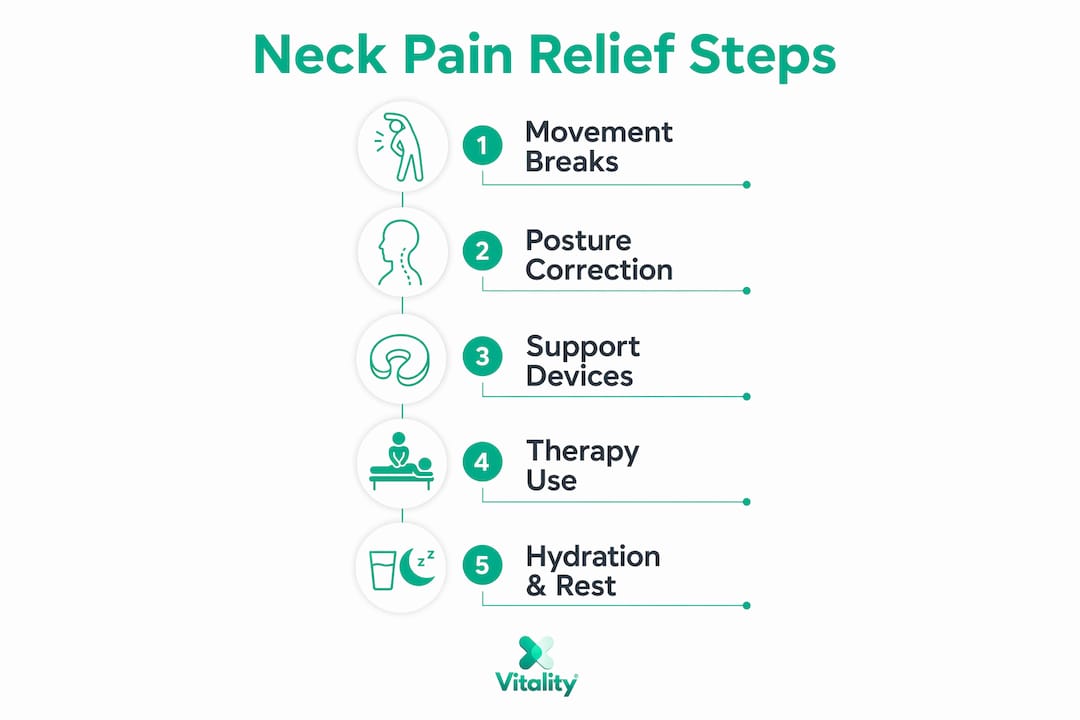
The most effective strategy for preventing vibration-induced neck pain is movement. Movement breaks every 90 minutes during road travel are the single most effective tool for preventing travel-related neck stiffness. This surpasses the benefit of ergonomic pillows or seat adjustments alone.
Movement breaks interrupt the muscle locking cycle that vibration creates. When you stand, walk, or perform gentle neck rotations, you restore blood flow to fatigued muscles and reset the protective spasm response. Even a two-minute walk at a rest stop delivers measurable relief.
Neck pillows help, but only when used correctly. Improper use of hard, non-conforming foam pillows forces the neck into constrained positions, increasing strain rather than reducing it. Soft but firm materials that support the natural cervical curve are the right choice. Placing a horseshoe-shaped pillow behind the neck rather than around the front of the throat better supports the curve and reduces tension.
Additional best practices for preventing neck pain during travel:
- Hydrate consistently: Cervical discs are largely water-based. Dehydration reduces disc height and flexibility, making them more vulnerable to vibration-induced compression.
- Perform neck range-of-motion exercises every 30 to 45 minutes: Slow chin tucks, lateral tilts, and gentle rotations maintain mobility and counter the stiffening effect of sustained vibration.
- Maintain thoracic spine mobility: Thoracic mobility reduces downstream cervical loading and breaks the cycle of pain leading to further immobility.
- Use lumbar support: Proper lower back support maintains the natural spinal curve, which reduces compensatory strain in the cervical region.
The table below summarizes common support methods and their effectiveness against vibration-related cervical discomfort.
| Support Method | Vibration Mitigation Benefit |
|---|---|
| Movement breaks every 90 minutes | Highest benefit; interrupts muscle locking and restores circulation |
| Correct cervical pillow use | Moderate benefit; reduces positional strain when properly fitted |
| Eye-level screen positioning | Moderate benefit; eliminates added cervical load from forward head posture |
| Neck range-of-motion exercises | Moderate benefit; maintains mobility and counters stiffening |
| Hydration | Supporting benefit; preserves disc flexibility and muscle function |
Pro Tip: Pack a small lumbar roll or rolled-up jacket for lower back support. When your lumbar curve is maintained, your neck does not have to compensate for the postural collapse that starts lower in the spine.
Can vibration therapy devices help relieve travel neck pain?
Vibration therapy for pain relief works through a different mechanism than the harmful vibration produced by vehicles. Therapeutic vibration is controlled, targeted, and applied at specific frequencies to relax muscles rather than stress them.
Vibration therapy initially increases muscle activity but produces a temporary relaxation effect after approximately 30 seconds of application. This means the timing and duration of device use matter. Applying a vibration therapy device for too short a period misses the relaxation window. Proper application produces genuine muscle release and improved local circulation in the cervical region.
Key benefits of vibration therapy devices for travel-related neck pain include:
- Muscle relaxation: Targeted vibration overrides the protective spasm response, allowing locked cervical muscles to release.
- Improved circulation: Increased blood flow to fatigued neck muscles accelerates recovery and reduces post-travel soreness.
- Nerve signal modulation: Therapeutic vibration can interrupt pain signals traveling through cervical nerves, providing short-term relief.
- Portability: Compact devices can be used during or after travel, making them practical for frequent travelers.
The Vitalitytherapy MagicPro 2.0 and MagicPro 3.0 combine electrical muscle stimulation, heat, and massage into one device. This multi-modal approach addresses vibration-induced muscle fatigue from several angles simultaneously. Doctor-recommended and designed for 15-minute daily sessions, these devices are built for use at home, at work, or in transit.
Pro Tip: Use a vibration therapy device after arriving at your destination rather than during the trip itself. Post-travel application targets the accumulated muscle tension from hours of vibration exposure and delivers the most effective relaxation response.
Key Takeaways
Vibration is the primary mechanical driver of travel neck pain, and managing it requires a combination of movement, posture correction, and targeted therapy.
| Point | Details |
|---|---|
| Vibration causes cervical dysfunction | Whole-body vibration forces extensor muscles to compensate, leading to fatigue and spinal segment locking. |
| Posture multiplies vibration damage | Forward head posture from screen use adds up to 60 pounds of cervical load on top of vibration stress. |
| Movement breaks are the top prevention tool | Breaks every 90 minutes interrupt the muscle locking cycle better than pillows or seat adjustments alone. |
| Pillow use requires correct technique | Hard, non-conforming pillows worsen strain; soft, curve-supporting designs placed behind the neck reduce tension. |
| Vibration therapy aids post-travel recovery | Therapeutic devices relax cervical muscles and improve circulation when applied for at least 30 seconds per session. |
What I have learned about vibration and neck pain the hard way
After years of observing how travelers manage cervical pain, the pattern is clear. Most people treat neck pain as an inevitable part of long trips. They accept it, reach for a pain reliever, and move on. That acceptance is the real problem.
The overlooked truth is that the vibration in a car, bus, or plane is doing structural work on your cervical spine the entire time you sit still. Stillness is not rest for your neck muscles. It is sustained loading under mechanical stress. The travelers who arrive without pain are not lucky. They move, they adjust their posture, and they support their cervical curve correctly.
Neck pillows are widely misused. Travelers push them around the front of the throat, which does nothing for the cervical curve and often pushes the head forward into the exact posture that causes pain. The pillow belongs behind the neck, not under the chin.
Realistic expectations matter with therapy devices too. A vibration therapy device is not a cure for a long trip’s worth of accumulated tension in one session. Used consistently before and after travel, it builds a recovery habit that keeps cervical muscles more resilient over time. That consistency is what produces lasting relief, not a single use.
The combination of movement, correct posture, and targeted therapy is not complicated. It is just underused.
— Achraf
Vitalitytherapy’s approach to vibration-related travel neck pain
Travel neck pain does not have to be a given. Vitalitytherapy designs devices specifically for the kind of cervical tension that builds up during long trips.
[IMAGE:cta_image]
The MagicPro 3.0 and MagicPro 2.0 combine electrical muscle stimulation, targeted heat, and massage in one compact device. Each session takes 15 minutes. The multi-modal design addresses the muscle fatigue, spasm, and circulation issues that vibration exposure creates. Travelers who use these devices consistently report meaningful reductions in post-trip neck soreness and stiffness. The full neck and nerve relief collection includes options suited to different levels of cervical discomfort, from mild travel stiffness to chronic tension.
FAQ
What causes neck pain during travel?
Neck pain during travel is caused by a combination of whole-body vibration, sustained posture, and muscle fatigue. Vibration forces cervical extensor muscles to compensate continuously, leading to spasms and stiffness.
How does vibration worsen cervical discomfort?
Vibration acts as a multiplier of postural stress, causing constant micro-adjustments in neck muscles that accelerate fatigue. Over time, this triggers protective muscle spasms that lock spinal segments and produce pain.
How often should I take movement breaks to prevent neck pain?
Movement breaks every 90 minutes are the most effective prevention strategy for travel-related neck stiffness. Even two minutes of walking or gentle neck rotation interrupts the muscle locking cycle caused by vibration.
Does looking at my phone make travel neck pain worse?
Yes. Looking down at a device for more than 20 minutes adds 40 to 60 pounds of force to the cervical spine. Combined with vehicle vibration, this significantly increases the risk of pain and muscle fatigue.
When should I use a vibration therapy device for travel neck pain?
Apply a vibration therapy device after travel rather than during the trip for the best results. Therapeutic vibration produces muscle relaxation after approximately 30 seconds of application, making post-travel sessions the most effective for releasing accumulated cervical tension.