


Text neck is the neck pain and stiffness that develops when you tilt your head forward and down to look at a phone, tablet, or laptop for extended periods. Raise your device to eye level right now. That single move immediately reduces the load on your cervical spine and is the fastest thing you can do to start protecting your neck.
Two to four immediate steps to reduce harm today.
- Raise your screen to eye level so your head stays balanced over your shoulders.
- Set a timer for every 20–30 minutes and stand up, roll your shoulders, and do a slow chin tuck.
- Hold your phone up rather than bending your neck down to meet it.
- Take a 1–2 minute movement break before switching to the next task.
Red flags that need prompt clinical evaluation: numbness or tingling running down one or both arms, progressive arm weakness, loss of grip strength, or neck pain following a fall or trauma. These symptoms suggest possible nerve involvement and should not be managed with self-care alone.
Key Takeaways
Forward head posture from device use places a significantly increased effective load on the cervical spine, making consistent ergonomic habits and daily corrective exercise the most reliable path to lasting relief.
| Point | Details |
|---|---|
| What text neck is | Cervical strain from sustained forward head posture during device use; not a formal diagnosis but a real clinical pattern. |
| The biomechanics | A 45-degree head tilt increases effective neck load well beyond the typical 10–11 pounds, straining muscles and discs. |
| Top prevention steps | Raise screens to eye level, take movement breaks every 20–30 minutes, and do daily chin tucks and scapular squeezes. |
| When to see a clinician | Arm tingling, progressive weakness, or symptoms lasting more than 4–6 weeks without improvement require professional evaluation. |
| My Vitality’s role | The MagicPro 2.0 and 3.0 devices offer adjunctive heat, EMS, and massage support alongside exercise and PT, not as a replacement. |
Table of Contents
- What is text neck, and why does it strain your spine?
- What causes text neck and who is most at risk?
- How text neck typically feels, and how to assess your own severity
- How clinicians evaluate text neck, and when to seek care
- Practical prevention: how to set up your workspace and build movement habits
- Evidence-based exercises to relieve and correct forward head posture
- What treatment options actually work for text neck?
- Will text neck resolve, and what happens if it goes untreated?
- Why the guidance in this article is trustworthy
- An editorial perspective on what actually moves the needle
- At-home relief that fits into your recovery plan
- Sources
What is text neck, and why does it strain your spine?
Text neck, also called tech neck, is a clinical pattern of cervical strain caused by sustained forward head posture during device use. The term is widely used but, as Spine-Health notes, it is not a formal diagnostic label. Clinicians diagnose the underlying condition through history and physical examination, reserving imaging or specialist referral for red flags or persistent neurological signs.
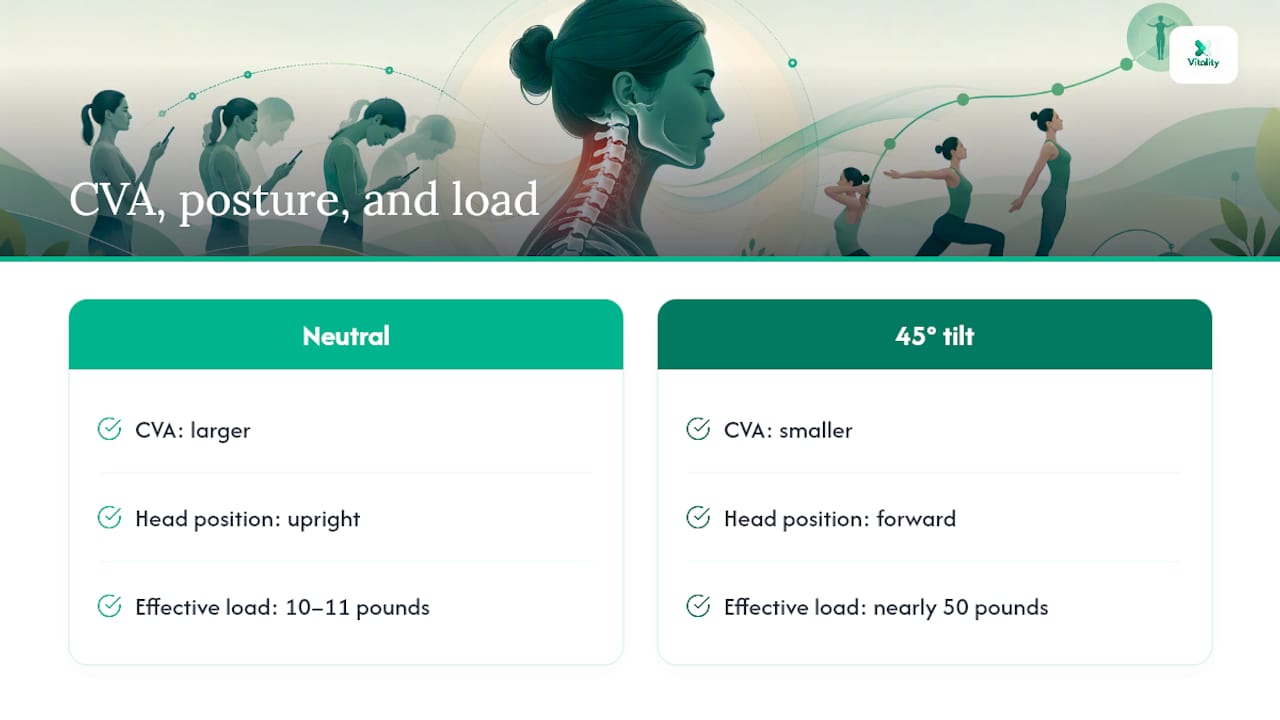
The mechanics are straightforward. An adult head weighs roughly 10–11 pounds in a neutral, upright position. Tilt it forward at 45 degrees and the effective load on the neck muscles climbs to nearly 50 pounds, according to New York-Presbyterian Health Matters. That is not a rounding error. It is the difference between carrying a grapefruit and carrying a small child on your neck for hours at a time.
The craniovertebral angle (CVA) is the clinical measurement used to quantify this posture. A smaller CVA indicates greater forward head displacement. Research published in PMC confirms that forward head posture from device use increases mechanical strain on cervical joints, ligaments, and muscles, and that the CVA is an accepted clinical measure for assessing its severity.
A useful home check: sit in your normal phone-scrolling position and notice whether your head would stay balanced if you fell asleep. If it would tip forward, your neck muscles are actively contracting to hold it up. That sustained contraction is what creates the fatigue, pain, and eventual structural strain associated with text neck.
What causes text neck and who is most at risk?
The root cause is simple: too many hours with your head tilted forward and not enough movement to counteract it. But several specific behaviors and personal factors raise the risk significantly.
Common causes:
- Prolonged smartphone or tablet use with the device held low in the lap.
- Fixed desk posture with a monitor set too low or too far to one side.
- Laptop use on a couch, bed, or low table without a stand or external keyboard.
- Reading or watching video in bed with the head propped at an angle.
- Sleep position with multiple pillows that push the head forward.
Risk factors that increase vulnerability:
- Spending more than 4 hours per day on screens outside of work.
- Sedentary occupation with limited opportunity to move or change posture.
- Age 45 and older, when natural disc narrowing makes cervical nerve roots more sensitive to added pressure from chronic poor posture.
- A previous neck injury or existing cervical degeneration.
- Carrying a heavy bag on one shoulder, which shifts spinal alignment.
Yale Medicine points out that portable devices encourage reduced movement and increased muscle fatigue, which compounds the problem over a full workday.
Pro Tip: Raise to eye, not stoop to read. Before you look at your phone, lift it to eye level first. This one habit, practiced consistently, reduces cumulative cervical load more than any single ergonomic product.

How text neck typically feels, and how to assess your own severity
Symptoms tend to build gradually. Many people notice stiffness only after they change position, because the discomfort from sustained muscle fatigue is delayed. By the time the ache registers, the strain has already accumulated.
Symptom spectrum from mild to severe:
- Mild: Dull ache or stiffness at the base of the skull or across the upper trapezius after prolonged device use; resolves with rest or movement.
- Moderate: Persistent soreness that carries into the evening; tension headaches starting at the back of the skull; shoulder tightness that limits rotation.
- Severe: Pain that does not resolve overnight; stiffness that restricts range of motion in the morning; referred pain into the shoulder blade area.
- Neurological signs: Tingling, numbness, or weakness running from the neck into the arm or hand; these indicate possible nerve root involvement.
Simple self-assessment steps:
- Range of motion check. Slowly turn your head left and right. Each side should reach roughly 70–80 degrees without pain. Reduced rotation or pain at end range suggests muscle tightness or joint restriction.
- Strength check. Press your palm against your forehead and resist with your neck. Weakness or pain during this test warrants clinical evaluation.
- Sensation check. Run a finger along the outer forearm and into the hand. Patches of reduced sensation compared to the other side are a red flag.
- Posture check. Stand sideways in front of a mirror. Your ear should sit directly above your shoulder. If your ear is noticeably in front of your shoulder, forward head posture is present.
Red flags requiring prompt evaluation: progressive arm weakness, loss of grip, numbness in both arms simultaneously, difficulty with balance or coordination, or any neurological symptom that worsens over days.
How clinicians evaluate text neck, and when to seek care
Text neck is diagnosed clinically. A clinician will take a history of your device habits, symptom duration, and any radiating symptoms, then perform a physical exam covering posture, range of motion, muscle strength, and neurological screening. As Spine-Health explains, imaging and specialist referral are reserved for cases with red flags or persistent neurological signs.
Urgent vs. routine care:
| Presentation | Recommended action |
|---|---|
| Local neck/shoulder ache, no radiation, no neurological signs | Routine: self-care, ergonomic changes, consider physical therapy if no improvement in 2–4 weeks |
| Headaches with neck stiffness, no neurological signs | Routine: primary care or physical therapist within 1–2 weeks |
| Pain radiating into the arm, mild tingling | Prompt: primary care or spine specialist within days; imaging likely needed |
| Progressive arm weakness, loss of grip, bilateral symptoms | Urgent: same-day or emergency evaluation |
| Neck pain after trauma or fall | Urgent: emergency evaluation; do not self-treat |
Clinicians commonly involved in text neck care:
- Primary care physician: First point of contact; manages mild to moderate cases, orders imaging, and coordinates referrals.
- Physical therapist: Core provider for conservative rehabilitation, posture retraining, and exercise prescription.
- Spine specialist or orthopedic surgeon: Consulted when structural pathology (disc herniation, stenosis) is suspected or confirmed.
- Neurologist: Involved when neurological deficits are prominent or unexplained.
- Pain management specialist: Considered for chronic pain that has not responded to conservative care.
Practical prevention: how to set up your workspace and build movement habits
Prevention is mostly about two things: reducing the angle at which you hold your head and interrupting static posture before strain accumulates. Both are achievable with small, consistent changes.
Workstation setup steps:
- Position your monitor so the top of the screen is at or slightly below eye level, allowing a natural 15-degree downward gaze. Mayo Clinic Health System recommends placing the screen about an arm’s length away.
- Set your chair height so your feet rest flat on the floor and your knees are at roughly 90 degrees.
- Support your lower back with a lumbar cushion or an adjustable chair backrest.
- Keep your keyboard and mouse at elbow height so your arms rest comfortably without shoulder elevation.
- If you use a laptop as your primary device, add an external keyboard and raise the screen with a stand.
Movement break schedule:
- Every 20–30 minutes: stand, do 5 shoulder rolls, and perform 5 chin tucks.
- Every hour: take a 2-minute walk or do a brief standing stretch.
- Every 2 hours: step away from the screen entirely for at least 5 minutes.
UPMC recommends 20-minute movement resets as a practical way to reverse forward-leaning posture throughout the day.
Phone use checklist:
- Use a phone stand or pop socket to hold the device at eye level.
- Switch to voice-to-text for longer messages.
- Keep your phone in a bag or pocket rather than in your hand during downtime.
Pro Tip: Pair your movement break with something you already do. Every time you finish a coffee, stand up and do a 60-second neck mobility sequence before sitting back down. Habit stacking removes the need for willpower.
Evidence-based exercises to relieve and correct forward head posture

These exercises address the two main physical problems text neck creates: tight anterior muscles (chest, neck flexors) and weak posterior muscles (deep neck flexors, mid-back stabilizers). Clinicians at NYP recommend motion and strengthening over rigid “sit up straight” posture cues alone.
Daily routine (10–12 minutes, once or twice daily):
- Chin tucks (cervical retraction): Sit tall. Gently draw your chin straight back, creating a “double chin.” Hold 5 seconds. Release. Repeat 10 times. This retrains the deep cervical flexors and reduces forward head displacement.
- Scapular squeezes: Sit or stand with arms at your sides. Squeeze your shoulder blades together and slightly downward. Hold 5 seconds. Repeat 10 times. Strengthens the mid-back muscles that support upright posture.
- Chest opener (doorway stretch): Stand in a doorway with forearms on the frame at 90 degrees. Lean gently forward until you feel a stretch across the chest and front shoulders. Hold 20–30 seconds. Repeat 3 times. Counteracts the chest tightening that pulls the head forward.
- Upper trapezius stretch: Sit tall. Drop your right ear toward your right shoulder. Place your right hand lightly on the left side of your head for a gentle assist. Hold 20–30 seconds each side. Repeat twice per side.
- Neck rotation mobility: Slowly turn your head to the right as far as comfortable. Hold 3 seconds. Return to center. Repeat left. Do 5 repetitions each direction. Maintains joint mobility and reduces stiffness.
- “Adult tummy time” (prone extension): Lie face down on a firm surface with arms at your sides. Gently lift your head and chest a few inches off the floor, keeping your gaze down. Hold 5–10 seconds. Repeat 5–8 times. UPMC clinicians specifically recommend this movement to reverse the effects of prolonged forward flexion.
Safety notes:
- Stop any exercise that produces sharp pain, increases arm tingling, or causes dizziness.
- If you have a known disc herniation or cervical stenosis, check with your physical therapist before starting.
- Progress gradually: start with fewer reps and shorter holds, then build over 1–2 weeks.
Pro Tip: Do your chin tucks every time you stop at a red light or wait for a page to load. Three sets of 10 throughout the day adds up to the same volume as a dedicated session, with zero extra time required.
What treatment options actually work for text neck?
Conservative care resolves the majority of text neck cases. The evidence base for physical therapy and movement-based approaches is strong. For most people, surgery is never relevant.
Conservative treatment options:
- Behavior modification and ergonomics: Raising screens, reducing session length, and building movement breaks. This is the foundation of recovery.
- Physical therapy: Targeted strengthening, manual therapy, and posture retraining. The most evidence-supported professional intervention for cervical strain.
- Short-term medications: Over-the-counter NSAIDs (ibuprofen, naproxen) or acetaminophen for acute pain management. Muscle relaxants may be prescribed for severe spasm.
- Manual therapy: Spinal mobilization or manipulation by a licensed physical therapist or chiropractor. Chiropractic treatment for text neck is a common first-line option for patients who prefer hands-on care; evidence supports short-term pain relief for cervical musculoskeletal pain.
- At-home adjunct devices: Devices combining heat, electrical muscle stimulation (EMS), and massage can support muscle relaxation and circulation between PT sessions. These work best as adjuncts to exercise, not replacements.
- Cervical pillow: A contoured cervical pillow supports neutral alignment during sleep, reducing overnight strain accumulation.
Physical therapy and active exercise consistently outperform passive treatments alone for long-term cervical pain outcomes. Movement retraining, not rest, is the primary driver of recovery. Passive modalities, including heat and EMS devices, are most effective when used alongside a structured exercise program rather than instead of one.
When to consider escalation:
- Persistent radicular symptoms (arm pain, tingling, or weakness) lasting more than 4–6 weeks despite conservative care.
- Progressive neurological deficit at any point.
- Imaging confirming significant disc herniation or stenosis causing nerve compression.
- Failure of 8–12 weeks of consistent conservative management.
Injections (epidural steroid injections) are occasionally used for nerve root inflammation that does not respond to conservative care. Surgery is rare and reserved for confirmed structural compression with progressive neurological deficit.
Will text neck resolve, and what happens if it goes untreated?
Most cases of text neck improve meaningfully with behavior change and physical therapy. Yale Medicine notes that the condition is usually manageable and self-limited with consistent posture changes, though pain radiating into the arms warrants clinical evaluation to rule out nerve impingement.
Factors that affect recovery speed:
- Chronicity: Symptoms present for less than 4 weeks typically respond faster than those present for months.
- Age: Adults 45 and older may recover more slowly due to existing disc narrowing, which reduces the cervical spine’s tolerance for added mechanical load.
- Occupation: Jobs requiring sustained screen use without ergonomic accommodations slow recovery unless the environment changes.
- Frequency of device use: High daily screen hours without movement breaks maintain the strain cycle even during treatment.
- Preexisting degeneration: Cervical spondylosis or prior disc injury reduces the structural buffer available.
Potential long-term consequences of neglect:
- Chronic muscle tension and recurring headaches that become harder to resolve.
- Accelerated cervical disc degeneration from sustained abnormal loading over years.
- Reduced cervical range of motion that becomes structural rather than muscular.
- Increased risk of nerve root irritation as disc height decreases with age.
Recovery timelines vary. Mild, recent-onset cases often improve within days to a few weeks of consistent ergonomic changes and exercise. Chronic cases with structural involvement may take several months of physical therapy to reach meaningful improvement. The key variable is whether the underlying postural habits actually change.
Why the guidance in this article is trustworthy
The recommendations here draw from peer-reviewed clinical literature, major academic medical centers, and established spine health resources. Specific sources include a PMC systematic review on text neck syndrome, clinical guidance from Yale Medicine, New York-Presbyterian, Mayo Clinic Health System, UPMC, and Spine-Health.
A brief note on evidence limitations:
- Most guidance on text neck comes from clinical reviews, expert consensus, and observational studies rather than large randomized controlled trials (RCTs).
- The evidence for physical therapy and exercise is strong. Evidence for specific passive modalities (heat, EMS, ultrasound) as standalone treatments is more limited.
- Individual response to treatment varies; what works well for one person may need adjustment for another.
For deeper reading, the sources listed in the Useful Sources section at the end of this article link directly to the primary clinical materials used here.
An editorial perspective on what actually moves the needle
The most underappreciated part of managing text neck is how little the problem has to do with willpower and how much it has to do with environment design. Telling someone to “sit up straight” is the least effective intervention available. It requires constant conscious effort, fails the moment attention shifts to the screen, and creates its own muscle fatigue when held rigidly.
What actually works is changing the physical setup so that neutral posture becomes the default, not the exception. Raise the screen and the head follows. Add a movement break every 20 minutes and the strain never accumulates to the point of pain. Pair a short daily exercise routine with an adjunct device for muscle recovery, and the neck gets both the strengthening and the relief it needs.
The other thing worth saying plainly: most people wait too long. They manage mild stiffness for months before seeking help, by which point the pattern is entrenched and recovery takes longer. If your symptoms have been present for more than 4–6 weeks and are not improving with the steps in this article, a physical therapist is the right next move, not more self-management.
At-home relief that fits into your recovery plan
Consistent exercise and ergonomic changes are the foundation of text neck recovery. An at-home device can support that foundation by addressing muscle tension and circulation between sessions, not by replacing the work.

My Vitality’s MagicPro 2.0 and MagicPro 3.0 combine electrical muscle stimulation, heat, and massage in one compact device designed for 15 minutes of daily use at home, at a desk, or in transit. Doctor-recommended and built around clinically proven technology, these devices are designed as adjunctive tools alongside your exercise routine and any physical therapy you are receiving. They are not a substitute for medical care. If you want to add a structured at-home component to your recovery, you can also explore My Vitality’s neck mobility exercise guide for a practical daily routine. Browse the full range of Vitality devices to find the option that fits your situation.
Sources
- How to Prevent and Fix ‘Tech Neck’ | Health Matters | NYP
- What Is Tech Neck—and How Can You Prevent It? | Yale Medicine
- Text Neck Syndrome: Disentangling a New Epidemic - PMC
- Tech neck tummy time | UPMC Share
- Tech neck: Effect of technology - Mayo Clinic Health System
- Text Neck Symptoms and Diagnosis | Spine-Health