


Prolonged sitting stiffens the neck by forcing the head into a forward position that dramatically increases the load on cervical muscles, triggering fatigue, tension, and eventually stiffness. A neutral head weighs roughly 10–12 pounds on the cervical spine. Tilt it forward just 45 degrees, as most people do when reading a screen, and that load jumps to approximately 50 pounds. The muscles holding your head up cannot sustain that force indefinitely. They fatigue, tighten protectively, and produce the familiar ache and stiffness you feel after long meetings or hours at a desk.
Why prolonged sitting stiffens the neck: the biomechanics
Forward head posture is the primary mechanical cause of neck stiffness from sitting. When your head shifts forward of your shoulders, the cervical spine must bear a load far beyond what it was designed to handle at rest. The physics work like a lever: the farther the weight moves from the fulcrum, the greater the force required to hold it.
A neutral head position places about 10–12 pounds of load on the neck. At 45 degrees of forward flexion, that load reaches approximately 50 pounds, forcing neck muscles into constant fatiguing isometric contraction. This is not a minor increase. It is a fivefold multiplication of force applied to structures that were never built for sustained static loading.
The effect compounds with small shifts. Each centimeter of forward displacement substantially increases cervical spine load, and a 5 cm forward shift roughly doubles it. Most desk workers sit with their head 5–10 cm ahead of their shoulders without realizing it.
The table below shows how head angle changes the effective load on the cervical spine.
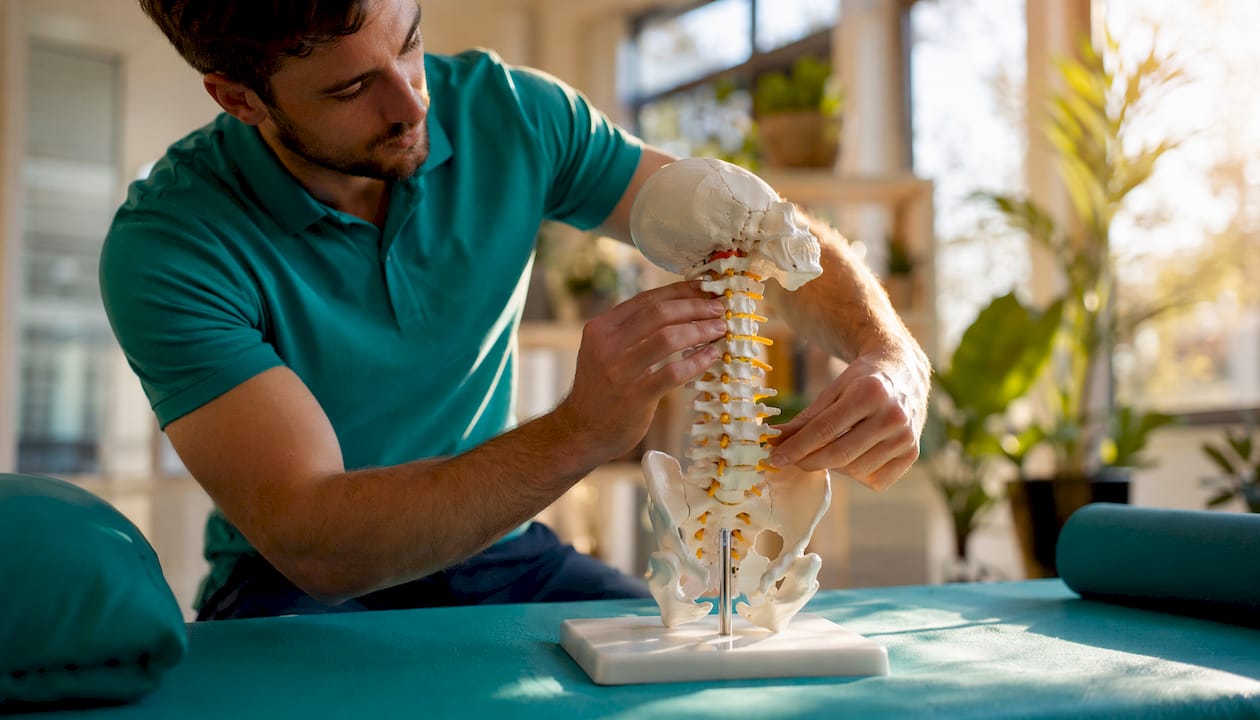
| Head angle (degrees forward) | Approximate cervical load |
|---|---|
| 0° (neutral) | 10–12 lbs |
| 15° | ~27 lbs |
| 30° | ~40 lbs |
| 45° | ~50 lbs |
| 60° | ~60 lbs |
Common desk setups make this worse. A monitor placed too low pulls the head down. A laptop on a table forces both neck flexion and shoulder rounding. Holding a phone in your lap drops the head to 45–60 degrees, the highest load range. Each of these positions is a version of the same problem: the head moves forward, the lever arm lengthens, and the cervical muscles work harder to compensate.
Why sustained muscle contraction causes stiffness
Neck muscles are designed for varied, dynamic movement. Prolonged static contraction causes fatigue and a reflex tightening response that the body uses to protect joints from further strain. That protective tightening is what you feel as stiffness.
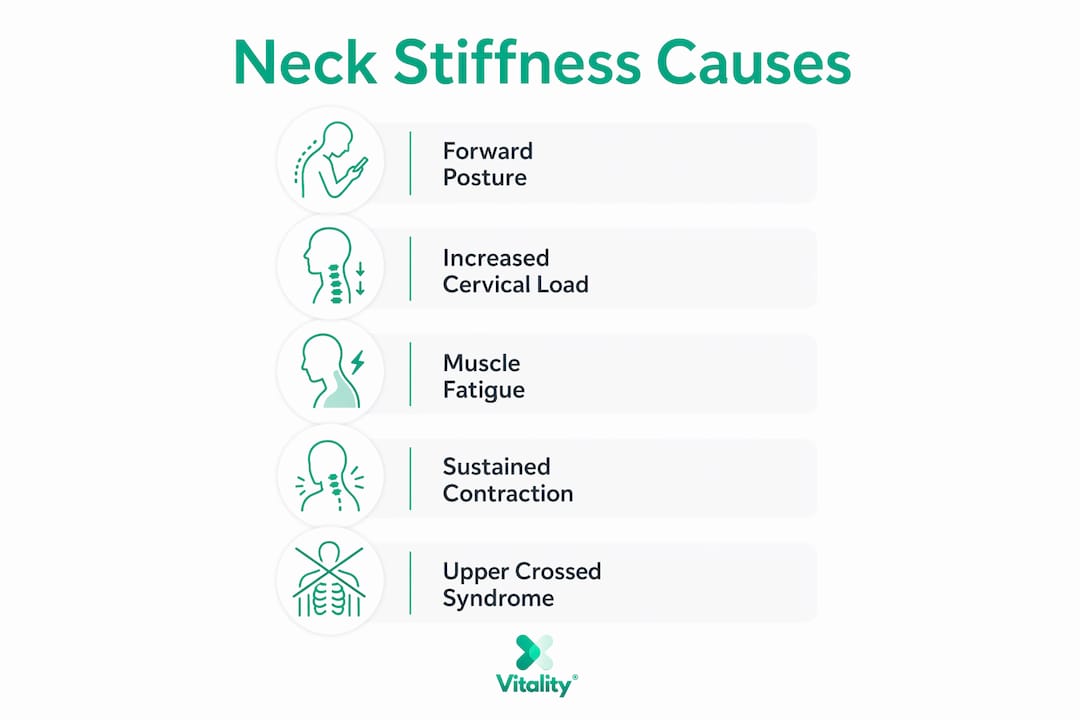
The muscles most affected are the cervical stabilizers, including the upper trapezius, levator scapulae, and suboccipital muscles. These muscles contract isometrically, meaning they generate force without shortening, to hold the head in position. Isometric contractions reduce blood flow to the working tissue. Less blood flow means less oxygen delivery and slower waste removal, which accelerates fatigue and increases the sensation of tightness.
A less obvious contributor is muscle weakness. Weakness in the deep neck flexors forces the superficial muscles to overwork and seize up. The deep cervical flexors, a group of small muscles running along the front of the spine, are the primary stabilizers of the cervical spine. When they are weak or underactive, the larger, more superficial muscles take over. Those muscles are not built for endurance work, so they fatigue faster and tighten sooner.
- Upper trapezius: spans from the base of the skull to the shoulder; one of the first muscles to tighten under load
- Levator scapulae: connects the cervical vertebrae to the shoulder blade; becomes chronically shortened in forward head posture
- Suboccipitals: four small muscles at the base of the skull; responsible for fine head positioning and highly sensitive to sustained tension
- Deep cervical flexors (longus colli, longus capitis): the stabilizing core of the cervical spine; weakness here shifts load to all the muscles above
Forward head posture also produces a pattern called upper crossed syndrome: tight chest and upper trapezius muscles paired with weak deep neck flexors and mid-back muscles. This imbalance reinforces poor posture and makes stiffness self-perpetuating.
Pro Tip: If your neck feels stiff every afternoon but fine in the morning, the cause is almost certainly muscle fatigue from sustained posture, not a structural problem. That timing pattern points directly to accumulated cervical load during the workday.
How posture, ergonomics, and movement habits make it worse
Poor posture habits and a poorly arranged workspace multiply the cervical load that sitting already creates. The most common patterns are forward head posture, rounded shoulders, and a slouched lower back. These three tend to occur together because the spine functions as a chain. When the lumbar spine collapses into flexion, the thoracic spine rounds, and the head moves forward to keep the eyes level.
Prolonged static posture also causes a process called tissue creep. Ligaments and discs adapt negatively to sustained loading by gradually deforming, which increases joint stiffness and vulnerability over time. This is why sitting for three hours feels worse than sitting for one, even if the posture is identical.
The following ergonomic factors consistently worsen neck stiffness in desk workers:
- Monitor height below eye level. The top of the screen should sit at or just below eye level. A monitor too low forces sustained neck flexion.
- Laptop use without a stand. Laptops combine a low screen with a fixed keyboard, making neutral posture nearly impossible without accessories.
- Chair without lumbar support. Without lumbar support, the lower back rounds, which pulls the entire spine into a posture that loads the neck. Reclining the chair 25–30 degrees with lumbar support shifts weight onto the backrest and reduces neck muscle contraction.
- Keyboard and mouse too far forward. Reaching forward rounds the shoulders and pulls the head with them.
- Phone use in the lap. This creates the steepest head angle and the highest cervical load of any common work habit.
Pro Tip: Set a recurring timer for every 25 minutes. When it goes off, stand up, roll your shoulders back, and do five slow neck rotations. That 90-second reset prevents the cumulative load that causes stiffness by afternoon.
Guidelines recommend changing posture every 30–60 minutes, with brief 1–2 minute movement breaks every 20–30 minutes for people with existing neck tension. Movement variability, not perfect posture, is the real goal. The cervical spine tolerates any posture better when it changes regularly.
You can also review common office posture problems that desk workers develop and the specific adjustments that correct them.
What actually reduces neck stiffness from sitting all day
Stretching provides short-term relief by relaxing tight muscles, but it does not build endurance. Lasting relief requires strengthening the deep cervical flexors and correcting the postural habits that overload them. Effective treatment combines manual therapy, deep cervical flexor rehabilitation, and postural correction.
| Approach | What it does | Limitation |
|---|---|---|
| Stretching | Reduces acute muscle tension | Relief is temporary; does not address weakness |
| Deep flexor strengthening | Rebuilds cervical stability | Requires consistency over weeks |
| Ergonomic adjustment | Reduces baseline cervical load | Does not fix existing muscle weakness |
| Movement breaks | Prevents cumulative fatigue | Must be frequent and consistent |
| Nervous system downregulation | Reduces stress-driven muscle guarding | Often overlooked in standard advice |
Stress deserves specific attention. Ergonomics alone do not resolve neck stiffness because the nervous system response to stress keeps neck muscles in a state of guarded tension. Controlled breathing, reduced screen intensity during breaks, and deliberate relaxation practices address this layer of tension that posture correction cannot reach.
Practical strategies that work together:
- Chin tucks: Pull the chin straight back, creating a “double chin.” Hold for five seconds. This activates the deep cervical flexors directly and counteracts forward head drift.
- Neck rotations and side bends: Gentle, slow range-of-motion movements during breaks prevent tissue creep and maintain joint mobility.
- Thoracic extension over a chair back: Opens the upper back and reduces the thoracic rounding that pulls the head forward.
- Diaphragmatic breathing: Slow, belly-focused breathing activates the parasympathetic nervous system and reduces the muscle guarding that stress creates.
For a structured approach to neck mobility exercises designed specifically for seated workers, Vitalitytherapy has published a detailed 2026 guide covering evidence-based movement sequences.
My take on sustainable neck care for desk workers
What I’ve learned about neck stiffness that most guides get wrong
The standard advice, “sit up straight and take breaks,” is not wrong. It is just incomplete in a way that leaves most people frustrated. I’ve seen people buy expensive ergonomic chairs, set up perfect monitor heights, and still end the day with a stiff neck. The missing piece is almost always muscle capacity, not posture perfection.
The most useful reframe I’ve encountered is this: the healthiest posture is the next posture. No single position is sustainable for hours. The goal is not to hold a perfect posture but to move through many postures throughout the day. That shift in thinking removes the guilt of slouching and replaces it with the habit of moving.
Neck stiffness is also more commonly a signal of muscle weakness than a flexibility problem. Stretching feels productive, but it addresses the symptom, not the cause. Building endurance in the deep cervical flexors is slower and less satisfying in the short term. It is also the only thing that actually changes the pattern.
My honest recommendation: spend less time trying to hold perfect posture and more time building the capacity to recover from imperfect posture quickly.
— Achraf
Neck and nerve relief from Vitalitytherapy
Knowing why neck stiffness happens is the first step. Having a reliable way to address it at the end of a long day is the second.
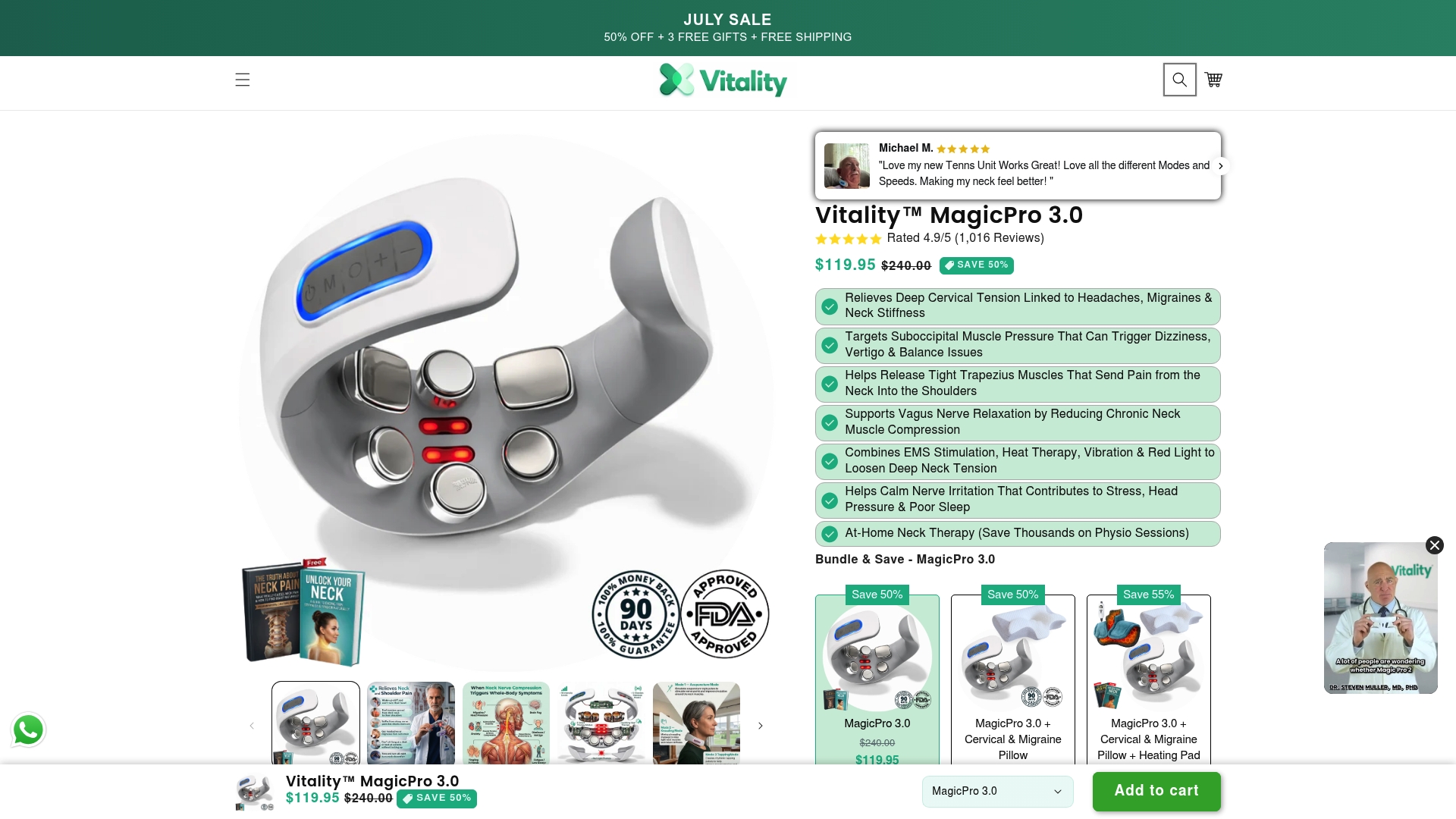
Vitalitytherapy’s Neck & Nerve Relief collection brings together devices that combine electrical muscle stimulation, heat, and massage to support muscle relaxation and circulation in the cervical region. The MagicPro™ 2.0 and MagicPro™ 3.0 are doctor-recommended and designed to deliver relief in 15 minutes per day, at home, at a desk, or in transit. For people who sit for long hours and carry the tension in their neck and shoulders, these devices offer a practical, consistent way to support recovery without adding complexity to the day.
Key takeaways
Prolonged sitting stiffens the neck because forward head posture multiplies cervical load, fatigues stabilizing muscles, and triggers protective tightening that stretching alone cannot resolve.
| Point | Details |
|---|---|
| Cervical load multiplies fast | A 45-degree head tilt increases neck load from 12 lbs to 50 lbs, causing rapid muscle fatigue. |
| Deep flexor weakness drives stiffness | Weak deep cervical flexors force superficial muscles to overwork, producing the tightness you feel. |
| Movement beats perfect posture | Changing posture every 20–30 minutes prevents cumulative load better than holding any single position. |
| Ergonomics reduce load, not weakness | Fixing your setup lowers baseline strain but does not rebuild the muscle endurance needed for lasting relief. |
| Stress amplifies muscle tension | Nervous system arousal keeps neck muscles guarded; controlled breathing addresses tension that ergonomics cannot. |
FAQ
Why does my neck stiffen specifically after long meetings?
Long meetings force sustained forward head posture without movement breaks, causing isometric muscle fatigue and protective tightening. The longer the static hold, the more pronounced the stiffness.
Does stretching fix a stiff neck from sitting?
Stretching provides temporary relief by releasing acute muscle tension, but it does not build the muscle endurance needed to prevent stiffness from returning. Strengthening the deep cervical flexors is required for lasting improvement.
How often should I move to prevent neck stiffness at a desk?
Guidelines recommend a posture change every 30–60 minutes, with 1–2 minute movement breaks every 20–30 minutes for people already experiencing neck tension.
Can stress make neck stiffness worse even with good posture?
Yes. The nervous system response to stress keeps cervical muscles in a state of guarded tension regardless of posture. Controlled breathing and reduced screen intensity during breaks help reduce this layer of tension.
What is the best ergonomic change for reducing neck stiffness?
Raising the monitor to eye level and reclining the chair 25–30 degrees with lumbar support reduces cervical muscle contraction more than any other single adjustment.