


The most effective airplane neck pain relief comes from combining three things: a supportive pillow positioned to hold your natural cervical curve, chin tucks and shoulder rolls every 30 to 45 minutes, and a short round of portable therapy after landing. Physical therapists back the movement piece, and a device like Vitality’s MagicPro™ handles the recovery piece in about 15 minutes.
TL;DR:
- Bring a supportive pillow that aligns with your sleep position, a heat patch, and a portable therapy device to effectively prevent and reduce neck stiffness during flights.
- Choose a seat with a solid headrest over the wing or window seats, and pack tools in the seat-back pocket for quick access without disrupting your routine.
- Perform chin tucks, shoulder rolls, and lateral neck movements every 30 to 45 minutes during the flight to maintain mobility and prevent ligament and muscle fatigue.
- Use a properly positioned pillow supporting the mid-cervical spine behind and below the ears to maintain the neck’s natural curve and minimize strain.
- Consider active recovery devices like the MagicPro™ post-flight for targeted relief, especially if you experience recurrent stiffness after long-haul trips.
Table of Contents
- What Should You Pack and Do to Prevent Airplane Neck Pain?
- Which Travel Pillow Design Actually Fits Your Sleep Style?
- How Do You Position a Travel Pillow So It Actually Helps?
- What Exercises Actually Stop Airplane Neck Stiffness?
- Are Neck Pillow Alternatives and Viral Hacks Actually Safe?
- When Does Neck Stiffness Need a Doctor Instead of a Stretch?
- How Do Vitality’s Portable Devices Fit Into Your Travel Recovery Routine?
- Why Does Cabin Pressure Make Your Neck Feel Worse Than Usual?
- What Should You Do Before the Flight to Prevent Neck Pain?
- Which Seat Choice Actually Reduces Neck Strain?
- My Honest Routine for Flying Without Neck Pain
- Get Airplane-Ready Relief With the MagicPro™
- Sources
What Should You Pack and Do to Prevent Airplane Neck Pain?
Preventing neck pain on a flight is mostly a packing and timing problem, not a mystery. Get the right gear in your bag and stick to a simple in-flight rhythm, and stiffness rarely gets the chance to set in.
Before you leave the house:
- Choose a pillow style that matches how you actually sleep or rest. Side-leaners need structure; forward-nodders need a chin brace. (More on this in the next section.)
- Pack a small heat patch or reusable warm compress. Cold cabin air stiffens muscles faster than most travelers expect.
- Bring a portable neck therapy device if you own one. Something the size of a phone case, like the MagicPro™, fits in a seat pocket without eating carry-on space.
- Toss in a compression strap or two if your pillow uses them, plus any topical analgesic you already know works for you.
- Check your airline’s seat map and pick an aisle or window seat with a solid headrest. Middle seats near the galley or lavatory tend to have shallower recline and less to lean against.
Once you’re in the seat, the game becomes cadence. Regularly, do a slow round of chin tucks and shoulder rolls during your flight. Set a phone reminder if you tend to lose track during a movie. Drink water on a fixed schedule rather than waiting until you’re thirsty. Dry cabin air (typically 10 to 20 percent humidity) pulls moisture from soft tissue, and dehydrated muscle tightens faster under sustained postural load.
Posture matters as much as movement. Keep your hips pressed back into the seat, not slid forward, and tuck a rolled sweater or small lumbar pillow into the small of your back if the seat’s built-in support feels flat. That single adjustment shifts your whole spine into a position where your neck has less work to do.
If stiffness shows up anyway, layer your remedies. Start with heat directly on the tight muscles for 10 to 15 minutes. Follow with a topical analgesic if you have one. If you’re still tense after landing, a short session with a multimodal device (electrical stimulation, heat, and massage combined) tends to resolve residual tightness faster than any single method alone.
Pro Tip: Pack your neck pillow and therapy device in your seat-back pocket, not your overhead bag. You will not get up to dig through the overhead bin every time your neck starts to ache, and you shouldn’t have to.
On TSA logistics, travel pillows generally clear security without issue. Inflatable versions may need to be deflated if a checkpoint officer asks, so build in an extra minute if you’re flying with one. Bulkier memory-foam pillows sometimes draw a second look simply because of their size, not because they’re restricted.
Which Travel Pillow Design Actually Fits Your Sleep Style?
Not every neck pillow solves the same problem, and buying the wrong shape is the single biggest reason travelers give up on pillows altogether.
- Memory-foam horseshoe: The classic shape, and for good reason. Reviewers and product testers consistently favor structured memory-foam designs for long-haul consistency, even though they take up more pack space than inflatable options. If you tend to lean sideways when you doze off, this is the design that stops your head from dropping onto a stranger’s shoulder.
- Wraparound or 360-degree designs: These wrap fully around the neck and often include a front panel that catches your chin. They suit people who nod forward as much as sideways, especially on turbulent flights where your head needs support from more than one direction.
- Brace-style or contoured supports: Built with a rigid or semi-rigid core, these stop forward nodding almost entirely. If your head drops straight down the moment you close your eyes, a brace-style pillow gives you the stabilization a soft horseshoe can’t.
- Inflatables and ultralight options: These pack down to almost nothing, which makes them tempting for carry-on-only travelers. The trade-off is real: inflatable pillows tend to give less consistent support once they’re inflated at cabin altitude, since firmness can shift with cabin pressure changes. Compensate by inflating them slightly firmer than feels comfortable on the ground.
Material choice matters more than most travelers think about until they’re three hours into a flight. Dense memory foam holds its shape but retains heat, which can feel stifling on a warm aircraft. Breathable, lower-density foam stays cooler but compresses faster and offers less support by hour six. Product reviewers note this exact trade-off repeatedly: packability and support consistency pull in opposite directions, so you’re picking a compromise, not a perfect pillow.
Hygiene deserves a mention too. A pillow with a removable, washable cover is worth the extra few dollars if you fly more than occasionally. Foam that can’t be washed absorbs sweat, hair product, and cabin air pollutants over dozens of flights, and there’s no fixing that once it’s baked in.
How Do You Position a Travel Pillow So It Actually Helps?
A pillow in the wrong position can make neck pain worse, not better. The goal is support at the mid-cervical level, roughly the C3 through C5 vertebrae, which keeps your neck’s natural forward curve intact instead of forcing your chin down toward your chest.
- Position the pillow so the bulk of the support sits behind and slightly below your ears, not directly under your chin.
- If your pillow has straps or toggles, secure them loosely enough that you can still swallow and breathe without restriction. Snug is fine; tight is not.
- Adjust your seat back so your hips sit fully against the backrest. A gap between your lower back and the seat forces your neck to compensate for a slouched spine, which cancels out whatever the pillow is doing.
- Raise your device or reading material to eye level instead of looking down at your lap. Forward head posture from looking down adds real weight to what your neck muscles have to hold, an effect covered in more detail in this breakdown of travel posture and discomfort.
- Run a quick self-check every hour: is your chin level, is your head centered rather than tilted to one side, and are your shoulders relaxed rather than hunched toward your ears?
During turbulence, a properly secured pillow does double duty as a stabilizer, keeping your head from jerking sideways if the plane hits a rough patch. A pillow that’s just resting loose against your shoulder offers none of that protection.
Pro Tip: If you wake up with your chin buried in your chest, your pillow is too soft or positioned too low. Reposition it higher, closer to ear level, before your next nap attempt.
What Exercises Actually Stop Airplane Neck Stiffness?
Physical therapists recommend short, frequent movement over one long stretch session, and the reasoning holds up: brief, repeated motion prevents the ligament creep and muscle fatigue that build during hours of static sitting.
- Chin tucks (cervical retraction): Pull your chin straight back, as if making a double chin, hold for 3 to 5 seconds, and repeat 8 to 10 times. This targets the deep neck stabilizer muscles that counteract forward head posture, which is exactly the position most seats push you into.
- Slow rotation: Turn your head gently toward one shoulder, hold briefly, then the other side. Stay well within a pain-free range; this isn’t a stretch to push through discomfort.
- Lateral flexion: Tilt your ear toward your shoulder on each side, holding for a few seconds. Keep the motion slow and controlled.
- Scapular squeezes: Pull your shoulder blades together and hold for 5 seconds, then release. This offloads tension from the neck by engaging the upper back instead.
- Shoulder rolls: Roll both shoulders backward in a slow circle, 8 to 10 times, to loosen the muscles that connect your shoulders to your neck.
Run through this sequence every 30 to 45 minutes. If you’re able to stand during boarding, before takeoff, or when the seatbelt sign is off, add a brief standing stretch to reset your spine after sitting compressed for a while.
One caution worth repeating: stop any exercise that triggers pain radiating down an arm, numbness, or tingling. Gentle, pain-free range of motion is the entire point. Pushing through sharp or radiating pain crosses from prevention into a different problem, one that a stretch in your seat won’t fix.
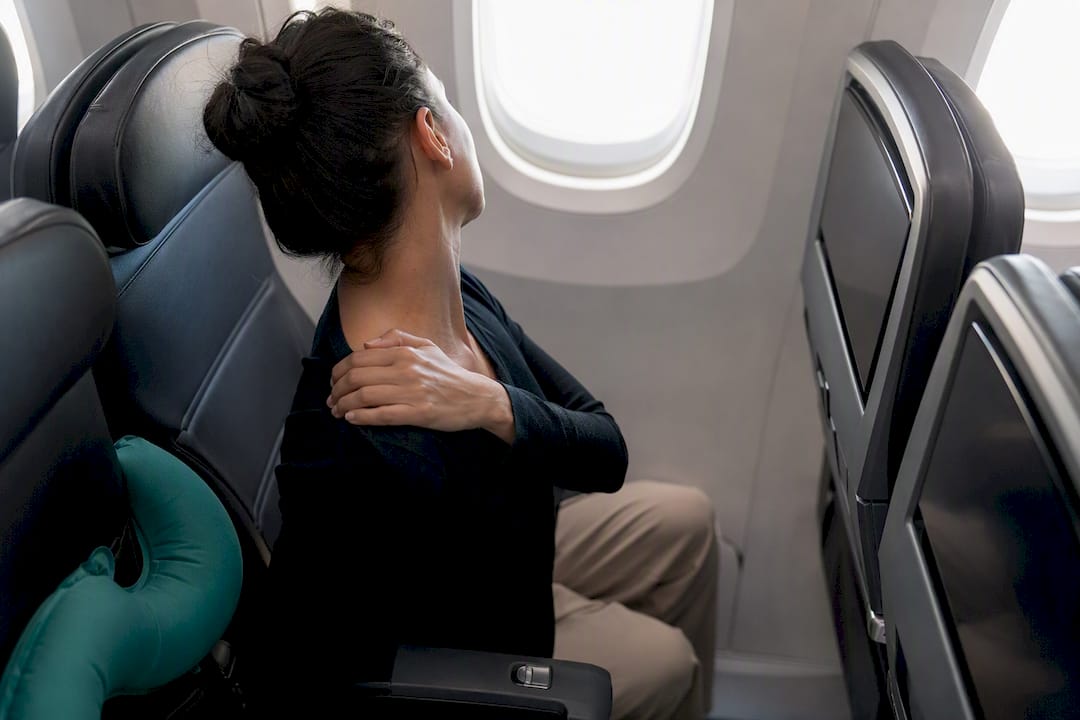
Pro Tip: Tie your exercise routine to something you’ll actually remember, like every time a drink cart passes or every time you finish an episode. A mental cue beats a phone alarm you’ll silence and forget.
Are Neck Pillow Alternatives and Viral Hacks Actually Safe?
A rolled towel or small inflatable lumbar cushion works better than a neck pillow for some travelers, particularly if your main issue is a slouched lower back rather than head drop. Fixing the base of your spine often does more for neck comfort than anything you put around your neck itself, since a neutral pelvis keeps the entire spine, including the cervical section, in a better position by default.
The viral “scarf chin-tie” hack, where travelers tie a scarf or hoodie string under the chin and over the top of the head to keep it from falling forward, deserves real skepticism. A sleep medicine physician has warned that this kind of chin-tie can function like a restraint, increasing static muscle load rather than relieving it, especially for anyone who already deals with chronic neck pain. A pillow that keeps your spine neutral does the job this hack is trying to do, without the added strain.
For short-term relief once you’re already tight, a few tools work well:
- A pocket-sized massage tool you can press into tight spots along the base of your skull
- Adhesive heat patches that stay warm for several hours without needing a plug
- Topical analgesics for spot relief between movement breaks
- A gel cold pack if inflammation, rather than plain stiffness, is the issue
Packing light doesn’t mean skipping these tools. A compact travel fitness kit built for carry-on space can hold most of this gear without adding real bulk. On the TSA front, standard neck pillows clear security without trouble; inflatable versions may just need a quick deflate if an officer asks.
When Does Neck Stiffness Need a Doctor Instead of a Stretch?
Most airplane-related neck stiffness is muscular and temporary, usually resolving with time and movement. But a specific set of symptoms means self-care isn’t the right move.
Seek medical care promptly if you notice:
- Weakness or numbness in an arm or hand
- Fever combined with neck stiffness
- A sudden, severe headache unlike any you’ve had before
- Symptoms affecting both sides of your body at once
Any of these can point to something beyond simple travel stiffness, and Harvard Health’s guidance on neck pain is direct on this point: don’t wait these out at home.
For everyone else, the normal timeline is reassuring. Muscle fatigue and stiffness from a long flight typically ease within 5 to 7 days with basic movement, heat, and rest. If your neck still feels tight or painful after a week, or if it’s clearly getting worse rather than better day by day, that’s the point to schedule a visit with a primary care provider or physical therapist rather than continuing to wait it out.
How Do Vitality’s Portable Devices Fit Into Your Travel Recovery Routine?
A pillow and a stretch routine handle prevention. A device fills the gap for active recovery, especially after a long-haul flight when stiffness has already set in. Vitality Therapy’s MagicPro™ devices combine electrical muscle stimulation, heat, and massage into one compact tool, which matters because these three mechanisms target different pain pathways: electrical stimulation reduces muscle guarding, heat increases local blood flow, and massage works directly on trigger points. Used together, they tend to shorten a stiff episode faster than any single method on its own.
- Run a session for 10 to 15 minutes during a layover or right after landing, before stiffness has time to fully settle in overnight.
- Pair it with the chin tuck and shoulder roll routine from earlier. The device handles muscle-level relief; the exercises rebuild mobility and range of motion.
- Keep sessions short and consistent rather than one long session. Fifteen minutes daily beats an hour once a week.
A safety note matters here: anyone with a pacemaker or other implanted electrical device, anyone pregnant, or anyone with open skin wounds near the treatment area should talk to a doctor before using electrical stimulation. That’s a standard caution across E-stim devices generally, not unique to any one product, and it’s worth taking seriously rather than skipping.
Pro Tip: If your flight lands late at night, do your device session before bed rather than skipping it because you’re tired. A tight neck that goes untreated overnight is harder to loosen the next morning than one treated right away.
Why Does Cabin Pressure Make Your Neck Feel Worse Than Usual?
Cabin altitude, typically maintained around 6,000 to 8,000 feet of pressure equivalent, causes mild tissue swelling in many travelers, and that swelling can extend to the soft tissue around your neck and shoulders. Combine that with engine vibration transmitted through the fuselage and seat frame, and you get a low-level, constant muscle contraction that most travelers never consciously notice, but that adds up over a six-hour flight.
Vibration specifically keeps small stabilizing muscles in your neck firing continuously to counteract tiny, rapid movements. It’s a bit like holding a phone steady while riding in a car on a bumpy road. Your hand doesn’t feel like it’s working hard in any given second, but by the end of the drive, it’s fatigued.
You can’t eliminate cabin pressure or vibration, but you can reduce how much they cost you. A pillow that keeps your head stable cuts down on how much your neck muscles have to fight against vibration-induced micro-movements. Choosing a seat over the wing, where vibration from the engines is typically less pronounced than seats near the tail, can help on louder aircraft. And staying ahead of dehydration matters more here than travelers expect: dehydrated tissue swells and stiffens faster under the same vibration and pressure load, which is one more reason keeping a regular hydration schedule beats waiting until you’re thirsty.
What Should You Do Before the Flight to Prevent Neck Pain?
Prevention starts well before you board. A few minutes of proactive work at home does more for your neck than any amount of in-flight scrambling.
Spend five minutes the morning of your flight doing the same chin tuck and shoulder roll sequence you’ll use in the air. Priming those muscles before hours of static sitting means they’re less likely to seize up early into the flight. If you know you’re prone to neck tension, a brief posture check in the mirror, shoulders back, ears over shoulders rather than jutted forward, resets a habit that’s easy to lose track of during a rushed travel morning.
Sleep matters too. Arriving at the airport already sleep-deprived means your muscles start the flight in a more reactive, tension-prone state. If you can, adjust your sleep schedule a day or two ahead of a long-haul flight rather than trying to “catch up” once you’re in the air.
Pack your pillow and any therapy tools where you can reach them the moment you sit down, not buried at the bottom of a bag. The travelers who avoid neck pain most consistently are the ones who treat prevention as part of packing, not something to figure out mid-flight.
Which Seat Choice Actually Reduces Neck Strain?
Seat selection has more influence on your neck than most travelers realize when they’re booking based on price alone.
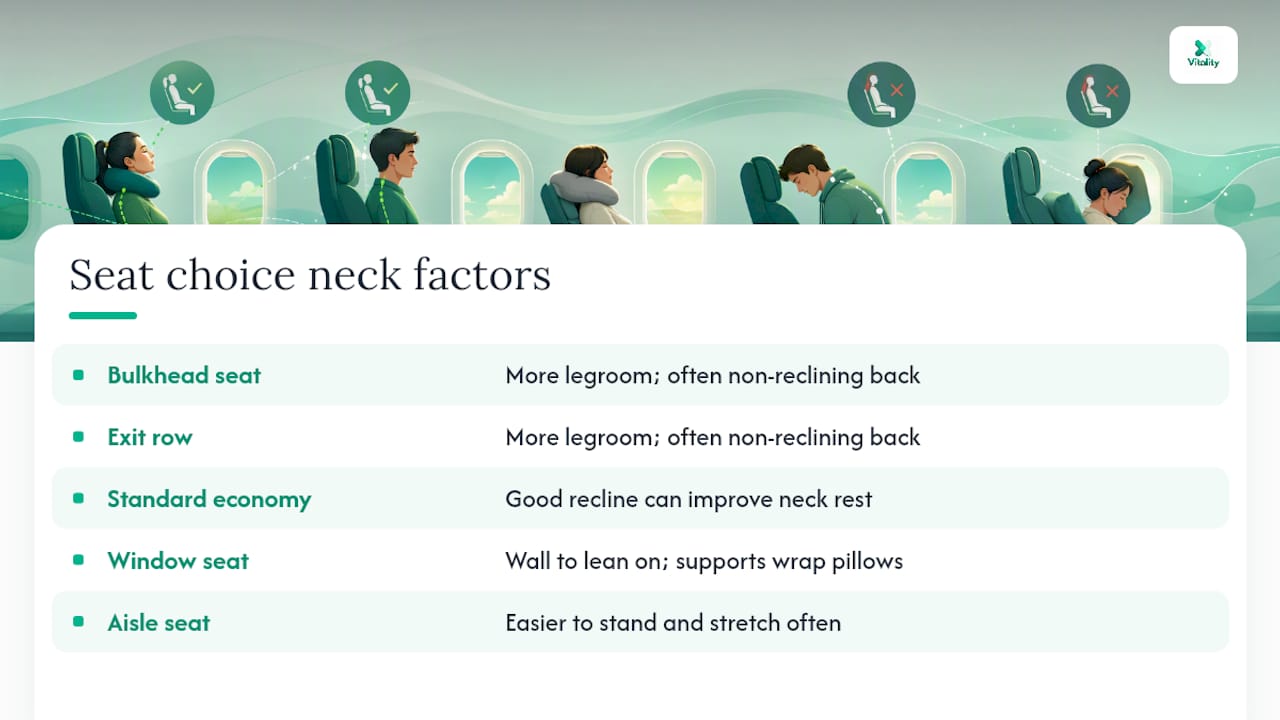
Bulkhead seats and exit rows offer more legroom but often have fixed, non-reclining backs, which can actually work against you if you rely on recline to rest your neck. A standard economy seat with a good recline angle sometimes beats a bulkhead seat for straight comfort. Window seats give you a wall to lean against, useful if you’re using a wraparound or brace-style pillow that benefits from a stable surface. Aisle seats trade that stability for easier access to stand and stretch, which matters given how much every-30-minutes movement helps.
Headrest quality varies more between aircraft than between airlines’ marketing suggests. Older aircraft often have flatter, less adjustable headrests, while newer widebody planes tend to include adjustable wings that fold in to cradle your head from both sides. If you have a choice between flights on different aircraft types for the same route, this is worth a quick look at seat review sites before booking.
My Honest Routine for Flying Without Neck Pain
I keep a short checklist for every flight longer than three hours: a contoured pillow that matches how I actually sleep, my MagicPro™ packed in the seat pocket, a water bottle I refill past security, and a phone stand so I’m not looking down at a screen for six hours straight.
In the air, I run through chin tucks and shoulder rolls roughly every 45 minutes, timed loosely to whenever a flight attendant passes with the cart. The one honest limitation: nothing you do in an upright seat replaces a flat bed. Even a perfect routine manages discomfort; it doesn’t eliminate what happens when your spine sits compressed for hours.
For packing, I skip anything that isn’t doing double duty. A pillow that also has a washable cover, a device that also doubles as an at-home tool later. Keep the kit small, and you’ll actually use it every flight instead of leaving it in a drawer.
— Achraf
Get Airplane-Ready Relief With the MagicPro™
Most travel routines stop at prevention. The MagicPro™ handles what happens after the flight already did its damage. Vitality’s MagicPro™ 2.0 and MagicPro™ 3.0 combine electrical muscle stimulation, heat, and massage into a single device small enough for a seat pocket, with sessions built around 15 minutes rather than an hour-long commitment. That’s the real advantage over relying on a pillow and stretches alone: active, targeted recovery instead of just prevention.
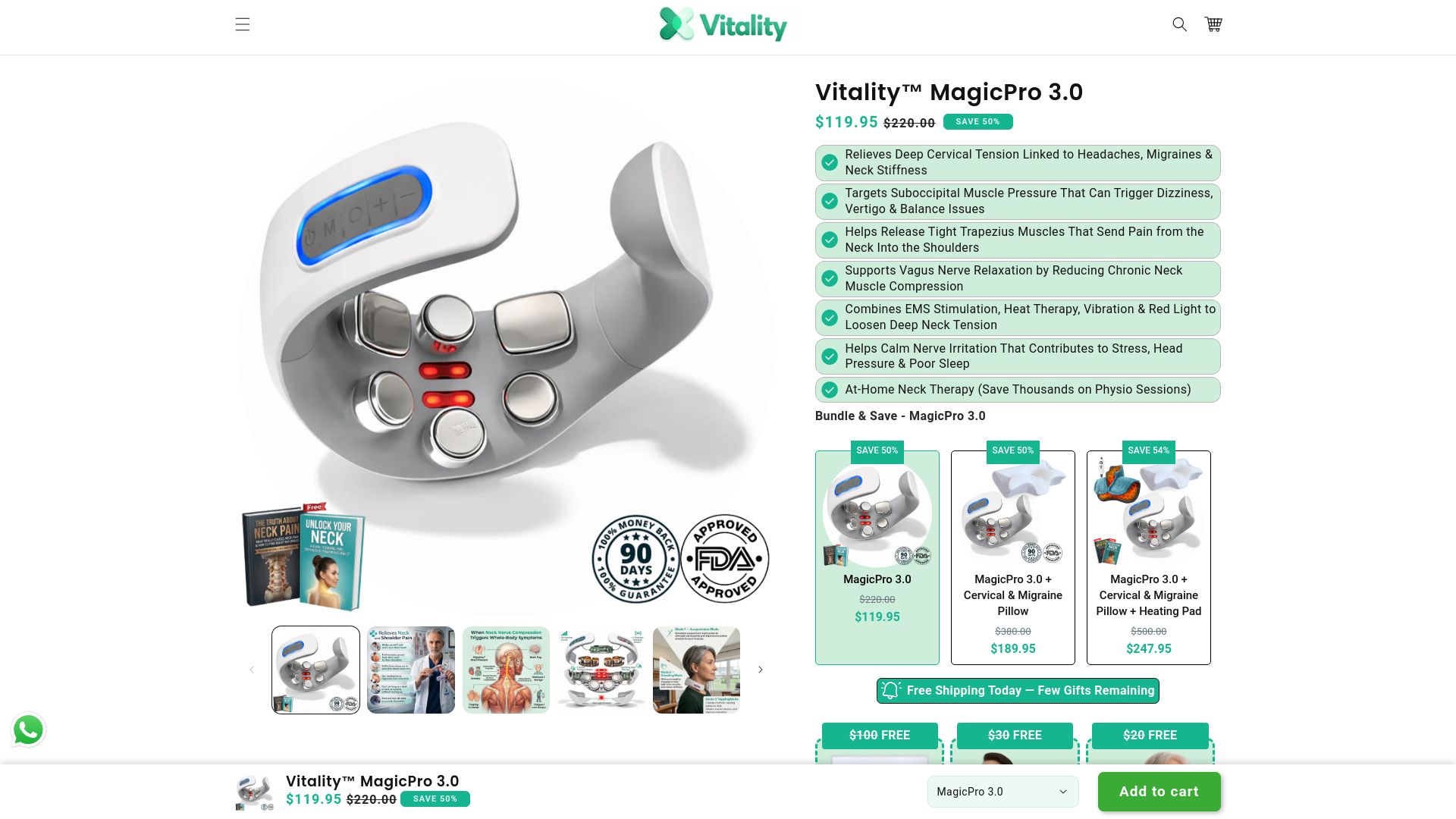
The devices run on rechargeable battery power, so there’s no cord to manage mid-flight or during a layover, and both models are built for frequent flyers dealing with recurrent stiffness rather than a one-time ache. Anyone with a pacemaker, an active pregnancy, or open skin near the treatment area should check with a doctor before using electrical stimulation, as with any E-stim device.
If your neck tends to lock up after every long-haul flight, browse the Vitality™ MagicPro 2.0 product page, check the specs against your own travel schedule, and see whether a 15-minute daily habit fits into how you already travel.
This article is general information, not a substitute for advice from a qualified doctor. Consult a qualified healthcare professional about your own circumstances before acting on anything here.
Sources
- The Best Travel Pillows | Wirecutter
- A Doctor Breaks Down This TikTok Neck Pillow Hack
- When to seek immediate medical attention for neck pain | Harvard Health
- Travel Without the Neck Pain: 5 PT-Approved Exercises for In-Flight Cervical Stiffness