

You can relieve neck pain in public without anyone noticing, using three low-profile methods: 60-second micro-movements like chin tucks, slim adhesive heat patches worn under a collar, and hands-free wearable devices that combine heat and gentle muscle stimulation. These methods work because they require no visible equipment, no privacy, and often no more than a minute of your attention. A 90-second daily drill developed by physical therapists has become one of the most cited public-safe routines for exactly this reason: it looks like nothing more than a stretch.
Before reaching for any tool, know your priority order. Movement-based relief costs nothing and works almost anywhere. Heat and adhesive patches add relief without drawing attention under a shirt collar or scarf. Wearable EMS and massage devices, like the kind My Vitality builds into its MagicPro line, give you the most consistent daily relief once you need something beyond a stretch.
- Chin tucks and isometric holds — looks like adjusting your posture, takes 15 to 30 seconds.
- Slim adhesive heat patches — worn under clothing for hours of steady warmth.
- Hands-free wearable EMS/heat/massage devices — silent, low-profile, usable during a commute or at your desk.
- Seated shoulder rolls and scapular squeezes — invisible under a blazer or sweater.
- A pocket self-massage tool — a soft foam ball or slim roller you can press against a wall or seat back.
Harvard Health notes that consistent, well-supported posture, even during sleep, meaningfully lowers your risk of chronic neck pain flaring up during the day. The goal isn’t a single fix. It’s a rotation of small, quiet habits that add up.
Key Takeaways
Discreet neck pain relief in public works best as a layered routine: quick movement resets throughout the day, backed by low-profile heat or wearable devices when tension builds further.
| Point | Details |
|---|---|
| Start with movement | Chin tucks and shoulder rolls take 5 to 30 seconds and require zero equipment. |
| Layer in heat or patches | Slim adhesive patches deliver hours of warmth invisibly under clothing. |
| Know the safety limits | Skip EMS/TENS with a pacemaker, pregnancy, or broken skin near the device site. |
| Watch for red flags | Numbness, weakness, or fever after injury means it’s time to see a doctor. |
| Add a wearable for consistency | My Vitality’s MagicPro combines EMS, heat, and massage in one hands-free 15-minute session. |
Table of Contents
- 60-Second Discreet Fixes You Can Do Anywhere
- What Seated Stretches Work in a Meeting or on a Train?
- How Can You Self-Massage Your Neck Without Anyone Noticing?
- Which Wearable Devices Offer Discreet Relief in Public?
- How Do Heat, Massage, and EMS Actually Relieve Neck Pain?
- When Should You Stop Self-Treating and See a Doctor?
- What Should Go in Your Discreet Public Relief Kit?
- Making Discreet Relief Part of Your Actual Routine
- A Discreet Device Worth Adding to Your Routine
- Frequently Asked Questions
- Sources
60-Second Discreet Fixes You Can Do Anywhere
Most neck tension builds during long stretches of stillness, not sudden strain. A short reset, done every hour or two, prevents the tightness that eventually becomes hard to ignore. None of these moves require standing up, undressing, or drawing attention.
- Chin tuck. Pull your chin straight back like you’re checking a text message on your lap. Hold for 5 seconds, repeat 5 times.
- Seated isometric press. Place your palm against your forehead and press gently without moving your head. Hold 5 seconds, switch sides.
- Slow neck rotation. Turn your head to look over one shoulder as if glancing at a door, hold 3 seconds, return, repeat on the other side.
- Shoulder rolls. Roll both shoulders back and down slowly, four times, as if stretching after sitting too long.
- Diaphragmatic breath reset. Inhale through your nose for 4 counts, hold 2, exhale for 6. This lowers the muscle guarding that tightens your neck and shoulders.
- Ear-to-shoulder tilt. Tilt your head slightly toward one shoulder, as if you’re listening closely to something, hold 5 seconds.
- Jaw release. Let your jaw hang open slightly for a few seconds, which unclenches the muscles connected to your upper neck.
- Scapular squeeze. Pull your shoulder blades together gently for 5 seconds, as if you’re adjusting how your shirt sits.
Two physical therapists behind a widely shared 90-second chin tuck, rotation, and extension routine designed it specifically to require no equipment and no privacy, making it one of the more practical public-safe drills available.
Pro Tip: Attach these moves to something you already do. Do a chin tuck every time the elevator doors close, or a shoulder roll every time your screen locks. Trigger-based habits stick far better than “remembering” to do them.
What Seated Stretches Work in a Meeting or on a Train?
Context changes what counts as discreet. A stretch that looks fine on a crowded train might draw a glance in a small meeting room. Read the room, then pick your move.
- Lateral neck stretch, seated. Tilt your head toward one shoulder while resting your hand casually on your thigh, not on your head, to keep the motion subtle.
- Thoracic extension micro-movement. Sit tall, gently arch your upper back against the chair, and hold for a few seconds, like resettling into your seat.
- Scapular squeeze with arms at your sides. Squeeze your shoulder blades together while your hands rest on your lap, invisible under a jacket.
- Cross-body arm stretch, low profile. Bring one arm across your body at waist height, as if adjusting your bag strap, to release tension along the upper back and neck.
- Wall-assisted shoulder press (standing in line). Press your shoulder blades gently into a wall or pillar behind you.
- Seated pelvic tilt. Shift your hips slightly forward and back in your chair, which resets your spine and reduces the forward-head posture that strains your neck.
- Gentle head figure-eight. In a low-traffic moment, trace a small figure eight with your chin. It loosens multiple directions of tightness at once.
Favor micro-movements, the ones lasting 3 to 5 seconds, in meetings or anywhere eyes might be on you. Save longer holds, 15 to 30 seconds, for a train seat, a waiting room, or anywhere you’re facing away from others.
Pro Tip: Keep one hand in your pocket or lap during a stretch. It anchors your posture and makes the motion read as fidgeting rather than exercise.

How Can You Self-Massage Your Neck Without Anyone Noticing?
Your hands are the most discreet tool you own, and a few targeted techniques handle a surprising amount of tension without any product at all.

Press your fingertips into the base of your skull, just above where your neck meets your head, and hold gentle pressure for 10 to 15 seconds. This targets the suboccipital muscles, a common source of tension headaches and neck stiffness. Follow it with a trap squeeze: reach across your body and squeeze the muscle between your neck and shoulder through your shirt, holding for a few seconds before releasing. A light jaw and temple massage, small circles with two fingers, helps release tension that radiates up into the neck from clenched teeth.
For added pressure without looking like you’re doing anything unusual, a few small tools help:
- A soft foam ball, pressed between your upper back and a chair, doubles as a portable massage tool you can carry in a bag pocket.
- A slim neck roll or small cylindrical pillow, tucked behind your neck during a commute, gives passive support and gentle pressure.
- A discreet thumb-sized massage tool, easy to palm and use one-handed under a scarf or collar.
Go easy on pressure in public settings. Aggressive self-massage can leave visible redness or make you wince, which draws exactly the attention you’re trying to avoid. If you’re using any tool regularly, rotate where you apply pressure to avoid overworking the same small area of muscle or skin.
Which Wearable Devices Offer Discreet Relief in Public?
Portable tech has closed the gap between clinical-grade relief and something you can use at your desk or on a train. Three categories dominate this space: adhesive heat patches, slim EMS or TENS units, and compact vibration or massage patches.
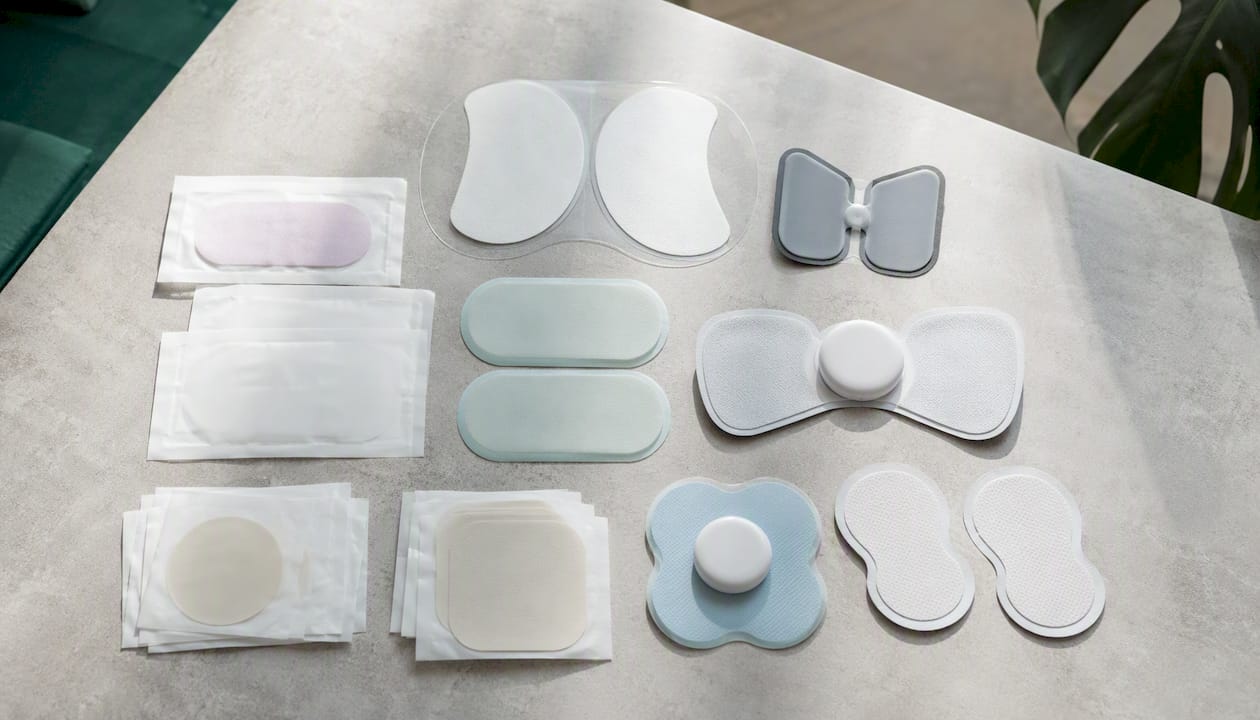
Adhesive heat patches deliver several hours of steady, low-level warmth and sit flat enough to wear under a collar or scarf without a visible bulge. Air-activated versions, like single-use heat wraps sold for on-the-go neck pain, need no batteries or charging, just skin contact. Slim EMS and TENS patches use small electrical pulses to interrupt pain signals and gently activate muscle, and modern versions run quiet enough that no one nearby will notice. Wearable massage patches use light vibration rather than deep kneading, which keeps them silent and low-profile enough for a quiet office.
| Device Type | Discretion Level | Typical Session Length | Power Source |
|---|---|---|---|
| Adhesive heat patch | Very high, no visible movement | 4 hours of warmth | Air-activated or self-heating |
| Slim EMS/TENS patch | High, silent operation | 15 to 30 minutes per session | Rechargeable battery |
| Wearable massage patch | High, minimal vibration noise | 15 minutes per session | Rechargeable battery |
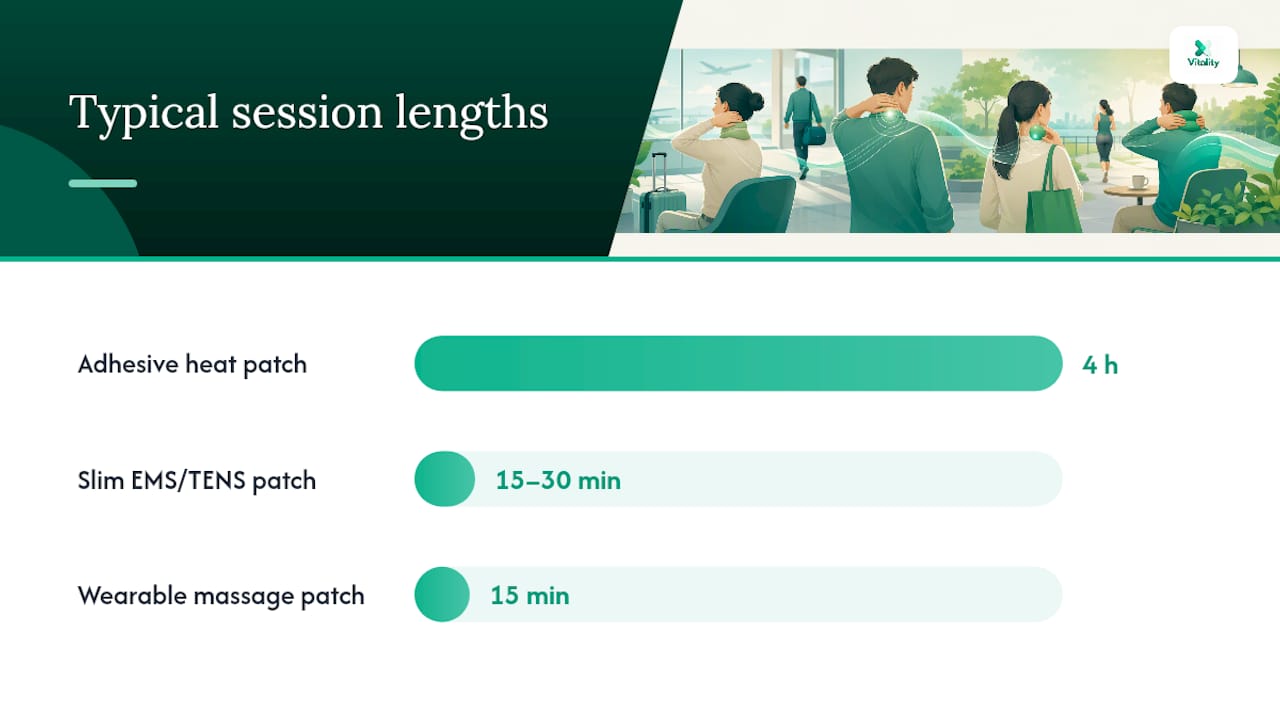
Battery-powered devices generally need a charge every few sessions, so a quick check before you leave the house avoids a dead unit halfway through your commute. Choose a device with a low, adjustable intensity setting if you plan to use it in a meeting or shared space, and always test a new adhesive patch at home first.
| Contraindication | Why It Matters |
|---|---|
| Pacemaker or implanted electrical device | EMS/TENS currents can interfere with device function |
| Pregnancy | Electrical stimulation near the torso is not recommended without medical guidance |
| Broken or irritated skin | Adhesive and electrical contact can worsen irritation or cause infection |
Skin sensitivity is the most common complaint with any long-wear adhesive product. Rotating between a patch-based device one day and a mechanical massager the next gives your skin recovery time and reduces the odds of irritation building up over a week of daily use.
How Do Heat, Massage, and EMS Actually Relieve Neck Pain?
Heat works by widening blood vessels near the skin’s surface, which increases circulation and helps relax tight muscle fibers. Massage works mechanically, breaking up local tension and interrupting the nerve signals that keep a muscle locked in a guarded state. EMS and TENS devices operate on a different principle entirely: they send a mild electrical pulse that can interrupt pain signals traveling to the brain while also encouraging small muscle contractions that support circulation.
A 2026 network meta-analysis covering 17 randomized trials and 1,224 patients with chronic nonspecific neck pain found that muscle energy technique outperformed conventional exercise for pain reduction, ranking highest among the compared approaches. The researchers were careful to note the evidence quality was moderate, since much of it relied on indirect comparisons rather than head-to-head trials. That’s a meaningful distinction: MET looks promising, but it isn’t a settled, one-size-fits-all answer.
| Modality | Primary Mechanism | Evidence Strength |
|---|---|---|
| Heat therapy | Vasodilation, muscle relaxation | Well-established, first-line self-care |
| Massage/MET | Mechanical release, nerve signal modulation | Moderate, promising for chronic pain |
| EMS/TENS | Pain gate interruption, muscle activation | Established for short-term pain relief |
Mayo Clinic recommends heat, over-the-counter pain relievers, and gentle movement as first-line self-care for mild to moderate neck pain, which typically resolves within 2 to 3 weeks. The same guidance cautions against relying on a soft cervical collar for more than three hours at a stretch or beyond one to two weeks, since prolonged use can weaken the muscles it’s meant to support.
When Should You Stop Self-Treating and See a Doctor?
Public-friendly relief methods work well for everyday tension, but they aren’t built to handle every cause of neck pain. Certain signs mean it’s time to put the self-care kit away and call a clinician.
- Progressive weakness in your arm or hand.
- Numbness or tingling that radiates down one or both arms.
- Severe pain that doesn’t ease with rest, heat, or over-the-counter medication.
- Fever following a recent fall, accident, or injury.
- Dizziness, balance problems, or vision changes alongside neck pain.
Persistent neck pain sometimes traces back to causes that ergonomic fixes and micro-stretches can’t touch. Specialists point to arthritis, disc degeneration, and nerve irritation as common underlying drivers, meaning treatment needs to target the actual diagnosis rather than posture alone.
| Situation | Action |
|---|---|
| Mild stiffness, no radiating symptoms | Self-care: heat, movement, over-the-counter relief |
| Numbness, tingling, or weakness in the arm | See a doctor promptly |
| Severe pain after a fall or accident, with fever | Seek medical attention immediately |
| Pacemaker or open skin near a device site | Skip EMS/TENS and adhesive patches entirely |
If you’ve been leaning on a soft collar for comfort, Mayo Clinic’s guidance is worth repeating here: short-term use only, and don’t let it replace an evaluation if pain persists past a couple of weeks.
What Should Go in Your Discreet Public Relief Kit?
A small, well-stocked kit means you’re never caught without options, whether you’re stuck in a long meeting or three hours into a road trip.
- Slim adhesive heat patches for hours of quiet warmth under a collar.
- Hypoallergenic skin patches to reduce irritation risk during repeated use.
- A soft microfiber neck roll for passive support on a train, plane, or car seat.
- A small foam ball for quick self-massage against a wall or chair back.
- A compact microfiber towel to wipe down a device or your neck after a warm session.
- A compact wearable device, like My Vitality’s MagicPro, for a longer session when you have 15 quiet minutes.
Store patches somewhere they won’t overheat, like a desk drawer rather than a car dashboard in summer, and check any rechargeable device’s battery the night before a long day out. Test a new patch or device on your skin at home first. This lets you catch any adhesive sensitivity before you’re relying on it in public, and pairs well with a gentle home-care routine if you want to build a baseline before taking your kit on the road.
Making Discreet Relief Part of Your Actual Routine
The advice in this article only works if it survives contact with a real day. Most people don’t fail at neck pain relief because they lack good moves. They fail because they never build a habit around using them.
Aim for two to three micro-sessions a day rather than one long session you keep postponing. A chin tuck after your first coffee, a shoulder roll before a midday meeting, and a heat patch or wearable session on your commute home cover most of what a typical desk day throws at your neck. Rotate your tools rather than leaning on one method daily. A patch one day, a wearable device the next, and a self-massage session on the third gives your skin a break and keeps any single muscle group from getting overworked by the same pressure point.
- Two to three short sessions daily beats one long session you keep skipping.
- Rotate between heat, massage, and movement to avoid skin or muscle overuse.
- Pair public micro-fixes with a longer physical therapy plan if pain is chronic rather than occasional.
- Treat red flags as a hard stop, not a reason to try one more stretch first.
None of this replaces a physical therapist’s guidance for pain that keeps returning. It just means the days between appointments don’t have to be miserable.
A Discreet Device Worth Adding to Your Routine
Most of the fixes above cost nothing, and they should be your first move. But when tension builds day after day, a dedicated device closes the gap between a quick stretch and lasting relief. My Vitality’s MagicPro is built around exactly that gap: a hands-free device combining electrical muscle stimulation, heat, and massage into one slim unit you can wear under a scarf or collar during a commute, a desk shift, or a quiet 15 minutes before a meeting.
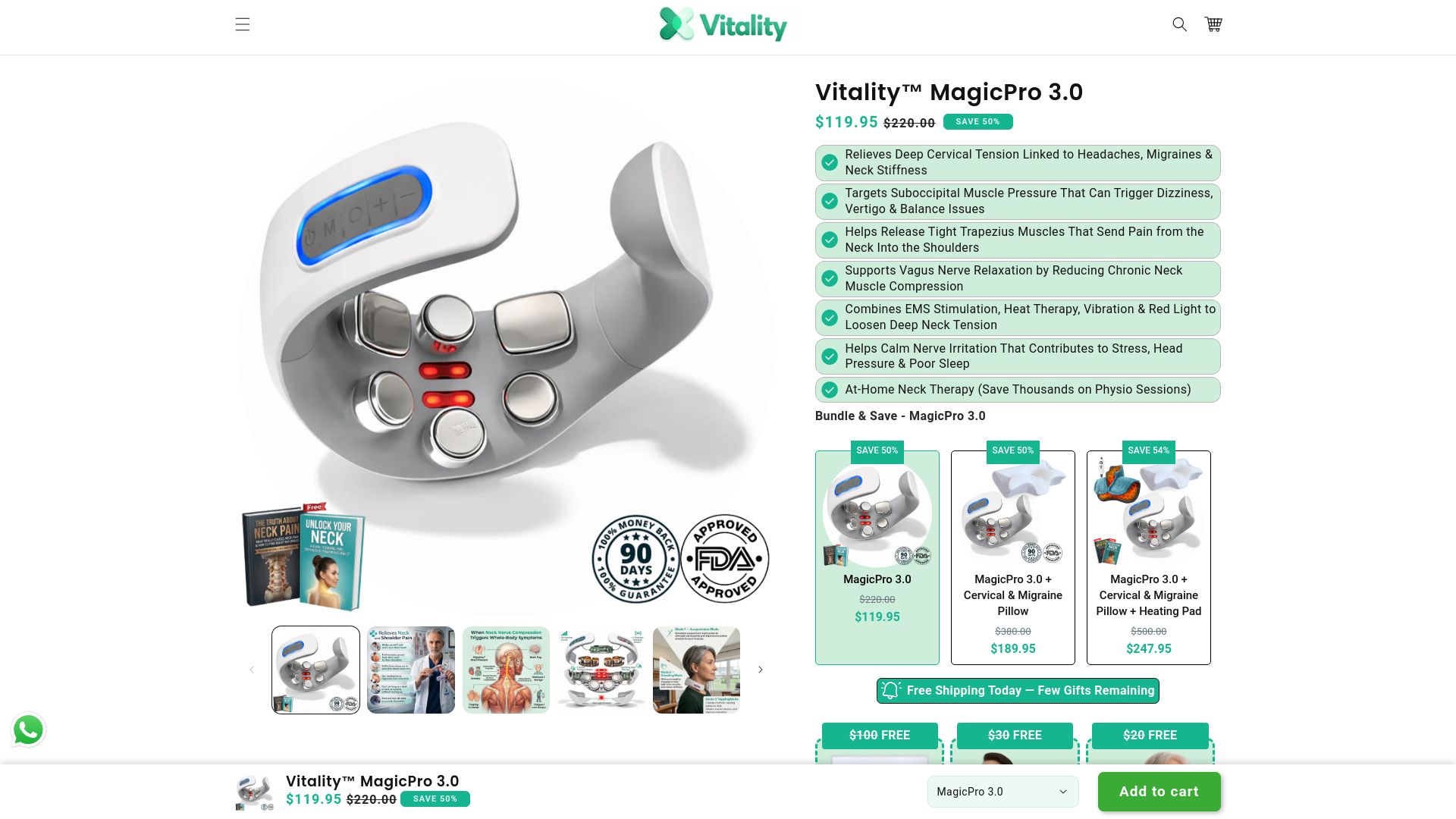
Before buying any wearable, check three things: battery life for a full day’s use, hypoallergenic labeling on any adhesive component, and a session length that fits your actual schedule rather than an ideal one. My Vitality’s MagicPro 2.0 is built for exactly this kind of low-friction, 15-minutes-a-day use, whether you’re at your desk, in transit, or unwinding at home. If you want to see the full lineup of portable options, the neck and nerve relief collection is a good place to compare what fits your routine. Order the MagicPro today and give your neck a real 15-minute reset instead of another day of pushing through it.
Frequently Asked Questions
Can I really relieve neck pain in public without anyone noticing? Yes. Chin tucks, isometric holds, and shoulder rolls look like ordinary posture adjustments, and slim adhesive heat patches or wearable devices sit flat enough under clothing to go unnoticed entirely.
How often should I do discreet neck relief moves during the day? Two to three short sessions daily, roughly every two to three hours, tend to prevent the buildup of tension better than one long session at the end of the day.
Are wearable EMS devices safe to use during a commute? Most are, at a low intensity setting, but skip them entirely if you have a pacemaker, are pregnant, or have broken skin near the device site, per standard device safety guidance.
When does neck pain stop being something I can manage on my own? If you notice numbness, tingling, arm weakness, or pain that doesn’t ease after two to three weeks of self-care, it’s time to see a doctor rather than continue with home methods.
What’s the fastest discreet fix if my neck tightens up right before a meeting? A chin tuck combined with a slow four-count breath reset takes under 30 seconds and works in a chair, an elevator, or a hallway without drawing attention.
This article is general information, not a substitute for advice from a qualified doctor. Consult a qualified healthcare professional about your own circumstances before acting on anything here.
Sources
- Neck pain - Diagnosis and treatment - Mayo Clinic
- Say good night to neck pain - Harvard Health
- Comparative efficacy of exercise therapies for chronic nonspecific neck pain — Frontiers in Neurology
- Two Physical Therapists Fixed Chronic Neck Pain With a 90-Second Daily Drill (No Equipment, No Medication Needed) - BoxLife Magazine
- The hidden causes of neck pain — Integrative Spine & Sports
Test any new patch, adhesive, or wearable device on your skin at home before relying on it in public. It’s a small step that saves you from discovering a sensitivity issue in the middle of a meeting.