


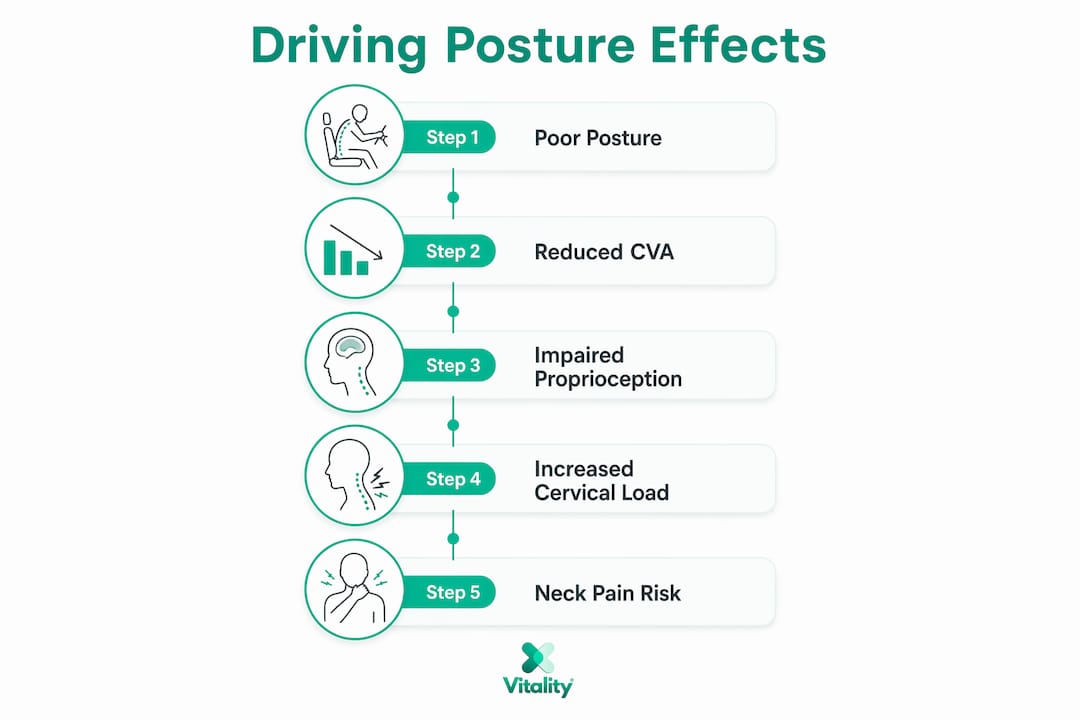
Poor vehicle posture, specifically forward head posture combined with inadequate thoracic and lumbar support, increases anterior head translation and compressive load on the cervical spine. This directly worsens cervical range of motion (CROM) and reduces proprioceptive accuracy, both of which sustain neck pain over time. Three things you can do right now:
- Adjust your headrest so it sits level with the center of your skull, not your neck.
- Add upper-back support (not just lumbar) to reduce how far your head drifts forward.
- Set a microbreak timer for every 30–40 minutes of driving to move your neck and reset your posture.
A 2024 cross-sectional study found that drivers with neck pain had a craniovertebral angle (CVA) significantly smaller than pain-free drivers, reflecting measurably greater forward head posture and higher mechanical load on the cervical segments.
Table of Contents
- How does vehicle posture change cervical spine alignment?
- Which seat settings most strongly affect your neck posture?
- What does the research actually show?
- How quickly does driving posture affect your neck?
- Practical in-car adjustments and habits to protect your neck
- Exercises to restore cervical posture after driving
- When should you see a professional?
- Evidence-backed at-home adjuncts for neck relief
- How prolonged driving causes cumulative cervical stress
- Early signs of cervical strain from poor driving posture
- Ergonomic setup for different vehicle types and body sizes
- Short-term pain relief during and after driving
- How often should you take posture breaks while commuting?
- Key Takeaways
- The part most guides skip
- My Vitality MagicPro 2.0: post-commute cervical relief in 15 minutes
- Key sources and further reading
How does vehicle posture change cervical spine alignment?
Forward head posture (FHP) is the clinical term for what happens when your head shifts forward of your shoulders. The craniovertebral angle (CVA) quantifies it: a smaller CVA means more anterior head translation and greater forward lean. Every degree of forward drift increases the lever arm acting on the cervical spine, raising compressive and shear forces on the discs and facet joints.
The same 2024 study showed that drivers with neck pain also had reduced proprioceptive accuracy by a mean of 4.5°, and lower CROM scores compared to pain-free drivers. Proprioception is your neck’s ability to sense its own position. When it degrades, your muscles compensate with chronic low-level tension, which feeds the pain cycle rather than breaking it.
Lumbar posture plays a direct role here too. Research published in PLOS One shows that increased lumbar flexion while seated correlates with higher neck extensor muscle activation. Your spine works as a chain. A slumped lower back pulls the thoracic spine into kyphosis, which pushes the head forward. Fixing only the neck without addressing the lumbar and thoracic regions rarely holds.
Pro Tip: If you feel neck tension building within 15 minutes of driving, your lower back is likely the first thing to check, not your headrest.

Which seat settings most strongly affect your neck posture?
Getting cervical alignment right in a car starts below the neck. These are the settings that matter most, in order of impact:
- Seatback angle. A standard 25° recline is the automotive industry benchmark, but research on seat back inclination shows it affects thoracic kyphosis significantly, especially in drivers with a lordotic cervical spine. Test between 20° and 25° and choose the angle where your upper back stays in contact with the seat without your chin jutting forward.
- Upper-back support. Most factory seats offer lumbar support only. A crossover randomized trial found that individualized upper-back support produced small but statistically significant reductions in anterior head translation during 30-minute simulated drives. Add a rolled towel or a dedicated thoracic support at the mid-back level.
- Headrest position. The top of the headrest should align with the top of your head. A headrest set too low acts as a fulcrum, not a support, and can actually increase cervical extension strain.
- Seat pan depth. Slide the seat so two to three fingers fit between the back of your knee and the seat edge. Too much thigh contact tilts the pelvis posteriorly, collapsing lumbar support.
- Steering wheel reach. Your elbows should have a slight bend with hands at 9 and 3 o’clock. Reaching forward for the wheel pulls the shoulders and upper thoracic spine away from the seatback, which immediately increases anterior head translation.
- Lumbar support prominence. Set it to fill the natural curve of your lower back without pushing you into a forced arch. Overly aggressive lumbar support can flatten the thoracic spine and paradoxically worsen neck posture.
What does the research actually show?
The strongest evidence comes from two recent studies.
| Study | Design | Key Finding |
|---|---|---|
| PMC 2024 cross-sectional | Drivers with vs. without neck pain | CVA difference; proprioception deficit of 4.5° |
| JAB 2023 crossover RCT | 40 participants, 30-min simulated drives | Individualized upper-back support reduced anterior head translation significantly |
| PLOS One experimental | Urban driving simulation | Neck balance system + lumbar support reduced neck extensor muscle activation |
The 2024 study is observational, so it shows association, not causation. The 2023 RCT is stronger in design but used a 30-minute simulated drive, not real-world commuting. Still, the direction of evidence is consistent: forward head posture is linked to measurable functional impairments, and seat modifications targeting upper-back support can reduce anterior head translation.
One important caveat: participants in the RCT reported lower satisfaction with the activated seat system despite objective posture improvements. What feels comfortable is not always what is best for your cervical spine.
How quickly does driving posture affect your neck?
The timeline is shorter than most people expect.
- Within a single commute: Neck extensor fatigue can build during frequent accelerations and decelerations, even on a 20-minute drive, particularly when posture is already compromised.
- At 30 minutes: Measurable posture shifts are detectable in experimental settings. This is why the RCT used 30-minute trials as its measurement window.
- Daily and weekly accumulation: Prolonged driving is linked to non-neutral spinal postures and higher rates of neck pain in professional drivers. The risk compounds with desk work, since office workers often arrive at their cars already in forward head posture.
- Accelerating factors: Long daily driving hours, no scheduled breaks, and a preexisting forward head posture from desk work all raise cumulative risk significantly.
The practical guideline: break every 30–40 minutes. Even 60 seconds of movement resets muscle activation patterns and interrupts the fatigue cycle.
Practical in-car adjustments and habits to protect your neck
Seat setup checklist (before you drive)
- Set seat height so your hips are level with or slightly above your knees.
- Adjust seatback angle between 20° and 25°, confirming upper-back contact.
- Position the headrest at skull-center height.
- Set lumbar support to fill, not force, your lumbar curve.
- Adjust steering wheel reach so elbows stay slightly bent.
- Place upper-back support at mid-thoracic level if your seat lacks it.
Habits while driving
Use a chin-tuck cue at red lights: gently draw your chin straight back (not down) to restore neutral cervical alignment. Keep hands at 9 and 3 o’clock to maintain shoulder contact with the seatback. During longer stops, roll your shoulders back twice and take one slow deep breath to release thoracic tension.
Pro Tip: If you drive a shared or rental car frequently, keep a compact lumbar-thoracic roll in your bag. A 30-second setup reset using your own support is faster and more reliable than adjusting an unfamiliar seat from scratch.
Exercises to restore cervical posture after driving
This 10–15 minute routine works before or after a commute. Move slowly and stop if you feel sharp pain or tingling.
Beginner sequence
- Neck mobility warm-up (2 minutes): Slow chin-to-chest, ear-to-shoulder (each side), and gentle rotation left and right. Three repetitions each direction.
- Thoracic rotation (2 minutes): Seated or standing, cross arms over chest and rotate upper body left and right. Five repetitions each side.
- Scapular retraction (1 minute): Squeeze shoulder blades together and hold for 5 seconds. Ten repetitions.
Intermediate: proprioceptive drills
- Head repositioning drill (3 minutes): Close your eyes, move your head to a neutral position from a flexed or rotated position, then open your eyes and check alignment in a mirror. Five repetitions. This directly targets the proprioceptive deficits seen in drivers with neck pain.
- Eyes-closed head repositioning (3 minutes): Same drill with a target angle marked on a wall. Aim to return to within 2° of the target. Progress by increasing the starting angle.
| Level | Frequency | When to Expect Change |
|---|---|---|
| Beginner | Daily, 10 min | Reduced stiffness in 2–3 weeks |
| Intermediate | 5x/week, 15 min | Measurable CROM improvement in 4–6 weeks |
When should you see a professional?
Most driving-related neck discomfort responds to posture correction and exercise. Seek prompt evaluation if you notice any of the following:
Red flags that require urgent attention: radiating pain or numbness into the arm or hand, progressive weakness in the arms or grip, neck pain following a collision or trauma, or symptoms that worsen steadily despite rest and posture changes. These may indicate nerve compression or structural injury that needs imaging and specialist assessment.
For persistent mechanical neck pain without red flags, a physical therapist can assess your CROM, proprioception, and strength, then build a program targeting your specific deficits. Physiatrists and neurologists are appropriate referrals when imaging or nerve conduction studies are needed. Multidisciplinary care, combining ergonomics guidance, manual therapy, and exercise, consistently produces better outcomes than any single approach alone. For additional context on clinical cervical spine treatment approaches, resources on cervical spine therapy can offer useful background.
Evidence-backed at-home adjuncts for neck relief
Physical rest alone is not enough when proprioceptive accuracy is reduced. These adjuncts support recovery between sessions:
- Neck balance systems with lumbar support: The PLOS One study found that combining a neck balance device with lumbar support reduced neck extensor muscle activation during simulated driving. Use for 10–15 minutes post-commute.
- Heat therapy: Targeted heat increases local circulation and reduces muscle guarding. Apply for 10–15 minutes to the cervical and upper thoracic region. Avoid heat over acute inflammation or open skin.
- Electrical muscle stimulation (EMS) and massage: EMS devices can reduce muscle tension and support neuromuscular re-education. Common contraindications include pacemakers, pregnancy, and active skin infections.
These are adjuncts. They work best when combined with the seat setup corrections and exercise routine above, not as replacements for them.
How prolonged driving causes cumulative cervical stress
Each drive places the cervical spine under sustained compressive and shear load. Over weeks and months, this cumulative mechanical stress can accelerate disc dehydration, reduce intervertebral disc height, and promote facet joint irritation. The cervical discs have limited blood supply and rely on movement for nutrient exchange. Sustained static posture in forward head position reduces that exchange. Over years, this pattern contributes to degenerative changes including osteophyte formation and reduced disc compliance, conditions commonly seen in long-haul and professional drivers. The key word is cumulative: no single commute causes degeneration, but daily unaddressed posture loads compound over time.
Early signs of cervical strain from poor driving posture
Recognizing strain early gives you the best chance to reverse it before it becomes chronic. Common early signs include:
- A dull ache at the base of the skull or across the upper trapezius after driving
- Stiffness that takes more than 10 minutes to resolve in the morning
- Mild headaches originating at the back of the head, often after longer commutes
- A sense of tightness when turning to check blind spots
- Fatigue in the neck muscles that feels disproportionate to the drive length
These symptoms often appear before any measurable structural change. That is the window where posture correction and exercise are most effective. For practical home-based cervical pain remedies that complement in-car adjustments, guidance on cervical pain at the desk is worth reviewing, since office and driving posture problems frequently overlap.
Ergonomic setup for different vehicle types and body sizes
Standard seat adjustment advice assumes an average body. It often does not fit. Research on spinal alignment and seat back inclination confirms that sex-based differences in cervical and thoracic alignment mean a single “optimal” angle rarely works for everyone.
Shorter drivers often sit closer to the steering wheel, which limits thoracic contact with the seatback and increases anterior head translation. Use a seat cushion to raise hip height before moving the seat forward.
Taller drivers in compact vehicles frequently cannot achieve full upper-back contact without reclining too far, which drops the headrest below skull center. A portable thoracic support becomes especially useful here.
SUVs and trucks typically have higher seating positions and more adjustability, but the steering wheel is often larger and farther away, encouraging a forward reach. Telescoping the wheel closer is the single highest-impact adjustment in these vehicles.
Sedans and sports cars tend toward lower seating with more reclined seatbacks. Drivers in these vehicles often show more pronounced thoracic kyphosis, which directly increases forward head posture.
Short-term pain relief during and after driving
When neck tension builds mid-commute, these techniques provide immediate relief without requiring you to stop:
- Chin tuck at red lights: Draw the chin straight back, hold for 5 seconds, release. Repeat three times.
- Shoulder blade squeeze: Retract both shoulder blades and hold for 5 seconds. Relieves upper trapezius tension.
- Neck side stretch at stops: Drop one ear toward the shoulder and hold for 15–20 seconds each side. Do not force the stretch.
- Supportive travel pillow: A U-shaped cervical travel pillow used during long drives or passenger travel reduces unsupported head weight and limits lateral drift during drowsiness.
After the drive, 10 minutes of gentle heat to the upper cervical region reduces residual muscle guarding and prepares the tissue for the exercise routine.
How often should you take posture breaks while commuting?
The evidence-informed recommendation is a movement break every 30–40 minutes of continuous driving. During a typical 60-minute commute, that means one break at the midpoint. For commutes under 30 minutes, a 60-second posture reset at your destination (chin tuck, shoulder retraction, thoracic extension against the seatback) is sufficient.
For daily exercise, 10 minutes of the beginner sequence every day produces noticeable stiffness reduction within two to three weeks. Progressing to the intermediate proprioceptive drills five times per week targets the CROM and proprioceptive deficits that sustain chronic neck pain. Consistency over four to six weeks is where measurable functional improvement typically appears.
Key Takeaways
Poor vehicle posture reduces the craniovertebral angle, impairs proprioception, and compounds cervical load daily, but targeted seat adjustments, microbreaks, and a 10–15 minute exercise routine can reverse these effects within weeks.
| Point | Details |
|---|---|
| CVA is the key measure | Drivers with neck pain show a smaller CVA than pain-free drivers. |
| Upper-back support matters most | Individualized upper-back support reduces anterior head translation; lumbar-only fixes are insufficient. |
| Break every 30–40 minutes | Measurable posture shifts occur within 30 minutes; scheduled microbreaks interrupt the fatigue cycle. |
| Proprioception needs retraining | A 4.5° proprioceptive deficit in drivers with neck pain requires active drills, not just rest. |
| My Vitality as a post-drive adjunct | The MagicPro 2.0 combines heat, massage, and EMS for 15-minute post-commute cervical relief sessions. |
The part most guides skip
Most articles on driving and neck pain focus on lumbar support and headrest height, then stop. What they miss is the proprioceptive dimension. A driver who has spent years in forward head posture has not just a structural problem but a neuromuscular one. The neck’s position sensors have recalibrated to a faulty baseline. Seat adjustments alone will not fix that. Neither will heat or massage, though both help with symptom management.
The evidence from the 2024 cross-sectional data is clear: the proprioceptive deficit in drivers with neck pain is measurable and meaningful. That means the exercise component of any recovery plan is not optional. It is the part that actually retrains the system. Commuters who add the head repositioning drills to their routine and stick with them for four to six weeks tend to see the most durable improvement, not because the exercises are complicated, but because they address the right target.
The other overlooked point: comfort and optimal posture are not the same thing. The RCT found that participants preferred the deactivated seat despite the activated version producing better objective posture outcomes. Trust the measurement, not the feeling, especially in the first few weeks of a new setup.
My Vitality MagicPro 2.0: post-commute cervical relief in 15 minutes
Seat adjustments and exercises address the root cause. For the tension that builds up during the drive itself, a targeted device can make the recovery faster and more consistent.
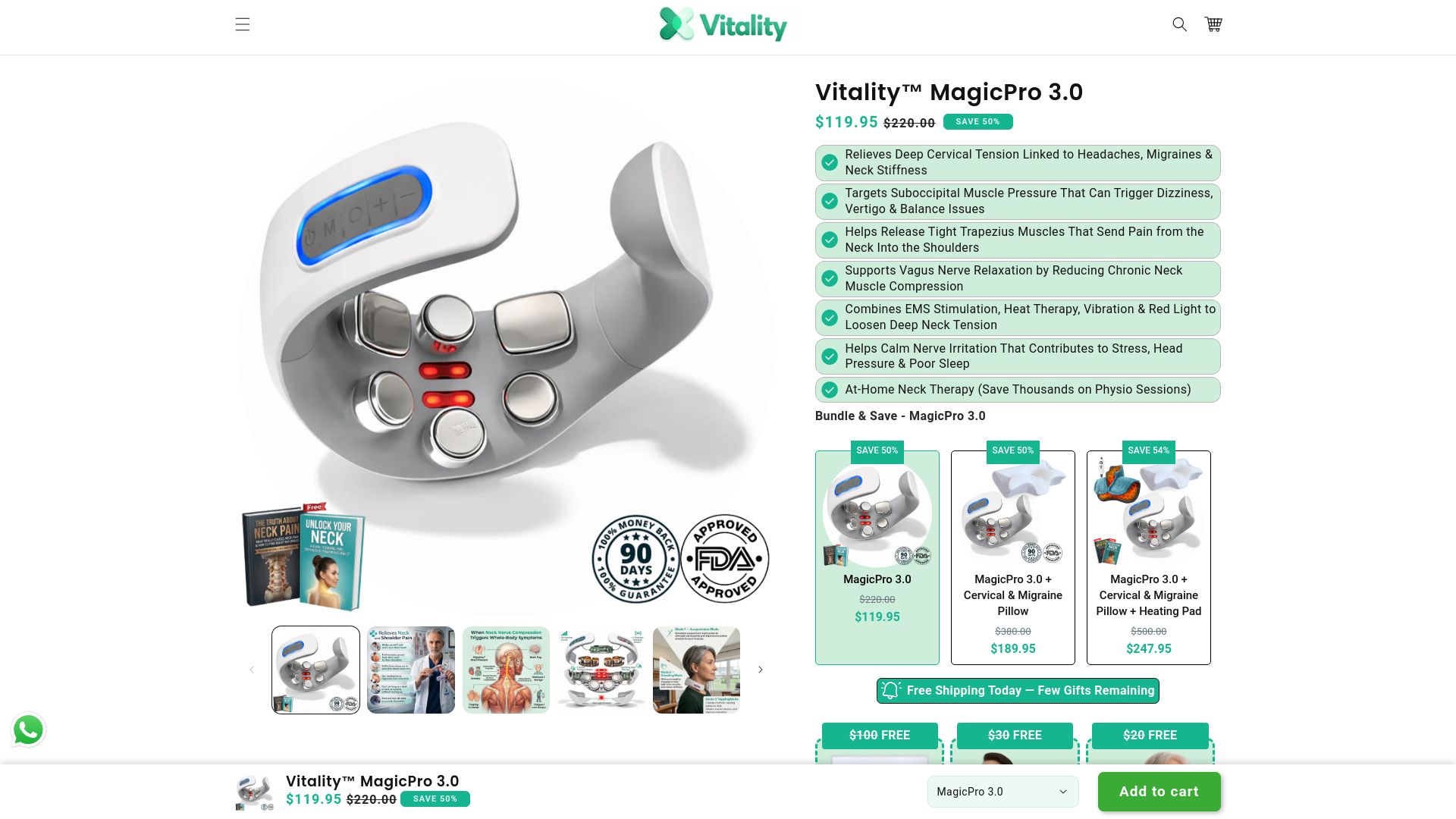
The My Vitality MagicPro 2.0 combines electrical muscle stimulation, heat, and massage in one compact device designed to be used at home, at your desk, or right after parking. A 15-minute session targets the cervical and upper trapezius muscles that bear the most load during driving. It is doctor-recommended and built for daily use as an adjunct to the posture and exercise routine described above, not a replacement for it.
Common contraindications include pacemakers, pregnancy, and active skin conditions over the treatment area. For the full range of Vitality devices, visit the collection page and find the option that fits your routine.
Key sources and further reading
- Cervical Health Parameters in Car Drivers: CVA, CROM, and Proprioception — PMC 2024
- The Vehicle Seating Intervention Trial: Crossover RCT on Upper-Back Support — Journal of Applied Biomechanics 2023
- Neck Balance System and Lumbar Support During Driving — PLOS One
- Effect of Seat Back Inclination on Spinal Alignment — PMC
- Vehicle Seating and Spinal Kinematics — Frontiers in Bioengineering and Biotechnology
- Cervical Health Parameters in Car Drivers — Dove Medical Press
This article is general health information, not medical advice. Confirm any treatment or exercise plan with a qualified clinician for your specific situation.