


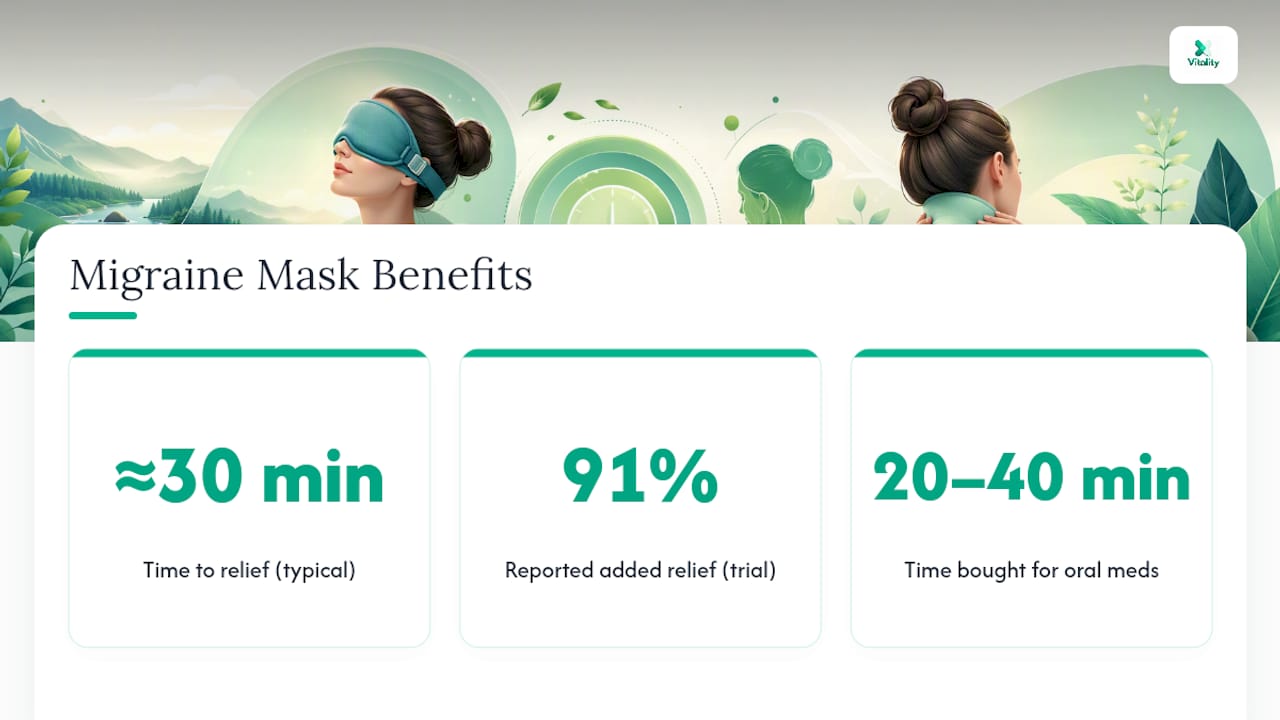
Migraine masks help most people who use them, and the relief usually comes fast. Cold therapy, gentle compression, and light-blocking work together to calm an active migraine within about 30 minutes for many users, according to a 2022 systematic review. Think of a mask as an adjunct, not a cure. It works best when applied early, alongside your regular medication, not as a replacement for it.
TL;DR:
- Cold therapy constricts blood vessels and activates pain-relief mechanisms within approximately 30 minutes during an attack.
- Masks that block light and apply gentle compression help reduce photophobia and muscle tension, enhancing relief.
- Applying a cold mask early in an attack, for 15 to 30 minute intervals, maximizes short-term symptom relief without side effects.
- Effectiveness varies with device design, fit, and timing, and masks provide only temporary relief, not long-term prevention.
- Combining masks with neck tension devices addresses both the immediate migraine symptoms and underlying triggers for better results.
Table of Contents
- The Science Behind Migraine Mask Benefits
- What Are the Real Benefits of a Migraine Mask?
- Types of Migraine Masks and Which Features Matter
- When and How to Use a Migraine Mask Safely
- What Does the Research Actually Say?
- Getting the Most Out of Your Mask
- An Honest Look at Where Masks Fit In
- A Better Fit for Neck-Tension Migraine Triggers
- Sources
The Science Behind Migraine Mask Benefits
Three mechanisms drive the relief a migraine mask offers, and each targets a different part of an attack.
Cold is the most studied piece. When the gel or ice pack touches your skin, blood vessels near the surface constrict, and this vasoconstriction appears to calm the inflamed nerve pathways involved in migraine pain. Cooling also activates TRPM8, a cold-sensing channel in your skin that plays a role in natural pain relief. That’s part of why an ice pack on your forehead can feel like genuine relief rather than just a distraction.
Compression adds a second layer. A snug mask applies steady pressure across the forehead and temples, which can ease the sensory nerve signals tied to muscle and temporal tension.
Light-blocking finishes the job. Migraines often bring photophobia, an intense sensitivity to light, and a mask’s blackout design removes that trigger entirely so your nervous system has one less thing to fight.
- Cold therapy: constricts vessels, calms inflamed nerves, activates TRPM8 for pain relief
- Compression: reduces muscle and temporal tension through steady pressure
- Light-blocking: removes photophobia triggers during an active attack
What Are the Real Benefits of a Migraine Mask?
The clearest benefit is speed. In small clinical studies, cold therapy delivered meaningful pain relief within roughly 30 minutes for many participants, a window that lines up with what most people report at home.
By the Numbers: In one small trial of a photoprotective mask combined with a topical treatment, 91% of the 33 participants reported additional relief. The sample size is small, so treat that figure as a promising signal rather than a guarantee.
Beyond raw pain scores, masks address the symptoms that make migraines miserable to sit through. Blocking light reduces photophobia almost immediately, and for many people, that alone lowers the nausea and overstimulation that come with a bright room. Resting in a dark, cool mask can buy you the 20 to 40 minutes it takes for an oral medication to take effect, which matters if you’re managing symptoms until the medicine kicks in.
The other benefit is risk. A mask carries none of the drug interactions, tolerance issues, or side effects that come with frequent medication use, which makes it a reasonable option for people who are limited in how often they can take abortive drugs. What a mask cannot do is prevent future attacks. Current evidence supports short-term symptom relief, not long-term migraine prevention, so pairing it with medication and trigger management still matters.
Types of Migraine Masks and Which Features Matter
Not every mask fits every migraine. The right choice depends on where your pain lives and what triggers you the most.
- Full gel caps cover the forehead, temples, and sometimes the back of the head, ideal for widespread tension or vascular pain.
- Eye-only cooling masks target orbital pain and photophobia, working well for people whose migraines center around the eyes and light sensitivity.
- Weighted or compression caps add gentle, even pressure, which some users find calms tension-type pain better than cold alone.
- Hybrid warm and cold models let you switch therapies depending on whether cold or heat feels better on a given day, since migraine response to temperature varies by person.
When comparing options, check thermal retention (how long the gel actually stays cold), whether the eye area has a true blackout flap or just light dimming, adjustable straps for a snug but not tight fit, and hypoallergenic fabric if you have sensitive skin. A gel head wrap with full coverage tends to suit temple and sinus pain, while a smaller eye mask suits photophobia-dominant attacks.
When and How to Use a Migraine Mask Safely
Timing changes everything. Applying a cold mask at the very first sign of an attack, rather than waiting for pain to peak, gives cold therapy the best chance to interrupt the inflammatory response before it builds.
- Apply within the first few minutes of noticing aura, light sensitivity, or head pain building.
- Wear in 15 to 30 minute blocks, removing the mask for a short break before reapplying if symptoms persist.
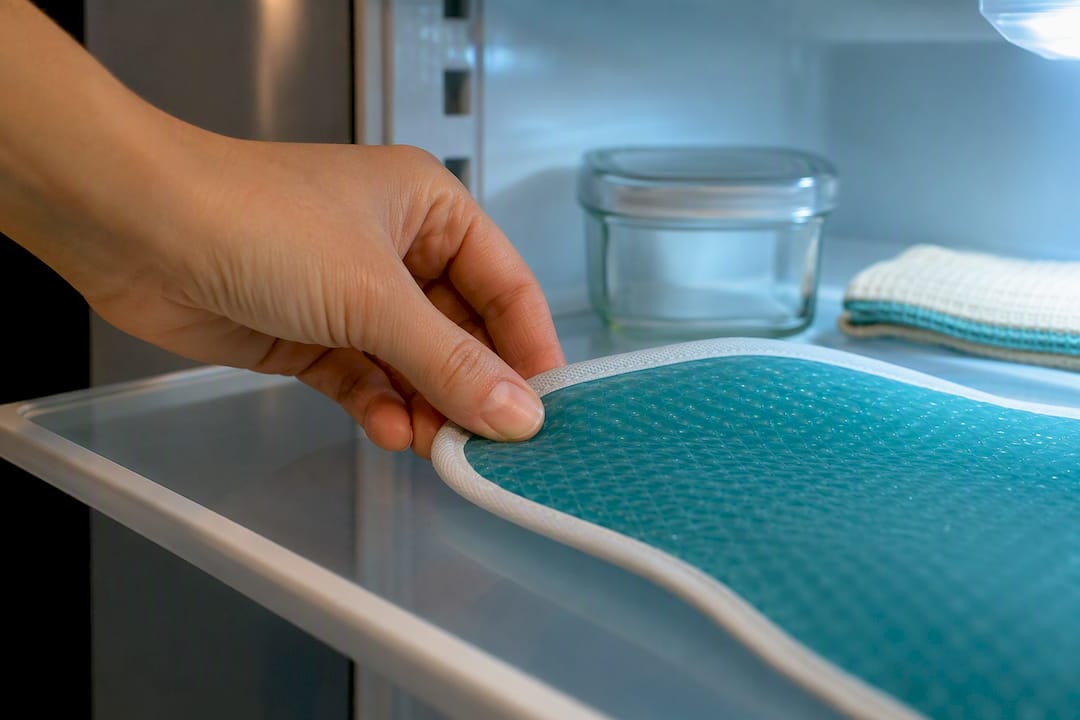
- Rotate two masks between the freezer and your head so you always have a properly cold one ready.
- Protect sensitive skin with a thin cloth barrier between the gel pack and your face to avoid direct, prolonged cold contact.
- Pair it with a dark, quiet room and your usual abortive medication rather than using the mask alone.
Stop and seek medical care if pain is the worst you’ve ever had, comes with fever, confusion, or vision loss, or doesn’t respond to your usual routine.
Pro Tip: Keep your mask in the fridge, not the freezer, if you have sensitive or thin skin. Fridge-temperature gel still triggers the TRPM8 cooling response without the frostbite risk that comes from skin sitting on a freezer-cold pack for 20 minutes straight.
What Does the Research Actually Say?
The strongest evidence points to short-term relief, not long-term prevention. A 2022 systematic review and meta-analysis pooling small studies found cold therapy produced meaningful pain reduction within around 30 minutes for many participants, a consistent enough signal that researchers considered it worth highlighting across multiple trials.
That said, the evidence base has real limits.
- Most trials involve small sample sizes, often fewer than 50 participants.
- Devices vary widely in design, coverage area, and temperature, making direct comparison difficult.
- Follow-up periods tend to be short, so long-term preventive effects remain unproven.
- Several studies combine masks with topical or oral treatments, which makes it hard to isolate the mask’s standalone effect.
A clinical review covering this body of work echoes the same conclusion: short-term benefit signals are real, but methodological heterogeneity keeps researchers from making confident claims about lasting efficacy. The American Migraine Foundation lists cold eye masks among the reasonable, low-risk options patients can try for acute symptom relief, which reflects where the science currently sits: worth trying, not a substitute for prescribed preventive care.
Getting the Most Out of Your Mask
A mask that isn’t cold enough or doesn’t fit right won’t do much for you, so a few adjustments usually solve most complaints.
- Check that the strap sits snug across the forehead without pinching, since a loose fit lets warm air in and cuts cooling time short.
- Make sure gel packs are distributed evenly before freezing so one section doesn’t stay warmer than the rest.
- Store gel masks in a labeled freezer pouch and avoid leaving them frozen solid for days, since over-freezing can stiffen the gel and reduce flexibility against your face.
- Wash fabric covers regularly, since sweat and oil buildup can shorten the life of the material.
If the mask isn’t helping after a few honest tries, experiment with a different coverage area, adjust your timing to apply it earlier in the attack, or try a higher-compression style. If migraines seem tied to neck stiffness, addressing that tension directly may matter as much as the mask itself.
An Honest Look at Where Masks Fit In
Migraine masks get treated online as either miracle cures or gimmicks, and both framings miss the point. The honest read of the evidence is narrower and, frankly, more useful: cold and compression interrupt an active attack for a meaningful window of time, and that window is worth having, especially for people who can’t or don’t want to reach for medication every time.
What gets underestimated is how often migraine pain has a tension component that a mask alone can’t touch. If your attacks consistently follow neck stiffness or a long day at a desk, treating the head symptom without addressing the neck is treating half the problem. Some neck pain relief devices use technology combining electrical muscle stimulation, heat, and massage, and users report improvement in neck discomfort and overall well-being. For readers whose migraines track with neck tension, that combination, a cold mask for the acute attack and a neck-focused device for the underlying trigger, makes more sense than betting on either one alone.
— Achraf
A Better Fit for Neck-Tension Migraine Triggers
If your migraines tend to follow a stiff neck, a long day hunched over a screen, or tension that builds through your shoulders, a cold mask only treats half of what’s happening. Some neck pain relief devices combine electrical muscle stimulation, heat, and massage in a device intended for daily use at home, work, or on the go.
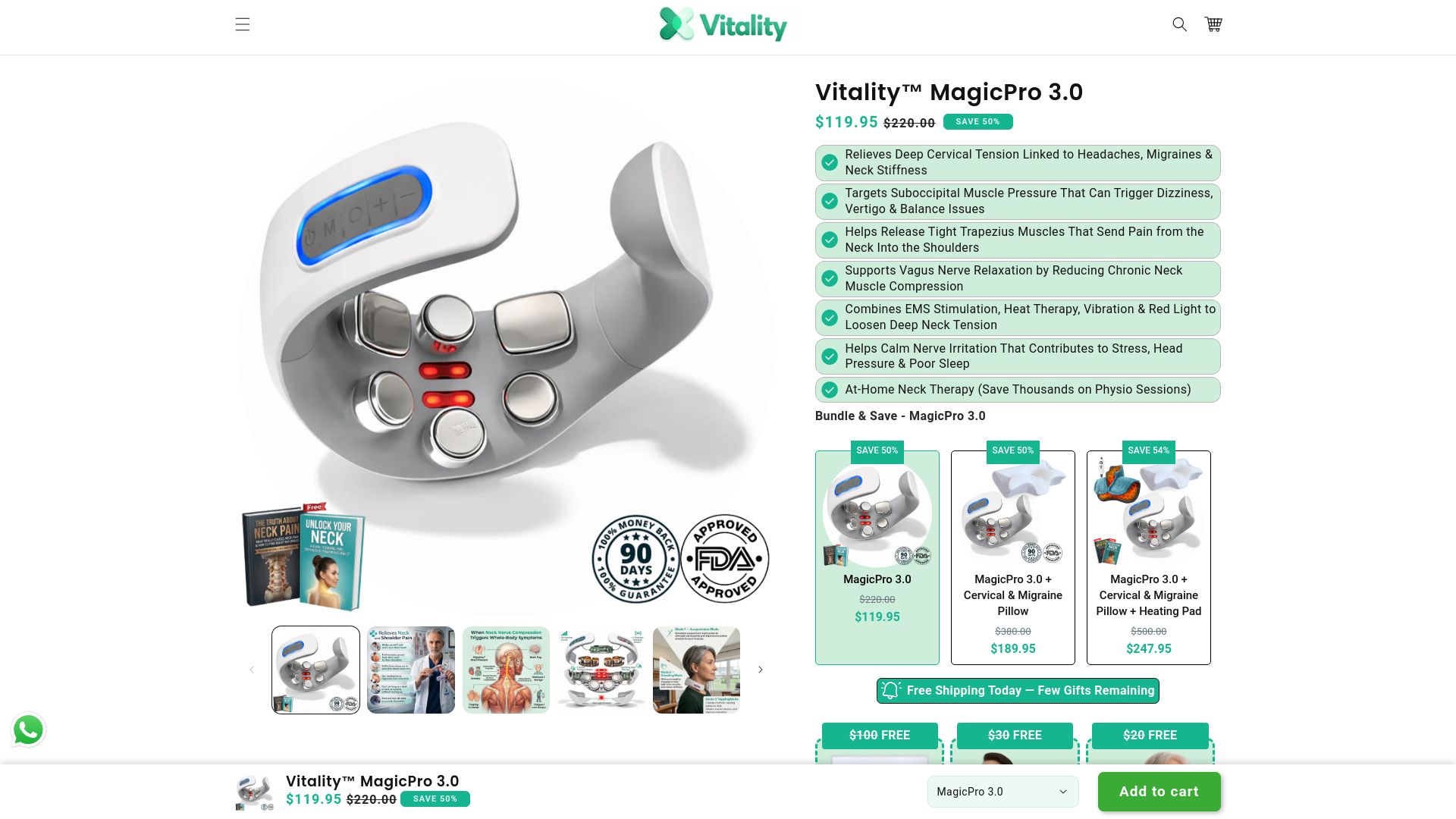
Unlike a mask you reapply attack by attack, MagicPro 2.0 works on the tension that may be setting migraines off in the first place. Users report improvement in neck discomfort and overall well-being, and pairing such devices with a cold mask routine may provide coverage for both acute symptoms and underlying triggers. If neck tension shows up before or during your migraines, it’s worth checking out the Vitality™ MagicPro 2.0 and seeing how it fits into your routine, and talk to your doctor if your migraines are frequent or severe.
Sources
- PubMed 35596276 — systematic review/meta-analysis (2022)
- PMC4182252 — anticephalgic photoprotective mask trial
- PMC9317682 — review on cold-sensing mechanisms and analgesia
- PMC8904749 — clinical review
- American Migraine Foundation — migraine signs & symptoms