


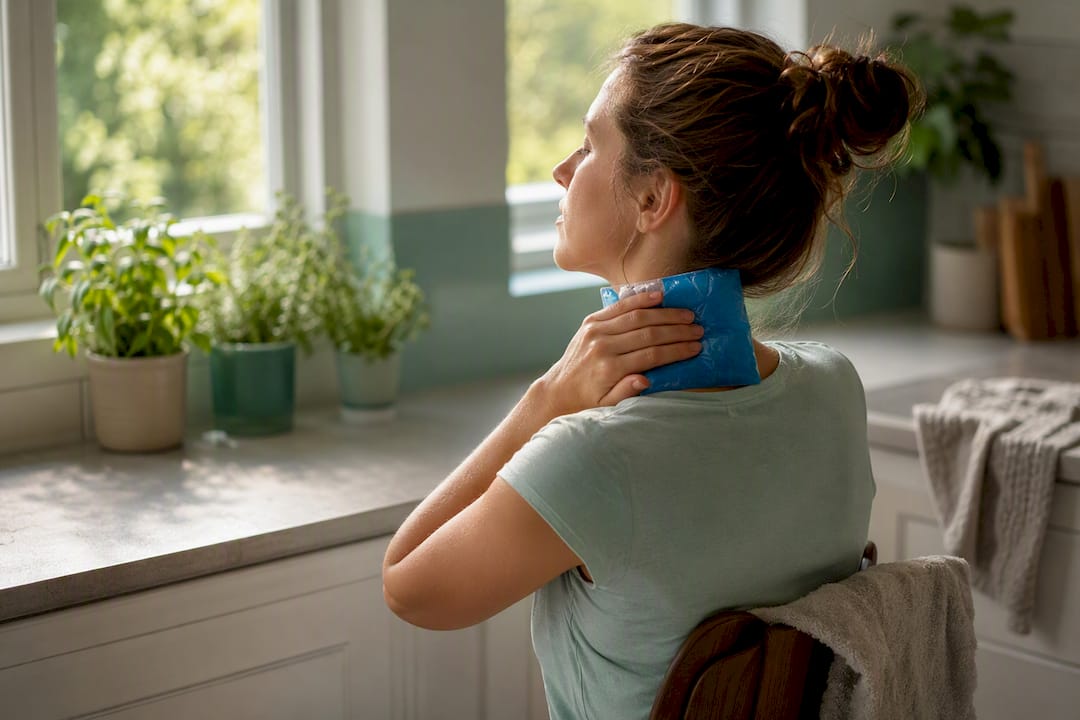
Cold therapy often gives quick, short-term relief from migraine pain, and it’s safe for most people to use alongside prescribed medication. If you feel a migraine building, place a cold pack against your forehead or temples, or wrap a cold band around your head and neck, for 10 to 25 minutes with a thin cloth between the cold source and your skin.
That single step is often the fastest, lowest-risk move you can make when pain starts to climb.
A few things to watch as you apply it:
- Stop immediately if you notice numbness, worsening pain, or dizziness. If you have cold intolerance or circulatory conditions, consult your doctor before trying this at home.
- Cold therapy supports your treatment plan. It doesn’t replace medication your provider has prescribed.
The rest of this guide walks through why cold works on migraine pain, what the research actually shows, and how to build it into your response plan the next time an attack starts.
Key Takeaways
Cold therapy applied to the forehead, temples, or neck for 10 to 25 minutes provides measurable short-term migraine pain relief through vasoconstriction, slowed nerve conduction, and reduced muscle tension.
| Point | Details |
|---|---|
| Apply cold early and correctly | Use a cold pack or headband for 10 to 25 minutes with a thin barrier as soon as symptoms start. |
| Evidence is real but limited | A 2006 pilot study showed significant pain reduction within 25 minutes, but larger trials are still needed. |
| Combine, don’t replace | Use cold therapy alongside prescribed medication, hydration, and a dark, quiet environment. |
| Watch for warning signs | Stop if you feel numbness, dizziness, or increased pain, and seek care for sudden severe or neurological symptoms. |
| Address tension between attacks | Neck-focused heat and EMS devices help manage the muscle tension that often triggers migraines. |
Table of Contents
- How Cold Therapy Reduces Migraine Pain
- What the Clinical Research Says About Cold Therapy for Migraine
- How to Use Ice for Migraines: A Step-by-Step Protocol
- Cold Therapy Options: Which Type Fits Your Migraine Pattern
- Is Cold Therapy Safe? Contraindications and Warning Signs
- Managing Migraine Triggers Between Attacks
- What Actually Matters When You’re Reaching for Ice
- Sources
How Cold Therapy Reduces Migraine Pain
Cold changes what’s happening in your blood vessels and nerves near the surface of your skin, and that shift is where the relief comes from.
When you apply cold to your forehead, temples, or neck, the superficial blood vessels in that area constrict. Migraine pain is closely tied to the swelling and dilation of blood vessels around the head, so narrowing them can ease the throbbing quality that makes migraine pain distinct from a tension headache. This is the same vasoconstriction mechanism clinical summaries point to when explaining why cooling helps.
Cold also slows nerve conduction. Sensory nerves near the skin transmit pain signals more slowly when they’re cooled, which produces a local numbing effect. That’s why an ice pack on a sprained ankle dulls the ache. The same principle applies to the trigeminal nerve pathways involved in migraine, where slowed signaling can blunt the intensity of pain messages reaching your brain.
There’s a third mechanism worth understanding: reduced metabolic demand. Cold lowers the rate at which cells in the treated area consume energy (measured as ATP usage), and some researchers believe this reduced metabolic activity may interrupt part of the migraine cascade, the chain reaction of inflammatory and vascular changes that drives an attack forward. This mechanism is less firmly established than vasoconstriction, but it’s a plausible piece of why cold sometimes works even when applied away from the exact pain site.
Cold therapy’s four working mechanisms:
- Vasoconstriction narrows superficial vessels, easing throbbing pain.
- Slowed nerve conduction produces local numbing and dulls pain signals.
- Reduced metabolic demand may interrupt part of the migraine process.
- Muscle relaxation in the neck and temples reduces tension that often compounds migraine pain.
Why timing matters: Applying cold early, as soon as you notice warning signs, appears to work better than waiting until pain peaks. One clinical insight notes that trial results show the most consistent pain reduction within 30 to 60 minutes of application, but the size of that effect depends heavily on device type, placement, and who’s using it.
There’s also a secondary benefit that gets overlooked: cold applied to the back of the neck or temporal muscles can relax tight muscle bands that often accompany migraine. For people whose attacks involve a stiff, tense neck alongside head pain, that muscular relief adds to the vascular and nerve-based effects above.
What the Clinical Research Says About Cold Therapy for Migraine
The strongest piece of evidence comes from a small but frequently cited 2006 pilot study, where researchers applied a frozen gel cap to the head for 25 minutes during a migraine attack. Pain scores on a standard visual analog scale (VAS) dropped from an average of 7.89 to 5.54 within that 25-minute window, a statistically significant reduction (P < 0.01). Responders continued to see lower pain scores at the one, two, and three hour marks afterward.
That’s a meaningful result, but it’s worth being honest about its size and scope. This was an open-label pilot study, meaning participants knew they were receiving the treatment and there was no control group for comparison. It’s a signal, not proof of a guaranteed effect for every migraine sufferer.
More recent reviews back up the general direction of that finding. Research summarized by Healthline shows that cold interventions, including ice packs, cold-gel headbands, and intraoral cooling devices, consistently produce short-term pain reductions across multiple trials. What none of these studies establish is a lasting preventive effect. Cold therapy calms an active attack; it doesn’t appear to reduce how often migraines occur down the road.
| Evidence type | What it shows | Key limitation |
|---|---|---|
| 2006 pilot study (gel cap) | VAS pain scores dropped significantly within 25 minutes | Small sample, open-label, no control group |
| Systematic reviews of cold devices | Consistent short-term pain relief across ice packs, headbands, and intraoral cooling | Long-term preventive benefit not established |
| Clinical mechanism reviews | Support vasoconstriction and nerve-conduction theories | Mechanistic evidence, not large-scale outcome trials |
The clinical takeaway is straightforward: cold therapy has real, measurable support as a short-term relief tool during an active attack. Mayo Clinic includes temperature therapy among its recommended acute self-care steps precisely because the evidence, while not extensive, is consistent and the risk profile is low. Where the science falls short is in longer, blinded, randomized trials that would let researchers say with confidence exactly how much benefit to expect, and for whom. Until those larger trials exist, cold therapy sits firmly in the category of “reasonable, low-risk adjunct,” not “proven preventive treatment.”
How to Use Ice for Migraines: A Step-by-Step Protocol
Knowing that cold therapy works is one thing. Using it correctly, at the right moment, in the right place, for the right amount of time, is what actually determines whether you get relief or just cold, wet discomfort. Here’s the protocol worth keeping on hand.
- Get your cold source ready before you need it. Keep a gel pack, cooling headband, or a bag of ice wrapped in a thin towel in your freezer at all times. Preparation is one of the biggest factors in whether cold therapy actually gets used early enough to help, since fumbling for supplies mid-attack often means you apply it too late.
- Choose your placement based on where the migraine hits hardest. Forehead or temple placement targets frontal throbbing pain most directly. The back of the neck works well if your migraines involve neck stiffness or start with tension at the base of your skull. Jaw and temporal muscle placement helps when clenching or muscle tightness is part of your pattern.
- Always use a barrier. Never apply ice directly to skin. A thin cloth, a pillowcase layer, or a gel pack’s built-in fabric cover protects you from cold burns while still allowing the therapeutic effect through.
- Time your session for 10 to 25 minutes. This matches both the American Migraine Foundation’s safety guidance and the duration used in the pilot study that showed measurable pain reduction. Some study protocols extended sessions to 60 minutes, but starting shorter and reassessing is the safer approach for home use.
- Space out repeat sessions. Wait at least 30 to 60 minutes between applications, or longer if your skin feels sensitive, cold, or numb from the previous round.
- Decide how cold therapy fits with your medication schedule. If you take acute migraine medication, Mayo Clinic’s guidance supports using cold therapy as a complement, not a replacement. Some people apply cold first while waiting for medication to take effect. Follow your provider’s dosing instructions and don’t delay medication solely because cold is helping in the moment.
- Layer in the rest of your self-care routine. Lie down in a dark, quiet room. Sip water steadily. Address nausea with an antiemetic if one’s part of your plan. Remove obvious sensory triggers like bright screens or strong smells while the cold pack does its work.
Pro Tip: Keep two cold packs in rotation in your freezer. Swapping to a fresh one halfway through a long attack keeps the temperature consistent, since a pack that’s been sitting against your skin for 20 minutes loses its edge faster than you’d expect.
Cold Therapy Options: Which Type Fits Your Migraine Pattern
Not all cold therapy tools work the same way, and the right pick depends on how often you get migraines, your budget, and how much precision you want over temperature and coverage.
- Gel caps and cooling headbands wrap the head evenly, which is exactly the design used in the pilot study that produced measurable VAS reductions. They’re reusable, hold a consistent cold range longer than a basic ice pack, and their snug fit means less shifting during a session, an advantage if you’re lying down in a dark room and don’t want to readjust anything.
- Reusable gel packs are the most affordable and widely available option, and they work well for spot treatment on the temples or neck. Their downside is uneven cooling. A gel pack that’s frozen solid on one edge and softer on the other can create cold spots that feel uncomfortable rather than soothing, so check the pack periodically during use.
- DIY ice packs (a bag of ice or frozen vegetables wrapped in a towel) cost nothing beyond what’s already in your freezer. They’re a fine emergency backup, but they carry the highest frostbite risk if the barrier layer is too thin, and the cold isn’t as evenly distributed as a purpose-built product.
- Intraoral cooling devices deliver more concentrated cooling and have shown up in some clinical research contexts, but they’re less common as an over-the-counter option and typically cost more. They’re worth knowing about, though most people will get sufficient relief from external application alone.
When you’re shopping for any cold therapy tool, prioritize a comfortable, adjustable fit; soft, skin-safe edges; a stable cold range that doesn’t spike uncomfortably cold at first contact; and clear instructions on how long to freeze it and how long to safely wear it.
Is Cold Therapy Safe? Contraindications and Warning Signs
Cold therapy carries a low risk profile, but “low risk” isn’t the same as “no risk.” A few rules keep it that way.
- Always use a cloth or fabric barrier between the cold source and your skin, and cap sessions at the recommended 10 to 25 minute window to avoid frostbite or cold burns.
- If you have diagnosed cold intolerance, Raynaud phenomenon, or another circulatory condition, get your provider’s approval before starting cold therapy on your own.
- Stop immediately if cold causes increased pain, persistent numbness that doesn’t resolve after removing the pack, or dizziness.
Some people simply can’t tolerate cold well. A subset of participants in early trials reported cold intolerance or vertigo and had to discontinue treatment, a reminder that this therapy, while generally safe, isn’t universal.
Certain symptoms go beyond what cold therapy or home self-care should ever be asked to handle. Seek immediate medical care for a first-time severe headache, a sudden “worst headache of your life” onset, or any new neurological symptoms like slurred speech, one-sided weakness, or vision loss. Those signs point to something that needs evaluation right away, not a cold pack.
Managing Migraine Triggers Between Attacks
Cold therapy handles the acute moment, but neck muscle tension is one of the most common triggers that sets a migraine in motion in the first place. If your neck feels tight, stiff, or knotted in the hours or days before an attack starts, that tension may be contributing to the frequency of your migraines, not just the discomfort around them.
This is where addressing the root tension between attacks matters. Devices that combine heat, electrical muscle stimulation, and massage, like My Vitality’s MagicPro line, are designed specifically to release the kind of chronic neck tension that often precedes a migraine. [brand_signal]
A practical way to think about it: use cold therapy the moment a migraine starts. Use tension-focused devices in the calmer stretches between attacks to keep that baseline neck tightness from building back up.
- Cold therapy: your acute-attack response tool.
- Neck-focused thermal and EMS devices: your between-attack maintenance tool.
- Both work toward the same goal from different angles: fewer migraine days overall.
What Actually Matters When You’re Reaching for Ice
Most advice on migraine self-care treats cold therapy as an afterthought, a folksy tip buried below a list of medications. That’s backward. The 2006 pilot study’s 25-minute pain reduction is a real, measured clinical result, not a wellness rumor, and it deserves to be treated as a first-line response, not a last resort.
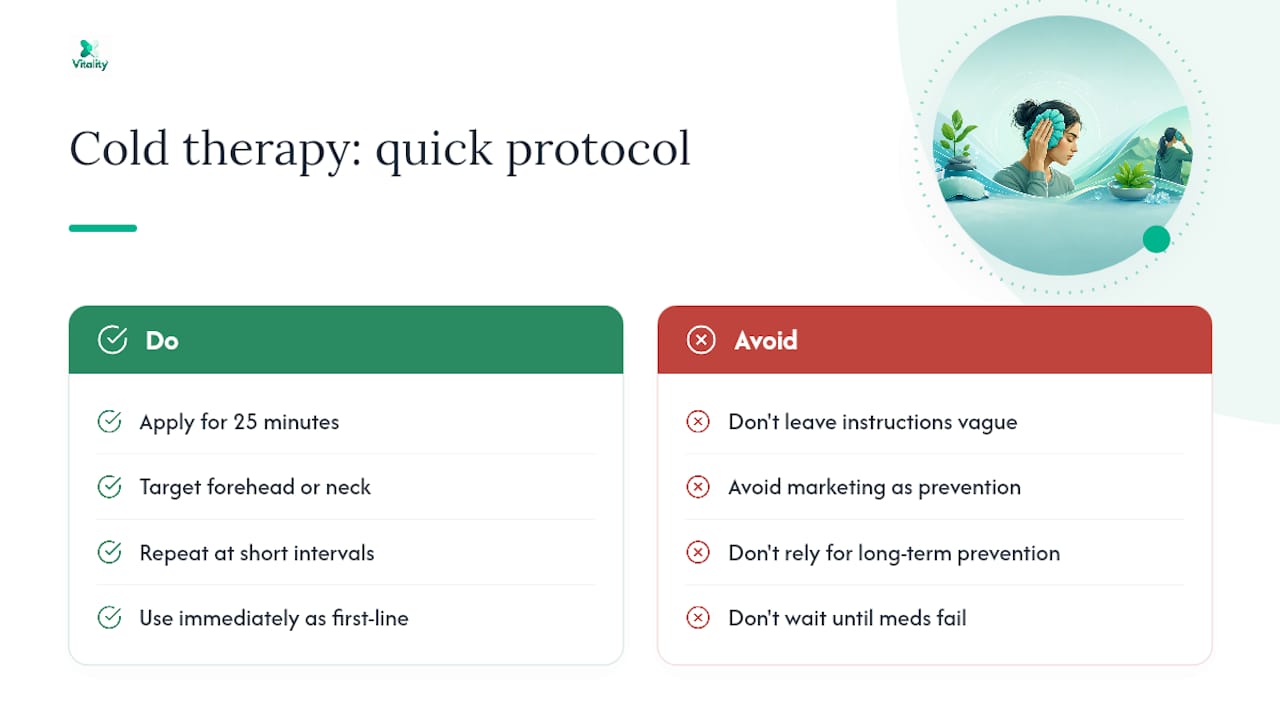
Where conventional advice falls short is specificity. Telling someone to “try an ice pack” without giving duration, placement, and repeat-interval guidance is nearly useless in the middle of an attack, when clear thinking is hardest to come by. The protocol matters as much as the tool.
My honest read: cold therapy earns its place because it’s fast, cheap, and has almost no downside for most people. It won’t prevent your next migraine, and nobody should market it that way. But as a bridge between “the pain just started” and “my medication kicks in,” it’s one of the most underused tools available, mostly because nobody explains it with enough precision to make it repeatable.
— Achraf
Sources
- Cold Therapy in Migraine Patients: Open-label, Non-controlled, Pilot Study
- Migraines: Simple steps to head off the pain - Mayo Clinic
- Migraine home remedies | American Migraine Foundation
- Cold therapy: Can it prevent or treat migraine? - Medical News Today
Consider ongoing neck tension between migraine episodes with the Vitality MagicPro 2.0, which pairs heat, electrical muscle stimulation, and massage to target the muscular triggers that often precede an attack. For those exploring other non-drug approaches to headache management, device-based neuromodulation therapies offer another angle worth understanding alongside cold therapy and trigger management.
This article is general information, not a substitute for advice from a qualified doctor. Consult a qualified healthcare professional about your own circumstances before acting on anything here.