


A 3–5 minute pre-commute warm-up, a properly adjusted seat and headrest, brief micro-movements during travel, and a 5–10 minute post-commute recovery routine are the four steps that protect your neck on long drives or transit rides. Neck care before and after a long commute doesn’t require a gym or extra equipment. It requires consistency and about ten minutes total.
Here’s the core plan at a glance:
- Before you leave: Gentle neck rolls, chin tucks, and shoulder circles to activate muscles and improve circulation.
- Seat setup (2 min): Adjust headrest, lumbar support, and mirrors before you pull out of the driveway.
- During the commute: Micro-movements and position changes every 20–60 minutes. Passengers only for seated exercises.
- After you arrive (5–10 min): Thoracic extension, neck stretches, and light isometrics to release static tension.
Safety note: Never perform neck exercises while driving. All movement exercises in this article are for passengers, transit riders, or stationary vehicles.
Pro Tip: Set a phone reminder labeled “neck reset” for two minutes before you leave home. That single trigger builds the pre-commute habit faster than willpower alone.
Key Takeaways
A combined approach of pre-commute warm-up, ergonomic seat setup, safe micro-movements, and a post-commute recovery routine gives commuters the most practical protection against neck pain and stiffness.
| Point | Details |
|---|---|
| Pre-commute warm-up | A 3–5 minute routine of chin tucks, cervical rotation, and thoracic extension activates stabilizers before driving. |
| Seat and headrest setup | Align the headrest to the center of your head, set lumbar support, and adjust mirrors after your seat is final. |
| Micro-movements during travel | Change position or perform a brief movement every 20–60 minutes; passengers only for neck exercises. |
| Post-commute recovery | A 5–7 minute routine including thoracic extension, neck stretches, and hip flexor work restores mobility after arrival. |
| My Vitality MagicPro 2.0 | Combines EMS, heat, and massage for 15-minute post-commute relief as a complement to the recovery routine. |
Table of Contents
- Why does a long commute strain your neck?
- How to warm up your neck before a long commute
- How should you set up your car seat to reduce neck strain?
- What can you do safely during a long commute?
- What’s the best post-commute recovery routine?
- Seated exercises safe for passengers and transit riders
- When should you see a doctor for neck pain after commuting?
- What treatments work, and how long do they take?
- A clinician-aligned 10-minute combined routine
- What actually makes these routines stick
- Fast relief at home after your commute
- Sources
Why does a long commute strain your neck?
Sustained posture is the primary culprit. When you hold your head in one position for 30 minutes or more, the deep cervical stabilizers fatigue while the superficial muscles compensate, creating uneven load across the cervical spine. Prolonged sitting stiffens the neck through a predictable chain of events that most commuters don’t recognize until the pain arrives.
Several overlapping mechanisms drive this:
- Forward head posture: For every inch the head shifts forward, the effective load on the cervical spine increases substantially. A head that sits two inches ahead of neutral can feel two to three times heavier to the muscles supporting it.
- Prolonged static contraction: Muscles held in the same position without movement accumulate metabolic waste products, reducing oxygen delivery and triggering the familiar ache and stiffness.
- Reduced thoracic mobility: A stiff mid-back forces the neck to compensate for rotation and extension, accelerating fatigue in the cervical region.
- Seat vibration: Vehicle vibration transmits mechanical stress directly into the spine, adding cumulative load on top of static posture strain.
- Stress-induced muscle guarding: Mental stress during a commute raises baseline muscle tension, particularly in the upper trapezius and suboccipital muscles, even when you’re not consciously aware of it.
Understanding these mechanisms explains why posture adjustments and movement breaks aren’t optional extras. They address the actual causes of neck pain after driving.
How to warm up your neck before a long commute
A short pre-commute warm-up activates the deep cervical stabilizers, improves blood flow to the muscles, and restores the range of motion that sleep and early-morning stiffness reduce. Physical therapists often recommend thoracic mobility and isometric neck strengthening as early, low-risk steps that can reduce symptoms and improve function, according to Spectrum Therapeutics. Five minutes before you get in the car is enough to make a real difference.
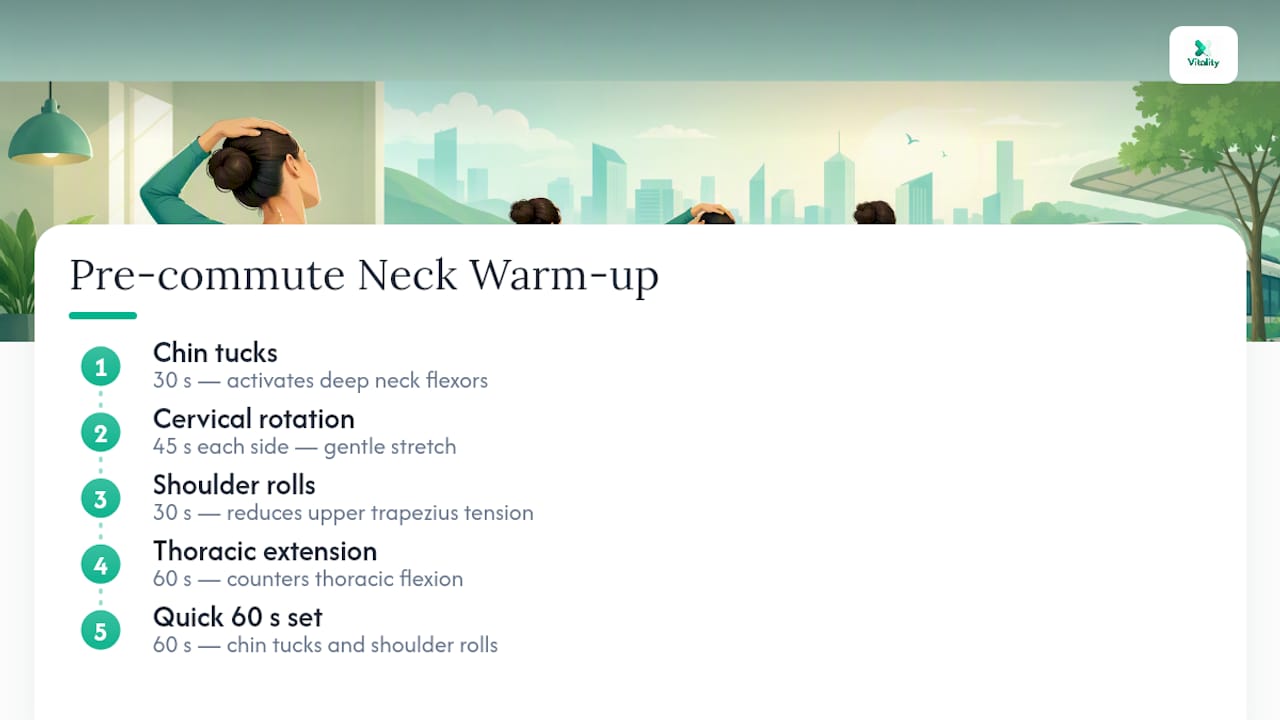
Start with chin tucks (30 seconds). Stand or sit tall, gently draw your chin straight back without tilting your head down, hold for two seconds, and release. This activates the deep neck flexors and counters the forward head position you’re about to hold for the next hour.
Move into cervical rotation (45 seconds each side). Slowly turn your head to the right until you feel a gentle stretch, hold for three seconds, return to center, then repeat left. Keep the movement smooth and controlled. If you feel any sharp pain or dizziness, stop immediately.
Follow with shoulder rolls (30 seconds). Roll both shoulders backward in slow, full circles. This opens the thoracic region and reduces the upper trapezius tension that builds during driving.
Finish with a thoracic extension over the back of a chair (60 seconds). Sit in a firm chair, clasp your hands behind your head, and gently extend your mid-back over the chair’s top edge. This is one of the most effective ways to counteract the thoracic flexion that driving locks in.
Pro Tip: On rushed mornings, a single 60-second set of chin tucks and shoulder rolls still activates the stabilizers. Something brief beats nothing at all.
How should you set up your car seat to reduce neck strain?
Your seat position determines how much work your neck does for the entire commute. A poorly adjusted seat forces your head forward and your shoulders up, loading the cervical spine before you’ve driven a mile. Practical car setup guidance consistently shows that seat height, lumbar support, headrest alignment, and mirror adjustment work together as a system, not independently.
Follow this sequence before every long drive:
- Seat height: Raise the seat so your hips are level with or slightly above your knees. Your feet should rest flat on the floor without stretching.
- Lumbar support: Adjust the lumbar support so it fills the natural curve of your lower back. If your car lacks built-in support, a small rolled towel or a lumbar cushion works well.
- Hips and knees: Aim for approximately 90 degrees at both joints. Avoid locking the knees fully straight.
- Headrest alignment: The center of the headrest should sit level with the center of the back of your head, not your neck. There should be no more than two inches between the back of your head and the headrest.
- Steering wheel: Position it so your arms have a slight bend at the elbow. Reaching for the wheel pulls the shoulders forward and loads the neck.
- Mirrors: Adjust your rearview mirror last, after your seat is set. This locks in your upright position as the baseline.
Pro Tip: Use your rearview mirror as a posture cue throughout the drive. If you can no longer see clearly in it, you’ve slumped. Sit back up, reset, and readjust only if the mirror is genuinely misaligned.
Varying your hand position on the wheel every 15–20 minutes gives different muscle groups brief recovery periods and reduces static load. Alternating between 9-and-3 and 8-and-4 positions is a simple way to build this habit.
For additional long commute neck support, generic accessories worth considering include cervical travel pillows (which maintain the natural cervical curve), lumbar cushions, and seat vibration-dampening pads. None of these replace a proper seat setup, but they can reduce fatigue on drives longer than 90 minutes.
What can you do safely during a long commute?
Short, regular micro-movements prevent the stiffness that builds when muscles stay locked in one position. For drivers, the options are limited to safe, minimal movements at stops. For passengers and transit riders, the range is much wider.
As a general rule, aim to change your position or perform a brief movement every 20–30 minutes on public transit and every 45–60 minutes when driving. The University of Washington Orthopedics notes that targeted commuting exercises can work the neck, trunk, and upper limbs safely in seated environments and can be adapted for buses, trains, or planes.
Safe strategies for all commuters:
- Shoulder blade squeezes: Pull both shoulder blades together gently and hold for five seconds. Safe at a red light.
- Seated posture reset: Sit tall, roll the shoulders back, and take three slow, deep breaths. This reduces stress-induced muscle guarding and resets your baseline tension.
- Neck isometrics (passengers only): Place your palm against your forehead and gently push your head forward while resisting with your neck. Hold five seconds. Repeat on each side.
- Chin tucks (passengers only): The same movement from the warm-up. Easy to do on a train or bus without drawing attention.
- Breath-based relaxation: Inhale for four counts, exhale for six. The longer exhale activates the parasympathetic nervous system and reduces the muscle guarding that stress triggers.
Never perform full range-of-motion neck exercises while driving. Even at a stop, keep any movement small and controlled.
What’s the best post-commute recovery routine?
A 5–7 minute recovery routine after you arrive addresses the stiffness, reduced circulation, and muscle fatigue that accumulate during a long commute. The goal is to restore mobility, not to push through pain. Post-commute stretching that includes hip and thoracic mobility alongside neck work produces better results than neck stretches alone, because the hip flexors and thoracic spine directly influence cervical posture.
- Standing thoracic extension (60 seconds): Clasp your hands behind your head, stand with feet shoulder-width apart, and gently extend your upper back. Hold each extension for three seconds.
- Cervical side bend stretch (45 seconds each side): Drop your right ear toward your right shoulder until you feel a gentle pull on the left side of your neck. Hold 20–30 seconds. Switch sides.
- Upper trapezius stretch (30 seconds each side): Reach your right arm behind your back, tilt your head left, and gently add pressure with your left hand on the top of your head. This targets the muscle most loaded during driving.
- Hip flexor lunge stretch (45 seconds each side): Step one foot forward into a lunge, lower the back knee, and press the hips forward. Tight hip flexors tilt the pelvis and increase lumbar and cervical load.
- Isometric neck strengthening (60 seconds total): Repeat the four-direction isometric holds from the warm-up. These rebuild the stabilizer endurance that the commute depleted.
- Diaphragmatic breathing (60 seconds): Lie on your back with knees bent, place one hand on your belly, and breathe slowly so the belly rises. This is the fastest way to reduce residual stress-related muscle tension.
Hydration note: Muscles recover faster when you’re well hydrated. Drink water before and after your commute.
Heat vs. ice: Apply a warm compress or heating pad to the neck for 10–15 minutes after a long commute to improve circulation and ease muscle tightness. Reserve ice for acute inflammation or sharp pain following an injury.

Pro Tip: Do the hip flexor lunge stretch immediately after getting out of the car, before you walk inside. Anchoring it to the exit moment means you’ll rarely skip it.
Seated exercises safe for passengers and transit riders
These exercises are for passengers, bus riders, and train commuters only. Do not perform them while driving.
Seated commuting exercises can work the neck, trunk, and upper limbs safely, and the University of Washington Orthopedics confirms they can be adapted for buses, trains, ferries, and planes. Here are seven moves that fit a standard seat:
- Chin tuck: Sit tall, draw your chin straight back, hold two seconds, release. Ten repetitions. Activates deep neck flexors and counters forward head drift.
- Cervical rotation: Slowly turn your head right, hold three seconds, return to center, then left. Five repetitions each side. Stop if you feel dizziness or sharp pain.
- Shoulder blade squeeze: Pull both shoulder blades toward each other, hold five seconds, release. Ten repetitions. Reduces upper trapezius overload.
- Seated thoracic rotation: Sit upright, cross your arms over your chest, and rotate your upper body right and left slowly. Five repetitions each direction. Improves thoracic mobility and reduces cervical compensation.
- Neck isometric side resistance: Place your right palm against the right side of your head and gently push your head into your hand while resisting. Hold five seconds. Repeat left. Three sets each side. Builds lateral stabilizer endurance.
- Scapular elevation and depression: Shrug both shoulders up toward your ears, hold two seconds, then press them down firmly. Ten repetitions. Restores normal scapular rhythm and reduces neck-shoulder tension.
- Diaphragmatic breathing with posture reset: Sit tall, inhale slowly for four counts expanding the belly, exhale for six counts. Five repetitions. Reduces stress-induced guarding and resets posture without any visible movement.
For stronger users, add a gentle resistance band pull-apart (if space allows) or increase isometric hold times to 8–10 seconds. Avoid any exercise that causes dizziness, radiating arm pain, or instability on a moving vehicle.
When should you see a doctor for neck pain after commuting?
Most commuter neck pain responds well to the self-care strategies above. However, certain symptoms require prompt professional evaluation, and a few require emergency care.
Go to the ER or call 911 immediately if you experience:
- Sudden severe neck pain following an accident or fall
- Neck pain with progressive weakness or paralysis in the arms or legs
- Loss of bladder or bowel control
- Neck pain with severe headache, fever, and stiffness (possible meningitis)
Book an urgent clinic or same-day appointment if:
- Radiating pain, numbness, or tingling runs down one or both arms
- Weakness in the hands or arms develops or worsens over days
- Pain is severe and unrelenting despite 48–72 hours of rest and basic care
Schedule a physical therapy or primary care visit within 1–2 weeks if:
- Neck pain persists beyond 7–10 days of self-care without improvement
- Stiffness significantly limits your range of motion
- Pain recurs consistently after every commute
Conservative, non-surgical interventions including physical therapy, mobility work, and targeted strengthening are effective early management for many cervical complaints. Starting PT early typically produces better outcomes than waiting.
What treatments work, and how long do they take?
Most commuter-related neck pain responds to self-care and physical therapy within a few weeks. Clinical rehab programs that combine targeted strengthening, thoracic mobility, and commute-specific positioning adjustments can produce meaningful improvement in 4–6 weeks for many patients.
Cost estimates are approximate and vary significantly by location, provider, and insurance coverage.
Exercise-based and multimodal conservative care is an evidence-aligned first-line approach for most musculoskeletal neck complaints. Injections and surgical options are generally reserved for cases where conservative care has not produced adequate improvement after several months.
Portable home devices that combine electrical muscle stimulation (EMS), heat, and massage fit naturally into a daily commuter recovery plan. They’re most useful as a complement to exercise and posture work, not a replacement.
A clinician-aligned 10-minute combined routine
This routine suits most commuters without red-flag symptoms. It combines the pre- and post-commute steps into one reference you can follow exactly. Physical therapists recommend thoracic mobility and isometric strengthening as low-risk, high-return starting points for cervical rehab.
- Self-massage or foam rolling (2 minutes): Use your fingertips or a small massage ball to apply gentle pressure to the base of the skull, upper trapezius, and the muscles along the sides of the cervical spine. This increases local circulation and reduces resting muscle tension before movement begins.
- Mobility work (3 minutes): Chin tucks (30 sec), cervical rotation (45 sec each side), thoracic extension over a chair (60 sec). Move slowly and stop at the first sign of sharp pain or dizziness.
- Isometric strengthening (3 minutes): Four-direction isometric holds (forward, back, left, right) for five seconds each, three rounds. These build the deep stabilizer endurance that protects the cervical spine during sustained posture.
- Breathing and relaxation (2 minutes): Diaphragmatic breathing, four counts in and six counts out, for ten cycles. This closes the routine by lowering cortisol-driven muscle guarding and signals the nervous system that the physical stress of the commute is over.
For commuters using a portable EMS or heat device, the best integration point is after the self-massage block and before mobility work. Ten to fifteen minutes of heat or EMS at that stage warms the tissue more thoroughly than manual massage alone, making the subsequent mobility work more comfortable. Always follow device instructions and consult a clinician if you have any underlying cervical condition.
Pro Tip: Split the routine in half if ten minutes feels like too much. Do the massage and mobility before your commute, and the isometrics and breathing after. The sequence is flexible; the consistency is what matters.
What actually makes these routines stick
The routines above work on paper. Getting them to work in real life comes down to one thing: anchoring them to something you already do. Attach the pre-commute warm-up to your morning coffee or the moment you pick up your keys. Attach the post-commute recovery to the act of parking or stepping off the train. Habit research consistently shows that pairing a new behavior with an existing trigger reduces the cognitive effort required to start.
Start smaller than you think you need to. Two chin tucks and a shoulder roll take 45 seconds. That’s a real warm-up for a rushed morning, and it’s far better than skipping the routine entirely because you don’t have five minutes. Once the trigger is solid, adding time is easy.
Cold-weather commuters face an extra challenge: cold muscles are stiffer and more injury-prone. In winter, do your warm-up indoors before stepping outside, and keep a small heat pack in your bag for post-commute recovery. The travel posture principles that apply in summer apply year-round; the cold just raises the stakes slightly.
The biggest mistake most commuters make is treating neck care as something to do only when pain appears. The routines above are most effective as prevention. By the time your neck hurts after a long drive, you’ve already accumulated hours of static load. Ten minutes a day before that happens is a much easier problem to solve.
Fast relief at home after your commute
After a long drive, your neck muscles have been working under static load for hours. Stretching helps, but sometimes the tissue needs more direct support to release tension and restore circulation.

The Vitality™ MagicPro 2.0 combines electrical muscle stimulation, heat, and massage in one compact device designed for exactly this scenario. Fifteen minutes of use after your post-commute recovery routine delivers targeted relief to the cervical muscles that stretching alone doesn’t fully reach. It’s portable enough to use at your desk, on the couch, or while winding down before bed.
The MagicPro 2.0 is a useful adjunct to the routines in this article, not a substitute for professional medical care. If you have red-flag symptoms, see a clinician first. For everyday commuter stiffness and tension, check out the MagicPro 2.0 and see whether it fits your recovery plan.
Sources
- Pmc
- Commuting exercises — University of Washington Orthopedics
- How Cervical Spine Rehab Can Make Your Commute Less Painful | Spectrum Therapeutics
- Commute Recovery: Stretching Moves That Prevent Tight Hips and Neck Pain - Commute Volt