


Yes, you can train the sternocleidomastoid (SCM) directly. Start with chin tucks, lying neck curls, and isometric head holds — light load, controlled tempo, no jerky movements. If you feel dizziness or sharp radiating pain, stop immediately.
The SCM is one of the most visible muscles in the neck, yet most people never train it with any intention. Compound lifts like deadlifts and shrugs don’t adequately stimulate the SCM’s fibers, so direct neck work is usually necessary for measurable strength or definition. For a quick start, aim for 2 sets of 10–12 chin tucks and 2 sets of 10 lying neck curls, three times per week. Keep the tempo slow and deliberate — especially on the way down.
Key Takeaways
Direct SCM training requires controlled, low-load exercises performed 2–3 times per week, with isometrics as the foundation before any loaded movement is introduced.
| Point | Details |
|---|---|
| Start with isometrics and chin tucks | Build baseline neck control before adding any external load or resistance. |
| Use a 3-second eccentric | A slow lowering phase on lying neck curls maximizes time under tension safely. |
| Train 2–3 times per week | Allow at least one rest day between sessions; the cervical muscles need recovery to adapt. |
| Stop for red flags | Dizziness, radiating arm pain, or sharp neck pain require immediate rest and clinical evaluation. |
| My Vitality MagicPro devices | Use as a post-training recovery adjunct to reduce tension and support circulation between sessions. |
Table of Contents
- What does a quick sternocleidomastoid workout look like?
- Step-by-step form cues for each SCM exercise
- How to warm up safely before training your neck
- How to program SCM work over 4 weeks
- How to safely release and stretch a tight SCM
- When should you see a clinician instead of training on your own?
- What does the SCM actually do, and why do these exercises target it?
- Common mistakes that undermine your SCM training
- A practitioner’s perspective on coaching SCM training safely
- At-home recovery tools that support your SCM training
- Primary sources and further reading
- Sources
What does a quick sternocleidomastoid workout look like?
This 3–5 minute routine gives you a solid foundation. Perform it 2–3 times per week, with at least one rest day between sessions.
- Chin tuck: 2–3 sets × 10–12 reps. Sit or stand tall, gently draw your chin straight back (not down), hold 2 seconds, release slowly.
- Lying neck curl: 2–3 sets × 12–15 reps. Lie on your back, tuck your chin, lift your head 1–2 inches off the floor, lower with a 3-second count. Beginner programming commonly uses 3 sets of 15 reps as an accessible starting point.
- Isometric head hold (four-way): 1–2 sets × 10–15 seconds per direction. Press your palm against your forehead, temple, or the back of your head; resist without moving. Work all four directions.
- Seated neck flexion (bodyweight): 2 sets × 10 reps. Sit upright, slowly lower your chin toward your chest, pause, return with control.
- Resisted rotation (band or hand): 2 sets × 8–10 reps per side. Apply light resistance at your temple; rotate your head against it slowly.
Beginner regression: Drop to 1 set per exercise, bodyweight only, and reduce reps by half until you feel comfortable. Progression: Add a light plate (2.5–5 lbs) to the lying neck curl or increase band tension once you can complete all sets with zero discomfort.
Stop if you feel dizziness, a sharp shooting sensation, or any pain that radiates into your arm or shoulder.
Step-by-step form cues for each SCM exercise
Chin tuck
Sit against a wall with your back flat. Gently retract your chin straight back — imagine making a “double chin.” You should feel a mild stretch at the base of your skull and light activation along the front of your neck. Hold 2 seconds, release over 2 seconds. Physical therapists recommend chin tucks as a foundational neck-control exercise before progressing to any loaded movement.
What you should feel: Gentle tension along the front of the neck and a mild pull at the suboccipital region. No pain, no dizziness.
Lying neck curl
Lie flat on your back, knees bent. Tuck your chin first, then lift your head 1–2 inches off the surface. The chin tuck cue is critical here — without it, you recruit the wrong muscles and lose SCM activation. Lower your head with a deliberate 3-second eccentric. A slow lowering phase is one of the most effective ways to build time under tension in this muscle without adding load.

Regression: Keep your head barely off the surface, reduce range of motion. Progression: Hold a light plate (2.5 lbs) against your forehead once 3 × 15 feels easy.
Isometric head holds (four-way)
Sit upright in a chair. Place your palm against your forehead and press your head into your hand without letting your head move. Hold 10–20 seconds. Repeat with your hand at the back of your head, then each temple. These four-way isometrics build baseline neck control and correct side-to-side imbalances before you add any loaded neck curls.

What you should feel: A firm, localized muscle contraction. Not a stretch, not pain.
Resisted rotation
Stand or sit. Loop a light resistance band around a fixed point at head height, or simply use your hand at your temple. Slowly rotate your head against the resistance, pause at end range, return with control. This directly targets the SCM’s rotational function — the muscle on the side you’re rotating away from does most of the work.
Seated neck flexion
Sit tall with your shoulders relaxed. Slowly lower your chin toward your chest over 3 seconds, pause briefly, then return. Keep your shoulders from rounding forward. This movement trains bilateral SCM contraction and is a good warm-up before loaded curls.
Demo tip: Short video demonstrations for each of these exercises are available through the UW Medicine exercise library, which includes clinician-safe cues for neck and upper-limb movements.
How to warm up safely before training your neck
Skipping a warm-up before neck work is one of the fastest ways to end a session early. The neck’s structural complexity means even small amounts of tension or stiffness can amplify discomfort under load.
A simple 3-minute warm-up:
- Light aerobic activity (1–2 minutes): Walk briskly, march in place, or do arm circles to raise your heart rate slightly and increase blood flow to the cervical region.
- Slow neck rotations (10 reps each side): Turn your head gently from side to side, staying within a pain-free range. No forcing, no bouncing.
- Ear-to-shoulder tilts (5 reps each side): Let gravity do the work. Keep your shoulders down and still.
- Chin tucks (10 reps): These double as both a warm-up and a motor control primer.
Core safety rules during SCM training:
- Use light loads only. The neck is not built for heavy progressive overload the way larger muscle groups are.
- Keep every rep slow and controlled. No ballistic movements, no momentum.
- Breathe steadily throughout each set. Holding your breath increases intra-cervical pressure.
- Never train through dizziness, visual changes, or pain that radiates into your arm.
Red flags — stop and seek clinical evaluation:
- Dizziness or vertigo during or after head movement
- Radiating pain, numbness, or tingling into the arm, shoulder, or hand
- Sudden severe neck pain, especially after any recent trauma
- History of cervical fracture, surgery, or instability
Pro Tip: Perform all SCM exercises seated rather than standing, especially when you’re new to neck training. Seated positions reduce the risk of a fall if dizziness occurs and make it easier to monitor your form.
How to program SCM work over 4 weeks
The right frequency for SCM training is 2–3 sessions per week. That gives the muscle enough stimulus to adapt while allowing adequate recovery — the cervical muscles respond well to moderate volume and high control, not high load.
Programming principles:
- Start with bodyweight and isometrics for the first 1–2 weeks.
- Progress by adding reps before adding resistance.
- Introduce light external load (a 2.5 lb plate or a light band) only after you can complete all sets with zero discomfort and full control.
- Prioritize time under tension over total weight moved.
As strength training literature confirms, compound lifts leave the SCM under-stimulated, so direct isolation work is the only reliable path to measurable neck development.
4-week sample plan:
| Week | Sessions/Week | Exercises | Sets × Reps | Focus |
|---|---|---|---|---|
| 1 | 2 | Chin tuck, isometric holds, seated neck flexion | 2 × 10–12 | Motor control, baseline activation |
| 2 | 2–3 | Chin tuck, lying neck curl, isometric holds | 2–3 × 12–15 | Volume build, bodyweight only |
| 3 | 3 | Lying neck curl, resisted rotation, isometric holds | 3 × 12–15 | Add light band or 2.5 lb plate |
| 4 | 3 | Full circuit (all 5 exercises) | 3 × 15 | Consolidate strength, assess progress |
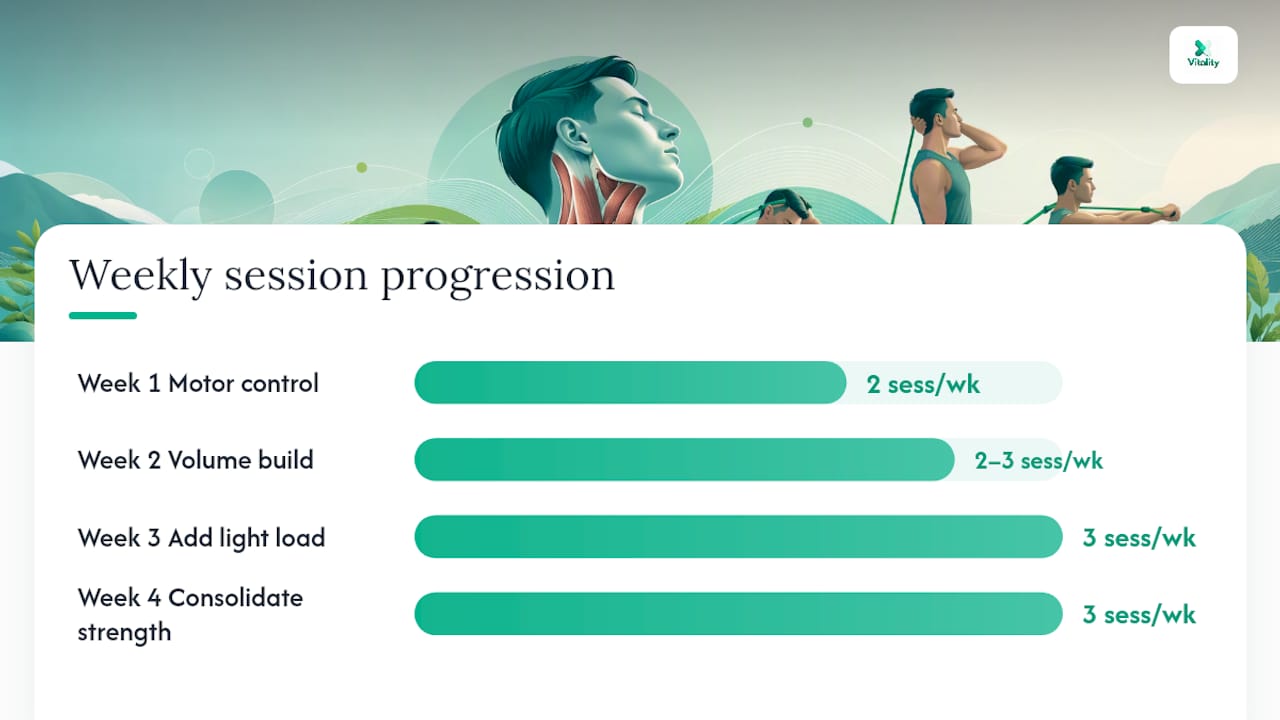
A structured approach like this, combining 2–3 training days with at least one active recovery day, reflects the programming structure used in beginner neck conditioning plans.
How to safely release and stretch a tight SCM
A tight SCM often contributes to neck stiffness, headaches, and restricted rotation. Releasing it gently before or after training helps restore comfortable range of motion without over-stressing the tissue.
Self-release technique:
- Sit upright in a chair with your feet flat on the floor.
- Tilt your head slightly to the right (ear toward shoulder) to slacken the right SCM.
- Using two or three fingertips, apply gentle, sustained pressure along the muscle belly — from just below the ear down toward the collarbone.
- Hold each point for 20–30 seconds. Move slowly down the muscle. Never compress the front of the throat directly.
SCM stretch (ear-to-shoulder with chin rotation):
- Sit or stand tall. Drop your right ear toward your right shoulder.
- Slowly rotate your chin upward and slightly to the right to increase the stretch along the left SCM.
- Hold 15–30 seconds. Practitioners recommend 2–4 sets per side to release tightness without over-straining the tissue.
- Return to neutral slowly. Repeat on the other side.
Precautions:
- Stop immediately if you feel lightheadedness, visual changes, or any sensation of pressure in your head.
- Avoid forceful compression of the anterior (front) neck — the carotid artery and jugular vein run alongside the SCM.
- Never pull your head forcefully into a stretch. Gravity and a relaxed posture are enough.
Follow-up mobility: After stretching, perform 5–10 slow, full-range neck rotations and 5 ear-to-shoulder tilts per side to restore balanced movement.
When should you see a clinician instead of training on your own?
Muscle tightness and mild soreness after neck training are normal. These signs are not.
Seek professional assessment if you experience:
- Dizziness or vertigo that occurs with head movement, not just during exercise
- Numbness, tingling, or weakness in your arm, hand, or fingers
- Persistent severe neck pain that does not improve with rest within 48–72 hours
- Neck pain following a fall, collision, or any recent trauma
- Headaches that begin at the base of the skull and radiate forward
- Any history of cervical instability, fracture, or prior neck surgery
A physical therapist will typically assess your cervical range of motion, muscle strength, palpation tenderness, and neural tension (through tests like the upper limb tension test). If neurological signs are present, imaging such as an MRI or X-ray may be ordered before any exercise program begins.
The takeaway: if your symptoms go beyond localized muscle tension and soreness, get evaluated first. A few sessions with a physical therapist can give you a safe, personalized baseline that no general article can replicate.
What does the SCM actually do, and why do these exercises target it?
The sternocleidomastoid is a two-headed muscle. Its sternal head originates at the top of the sternum; its clavicular head originates at the medial clavicle. Both heads insert at the mastoid process, just behind the ear.
Its primary actions are straightforward: unilateral contraction tilts the head toward the same side and rotates it to the opposite side. When both SCMs contract together, they flex the cervical spine — pulling the chin toward the chest. The muscle also assists with breathing during deep inhalation by elevating the sternum.
The exercises in this article target those exact functions. Lying neck curls and seated neck flexion load bilateral SCM contraction. Resisted rotation targets the unilateral rotational function. Isometric holds build the muscle’s capacity to stabilize the head under load — which is what it does most of the time in daily life.
Common mistakes that undermine your SCM training
Most setbacks in neck training come from a handful of repeatable errors. Knowing them in advance saves you weeks of frustration.
The five most common pitfalls:
- Going too heavy too soon. The SCM is a small, structurally sensitive muscle. Coaches consistently recommend light weights and controlled reps to prioritize functional strength and avoid injury. A 2.5 lb plate is often enough for months of productive training.
- Using momentum. Swinging or jerking the head through reps removes tension from the SCM and transfers stress to the cervical joints. Every rep should be deliberate.
- Neglecting lateral and rotational work. Most people only train neck flexion. The SCM also rotates and laterally flexes the head — skipping those planes leaves half the muscle undertrained.
- Ignoring dizziness. Mild lightheadedness during neck training is a signal, not something to push through. Stop, rest, and reassess your position and breathing before continuing.
- Training through sharp pain. Dull muscle fatigue is normal. Sharp, shooting, or radiating pain is not. Stop the set.
Corrective cues:
- If you’re using momentum: slow the eccentric to a full 3-second count on every rep.
- If you’re neglecting rotation: add resisted rotation and isometric side holds to every session.
- If dizziness keeps occurring: switch to seated positions and reduce range of motion until symptoms resolve.
Training philosophy: prioritize high-quality reps over total volume. Ten perfect reps build more functional strength than 30 sloppy ones, and they carry far less injury risk.
Pro Tip: Sequence SCM work at the end of your upper-body session, not the beginning. Fatiguing the neck before pressing or pulling movements reduces cervical stability when you need it most.
A practitioner’s perspective on coaching SCM training safely
The most common mistake people make when they start training the neck is treating it like any other muscle group. They add load too quickly, skip the isometric phase, and wonder why they feel worse after two weeks than before they started.
A sound approach starts with assessment. Before any loaded movement, you need to know your baseline: Can you perform a chin tuck with full control? Can you hold a 15-second isometric in all four directions without pain or dizziness? If the answer to either is no, that is your starting point — not the lying neck curl.
The first 2–3 sessions should be entirely bodyweight and isometric. No plates, no bands. The goal is motor control: teaching the nervous system to activate the SCM cleanly without recruiting the scalenes or upper traps to compensate. Once that pattern is established, adding light resistance produces results quickly.
Daily homework matters too. Chin tucks performed 2–3 times throughout the day — at a desk, in a car, between meetings — reinforce the motor pattern and counteract the forward head posture that tightens the SCM in the first place. Pairing SCM work with upper-back strengthening (rows, face pulls, band pull-aparts) creates a balanced cervical environment where the neck can actually get stronger without compensating.
When the neck relaxes, the brain often follows. That’s not just a metaphor — reduced cervical tension genuinely improves circulation and nerve signal quality to the head. Training the SCM well is one of the most underappreciated things you can do for your overall neck health.
At-home recovery tools that support your SCM training
Exercise builds the SCM. Recovery is what lets it adapt. For readers who want a practical at-home adjunct to their neck training, devices that combine heat, electrical muscle stimulation (EMS), and massage can ease post-workout tension and support circulation between sessions.

My Vitality’s MagicPro devices are doctor-recommended and designed specifically for neck recovery. The MagicPro 2.0 combines EMS, heat, and massage in a single portable device that delivers relief in about 15 minutes. It’s not a substitute for the exercises in this article or for clinical care if you have red-flag symptoms. Used after a training session or on recovery days, it can reduce muscle tension, improve local circulation, and help you stay consistent with your program.
Key benefits when used alongside SCM training:
- Reduces post-exercise muscle tightness without adding mechanical stress
- Heat application supports tissue pliability before stretching
- EMS stimulation helps maintain muscle activation awareness on rest days
If you’re dealing with persistent neck discomfort alongside your training, the full range of Vitality devices offers options for different needs and recovery goals. Talk to a clinician first if your symptoms are severe.
Primary sources and further reading
These references back the guidance in this article and offer additional demonstrations and clinical context.
- Sternocleidomastoid Pain — Verywell Health: Practical guidance on SCM stretching, hold times, and self-release techniques from a clinician-reviewed health publication.
- Neck Muscles Exercises and Workout — StrengthLog: Exercise library with programming examples for neck curls and beginner sets/reps guidance.
- Neck Strength Training: Are Deadlifts and Shrugs Enough? — Stronger by Science: Evidence-based analysis of why direct neck work is necessary and how the SCM functions anatomically.
- 6 Best Neck Exercises — Hinge Health: Physical therapist-recommended exercises including chin tucks and isometric holds, with clear form cues.
- How Training Your Neck Can Help You Look Jacked — Men’s Journal: Coaching perspective on controlled loading, eccentric tempo, and functional SCM development.
- Strengthening Exercises: Neck and Upper Limbs — UW Medicine: Hospital-based exercise library with clinician-safe cues for neck and upper-limb movements; useful for video demonstration reference.
Sources
- How to Train Your Neck Muscles: Exercises & Workout – StrengthLog
- How Training Your Neck Can Help You Look Jacked - Men’s Journal
- Neck Strength Training: Are Deadlifts and Shrugs Enough? • Stronger by Science
- 6 Best Neck Exercises to Strengthen Your Neck Muscles