


The most practical types of travel-friendly therapy tools fit into six compact categories: graded loop bands, a mini percussion device or massage ball, a foldable travel mat, a pocket TENS/EMS unit, a portable red-light option, and a small speech-manipulative bundle. Together, these address the four most common travel therapy problems: immobilization stiffness, circadian disruption, localized pain, and speech practice gaps.
A Cochrane review confirmed that graduated compression stockings reduce asymptomatic deep vein thrombosis incidence on flights longer than four hours. Pairing compression with movement breaks and the portable therapy tools below gives you a complete in-transit recovery strategy. TheraBand is the widely recognized industry standard for color-coded graded resistance bands, and My Vitality’s MagicPro 2.0 and MagicPro 3.0 serve as compact multi-modal electronic options that combine EMS, heat, and massage in a single travel-ready device.
Table of Contents
- What are the best resistance tools for travel?
- How do you relieve stiffness with compact massage tools?
- Which stretching aids help you maintain range of motion on the road?
- Why does a travel mat make your therapy safer and more effective?
- What compact electronic therapy devices are worth packing?
- Is portable red-light therapy worth packing for travel?
- How do sleep and sensory tools support recovery on the road?
- What speech therapy tools travel well in a carry-on?
- How do you choose and pack the right therapy toolkit?
- How do you use therapy tools safely while traveling?
- Key Takeaways
- The case for simplicity over gadgetry
- My Vitality MagicPro: the compact multi-modal device built for travel
- Useful sources and further reading
What are the best resistance tools for travel?
Graded resistance loop bands outperform single heavy weights for travelers because they cover progressive loading across multiple muscle groups while fitting in a sandwich bag. Color-coded tension levels let you increase difficulty without adding weight to your luggage.
Types worth packing
- Flat loop bands (mini loops): best for lower-body work like glute bridges, clamshells, and lateral walks. They weigh almost nothing and pack flat.
- Figure-8 mini loops: useful for ankle and wrist resistance, particularly for post-surgical rehab progressions.
- Tube bands with handles: better for upper-body pulling and pressing patterns; slightly bulkier but still carry-on friendly.
- Over-the-door anchors: a small foam-padded clip that turns any hotel door into a cable-machine anchor point for seated rows and shoulder external rotation.
When selecting bands, check for latex-free options if you have sensitivities. Aim for a set that spans at least three tension levels. A full set of flat loop bands is very lightweight and affordable. Tube bands with handles and a door anchor add a modest weight and cost moderate amounts.
Quick hotel-room progressions
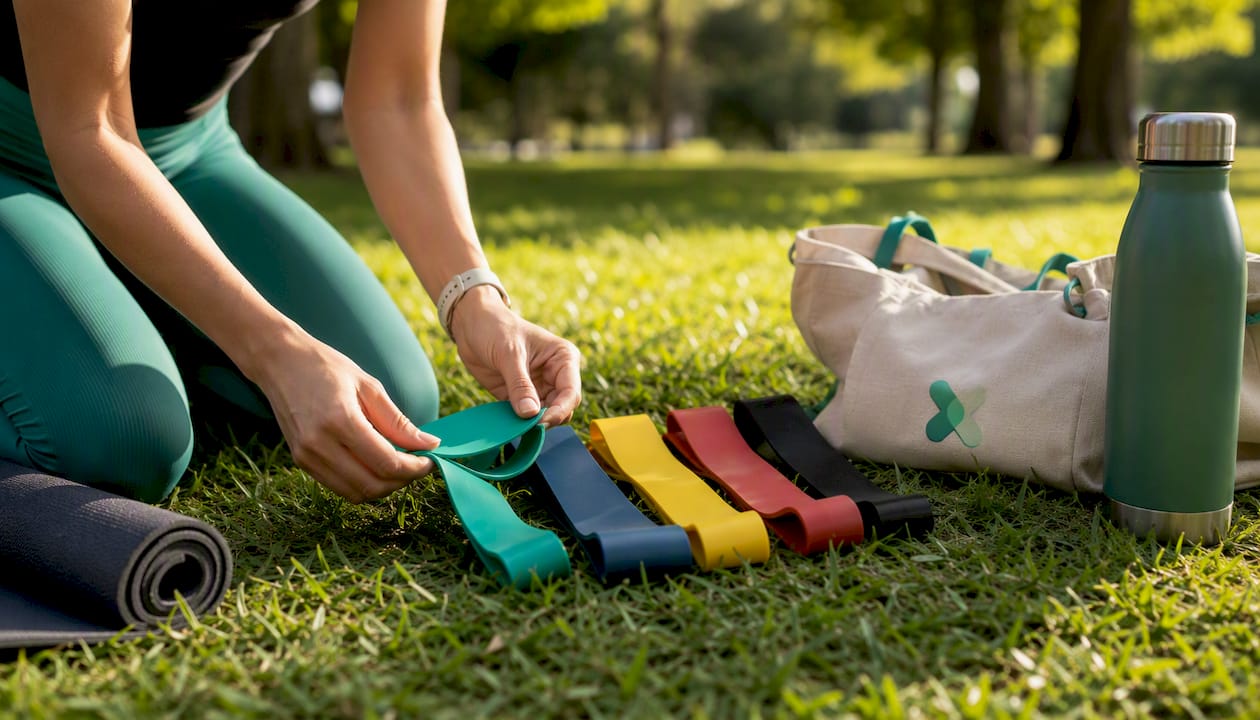
A banded glute bridge (flat loop above knees), banded pull-aparts (tube band at chest height), and a seated row with the door anchor cover hip stability, scapular control, and mid-back strength. Three sets of 12–15 reps each takes under 12 minutes.
Pro Tip: Track progress with rep-based or RPE (Rate of Perceived Exertion) adjustments rather than adding weight. When 15 reps feel easy at a 6/10 effort, move to the next tension level. This mirrors how clinicians grade resistance in outpatient PT.
For travelers who also use Pilates-based resistance work, graded resistance tools for home and travel from the Pilates field offer complementary guidance on band selection and versatility.
How do you relieve stiffness with compact massage tools?
Long flights and car rides compress soft tissue and reduce circulation. Short, targeted myofascial release sessions break that cycle without requiring a full foam roller or a massage table.
The tools that actually fit in a carry-on
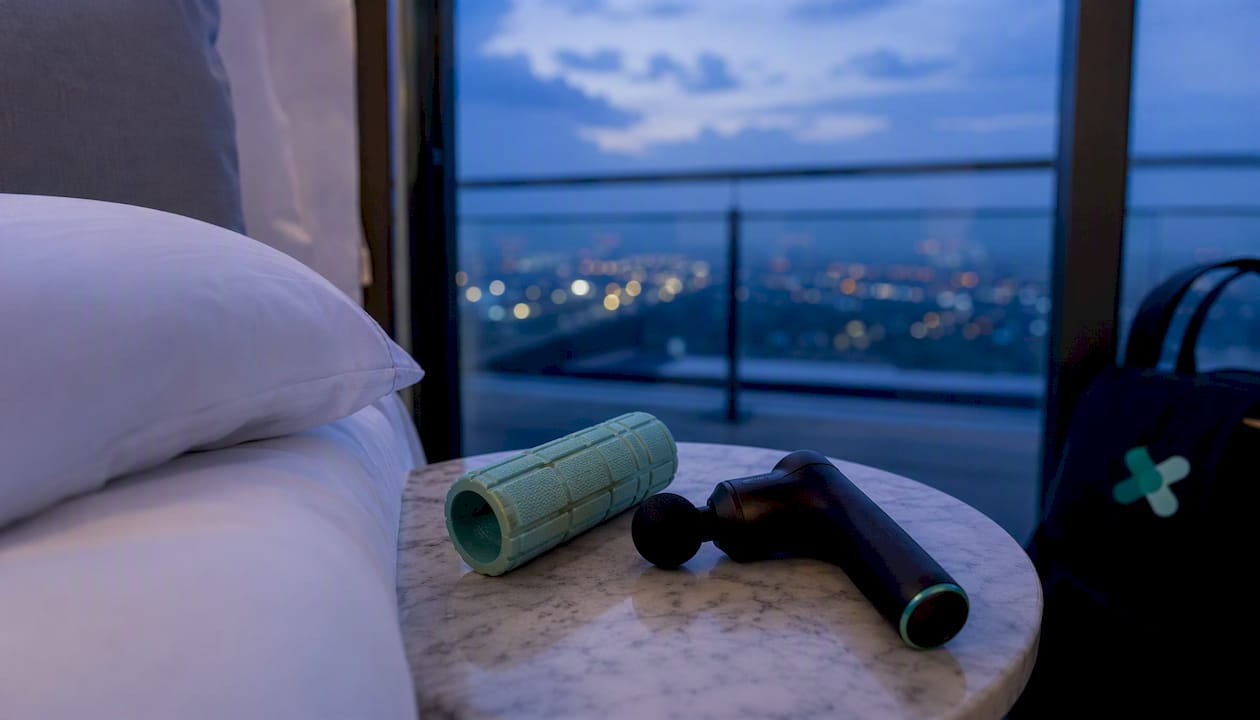
- Lacrosse ball or MB1-style massage ball: dense enough for plantar fascia rolling and thoracic spine release against a wall. Weighs 2.5 oz.
- Vibrating massage ball: adds low-frequency vibration for deeper tissue response. Most USB-charge in 90 minutes and run 2–3 hours per charge.
- Mini percussion massager (travel massage gun): delivers targeted percussive therapy to larger muscle groups. Look for models under 1 lb with a carrying case.
- Travel percussive stick: a manual roller with ridged handles; no battery needed, no airline restrictions, and it fits in a side pocket.
Micro-sessions of 60–90 seconds per spot are the practical standard for travel percussion use. They reduce stiffness effectively without over-stimulating tissue or draining battery.
Seat-friendly release techniques
- Under-glute release: place a lacrosse ball under one glute while seated, shift weight gently, hold 60 seconds per side.
- Plantar rolling: remove your shoe, roll the ball under your foot for 90 seconds per foot.
- Upper-trap softening: lean your head slightly away from the tight side, press a ball between your shoulder and the seat back, and hold 60 seconds.
The main tradeoff between a mini foam roller and a mini percussion device comes down to space. A foam roller, even a short travel version, is bulkier than a percussion device that weighs under 1 lb. For targeted release on specific spots, the percussion device wins on both weight and precision.
Pro Tip: Keep percussion sessions to 60–90 seconds per muscle group. Longer sessions on already-fatigued travel muscles can increase soreness rather than reduce it. Start at the lowest intensity setting and increase only if the tissue responds well.
Which stretching aids help you maintain range of motion on the road?
Stretch straps, over-the-door anchors, and lightweight strap loops are the most practical range-of-motion tools for travel. They are lightweight, affordable, and require no floor space beyond what a hotel room already provides.
A good stretch strap is long enough with multiple loops for hand placement adjustments. Nylon webbing holds up better than cotton after repeated washing in hotel sinks. Avoid straps with metal buckles if you want to move them through security quickly; plastic D-rings work just as well and weigh less.
Simple setups for three key areas
Hamstring ROM: lie on your back, loop the strap around your foot, and extend the leg toward the ceiling. Adjust hand position along the strap to control tension. Hold 30–45 seconds per side.
Shoulder ROM: anchor the strap in the door at shoulder height. Face away from the door, hold the strap with one hand, and step forward until you feel a gentle anterior shoulder stretch. This replicates a common post-surgical shoulder protocol.
Calf and ankle ROM: loop the strap around the ball of your foot while seated on the bed edge. Pull gently toward you for a calf stretch, then push away for ankle dorsiflexion work.
Inexpensive straps ($8–$15) consistently outperform heavier, padded alternatives when traveling because the weight savings are real and the function is identical. A strap that costs $40 does not stretch your hamstring any further than one that costs $10.
Why does a travel mat make your therapy safer and more effective?
A stable, grippy surface is the foundation for safe exercise when you are changing locations every few days. Hotel carpet varies wildly in grip and cleanliness. A dedicated travel mat solves both problems.
Clinical reviewers and traveling clinicians consistently emphasize traction and a consistent surface as prerequisites for safe mobility and ROM work across locations.
What to look for
- Grip and traction: a mat that slides on tile or hardwood is a fall risk during single-leg balance work. Look for a non-slip bottom surface.
- Packed dimensions: a foldable travel yoga mat should fold to roughly 12" x 9" x 1.5" or smaller. Ultra-thin mats (1–2 mm) roll tightly and fit in a carry-on side pocket.
- Washability: wipe-clean or machine-washable surfaces matter when you are using the mat on hotel floors.
- Weight: aim for under 2 lbs. Many foldable travel mats weigh around a pound or slightly more.
A towel-plus-grip-spray solution works for the lightest possible packing footprint, but it does not replicate the joint protection a mat provides during kneeling or prone exercises. For any therapy routine that includes floor work, a dedicated mat is the better call.
Pro Tip: Use the same mat placement and orientation in every hotel room. Consistent spatial setup helps your nervous system recognize the “therapy context” and improves motor pattern recall, especially for balance and proprioception work.
What compact electronic therapy devices are worth packing?
Electronic therapy devices cover what passive tools cannot: nerve-level pain modulation, heat delivery, and deep tissue stimulation. The key is choosing devices that are small, USB-rechargeable, and airline-compliant.
Device types and what they do
- Pocket TENS/EMS units: deliver electrical pulses to modulate nerve pain signals (TENS) or stimulate muscle contractions (EMS). Most pocket units are very lightweight and run for many hours per charge.
- Wearable neck massagers with heat: wrap around the cervical spine and deliver heat plus vibration or EMS simultaneously. Useful for neck stiffness accumulated during long flights.
- Mini percussion massagers: covered in the mobility section above; also relevant here for post-arrival muscle activation.
- Compact red-light wands and pads: covered in the next section.
Battery and airline rules
The FAA limits lithium-ion batteries to a certain watt-hour threshold for carry-on without airline approval, with higher limits allowed if approved. Most small therapy devices fall well below the FAA’s watt-hour limits. Always carry electronic devices in your carry-on, not checked luggage, to comply with airline battery rules and protect them from temperature extremes.
Safety notes
Avoid TENS/EMS use if you have an implanted electrical device (pacemaker, spinal cord stimulator) or are pregnant. Inspect electrode pads before each use and replace them when adhesion weakens. Never place electrodes over broken skin or directly over the spine.
MagicPro 2.0 and MagicPro 3.0
My Vitality’s MagicPro 2.0 and MagicPro 3.0 are designed specifically for this use case. Both devices combine EMS, heat, and massage in a single compact unit. The MagicPro 3.0 adds vagus nerve stimulation and red-light therapy modes, making it a multi-modal device that replaces several single-purpose gadgets in a single carry-on-friendly package. A 15-minute session delivers clinician-recommended therapy without requiring a clinic visit. Learn more about how wearable therapy devices work for neck pain before your next trip.
A 3-item core gadget kit (pocket TENS, mini percussion massager, white-noise device) can weigh under 1.5 lbs combined and cost $150–$280, offering high utility for chronic pain travelers. A multi-modal device like the MagicPro reduces that count further.
Pro Tip: Use micro-sessions (10–15 minutes at low intensity) to preserve battery life during multi-day trips. Charging every night via USB keeps devices ready without carrying extra power banks.
Is portable red-light therapy worth packing for travel?
Red-light therapy uses specific wavelengths (typically 630–850 nm) to support tissue recovery and reduce localized inflammation. Stanford Medicine notes growing clinical interest in red-light applications across dermatology and musculoskeletal recovery. University of Utah Health describes it as a legitimate therapeutic modality with an expanding evidence base, though outcomes depend heavily on device irradiance and session consistency.
For travel, the question is whether the device you pack delivers enough irradiance to be effective without being too heavy or too large.
Form factors compared
| Form Factor | Portability | Coverage Area | Typical Session Time | Best For |
|---|---|---|---|---|
| Wand | Lightest (under 0.5 lbs) | Spot treatment only | 2–5 min per spot | Targeted joint or wound support |
| Flexible pad | Moderate (0.5–1 lb) | Medium area (shoulder, knee) | 10–20 min | Area treatment during rest |
| Small foldable panel | Heaviest (1–2 lbs) | Largest coverage | 10–15 min | Full back or multi-zone sessions |
Practical travel tradeoffs
- Wands are the easiest to pack and the most airline-friendly, but they require you to hold them in place, which limits multitasking.
- Flexible pads wrap around a joint and free your hands, but they need a power source and take more space.
- Small foldable panels offer the most coverage but add meaningful weight. They are best for travelers staying in one place for several days rather than moving daily.
USB-charging units are preferable for travel. Always store battery-powered red-light devices in your carry-on. Most wands and pads fall well under the FAA’s 100 Wh carry-on limit.
Price ranges: wands typically run $30–$80, pads $60–$150, and small panels $100–$300.
How do sleep and sensory tools support recovery on the road?
Poor sleep in unfamiliar hotels compounds every physical therapy problem. Stiffness worsens, pain sensitivity increases, and motor learning slows. Three compact items address this directly.
- Dedicated white-noise device: field reviews report that dedicated units run 8–12 hours on USB power and mask ambient hotel noise effectively in the 40–55 dB range. That consistent output is difficult to replicate with a phone app, which also drains your battery overnight.
- Full blackout sleep mask: hotel blackout curtains are rarely fully effective. A contoured mask that blocks light from all angles costs $10–$30 and weighs under 2 oz.
- High-quality foam earplugs: NRR-rated foam earplugs (NRR 32–33) reduce ambient noise by roughly 16 dB in real-world conditions. They cost under $5 for a multi-pack and weigh almost nothing.
Dedicated hardware for sleep outperforms phone apps because it spares phone battery and maintains consistent masking frequencies throughout the night. This matters especially after red-eye flights, when circadian disruption is at its worst. The Mayo Clinic recommends light management and sleep scheduling as primary strategies for jet lag recovery, and your sensory kit supports both.
Pro Tip: Pack the sleep mask and earplugs in an outer pocket of your carry-on, not buried in your checked bag. Deploying them within the first hour of arrival, even for a 20-minute rest, helps anchor your circadian rhythm to the new time zone faster.
What speech therapy tools travel well in a carry-on?
Speech-language pathologists and parents maintaining a child’s therapy routine on the road need tools that are light, wipeable, and versatile across articulation, language, and social-communication goals.
High-value speech therapy minis
- Bingo chips with a magnetic wand: lightweight, reusable, and useful for tracking trials, turn-taking, and attention tasks. A set of 50 chips and a wand weighs under 3 oz.
- Dry-erase mini board and markers: a 5" x 7" board covers word mapping, sentence building, and quick articulation drill grids. Wipe clean between sessions.
- Small manipulatives: mini figures, token sets, or sorting objects support language and play-based therapy. Choose items that fit in a small zip pouch.
- Laminated stimulus cards or a small picture book: a set of 20–30 laminated cards covers naming, describing, and narrative tasks. Laminated cards wipe clean and survive spills better than paper.
Organizing a compact speech kit
A single quart-sized zip bag holds all four categories above and weighs under 0.5 lbs total. Label small compartments within the bag for articulation items, language items, and social-communication items so you can pull the right materials quickly during a 15-minute waiting-room session.
- 15-minute articulation session: use stimulus cards for 10 trials per target sound, track with bingo chips, and record accuracy on the dry-erase board.
- 15-minute language session: use manipulatives for a sorting or describing task, then use the dry-erase board for sentence-level targets.
- Social-communication session: use turn-taking with bingo chips and a picture book for narrative retell or commenting practice.
For sanitation, store manipulatives in a wipeable silicone pouch and wipe stimulus cards with an alcohol-free antibacterial wipe after each session.
How do you choose and pack the right therapy toolkit?
The single most useful packing rule: aim for a total therapeutic-device kit under 1.5 lbs. Heavier kits get left behind, which defeats their purpose entirely.
Decision criteria
- Portability: packed dimensions and weight. If it does not fit in your carry-on, you will not bring it.
- Versatility: multi-use items earn their weight. A loop band set covers 20+ exercises; a single-use gadget covers one.
- Durability: can it survive repeated packing, unpacking, and hotel-sink washing?
- Power logistics: USB-rechargeable devices are easier to manage than those requiring proprietary chargers or AA batteries.
- Price: replacement cost matters. A $10 strap you lose at a hotel is less painful than a $200 device.
Three kit tiers
Under-1-lb minimal kit (addresses circulation, mobility, and sleep):
- Compression socks (1 pair)
- 3-pack flat loop bands
- Sleep mask and foam earplugs
This configuration addresses circulation, mobility, and sleep without a percussion device or foam roller, and it fits in a single zip pouch.
Under-3-lb balanced kit (adds electronic therapy and myofascial release):
- Everything in the minimal kit
- Pocket TENS/EMS unit
- Lacrosse ball or vibrating massage ball
- Stretch strap with door anchor
- Foldable travel mat
Full-recovery carry-on kit (adds red-light, speech tools, and sleep hardware):
- Everything in the balanced kit
- Portable red-light wand or pad
- Speech therapy zip pouch
- Dedicated white-noise device
- My Vitality MagicPro 2.0 or 3.0
Organization tips
Use modular pouches: one for resistance tools, one for electronic devices and cables, one for speech materials. Include a small sanitation and repair kit (fabric-safe wipes, spare resistance-band clips, needle and thread) to extend tool life across multi-location trips. A toiletry-sized tech pocket in your carry-on keeps electrode pads, spare clips, and charging cables accessible without digging through your main bag.
How do you use therapy tools safely while traveling?
Short micro-routines work better than long sessions when you are in transit. Your body is already under stress from travel; adding a 45-minute workout on top of it often backfires.
Sample micro-routines
Pre-flight (10 minutes at the gate):
- 60-second plantar rolling per foot (lacrosse ball)
- Banded clamshells, 2 x 15 per side (flat loop band)
- Seated upper-trap release, 60 seconds per side
In-transit (5–10 minutes in seat):
- Under-glute lacrosse ball release, 60 seconds per side
- Ankle circles and calf pumps, 2 minutes
- TENS unit on low intensity for 10–15 minutes (if privacy allows)
Post-arrival (15 minutes in hotel room):
- Full stretch strap sequence (hamstring, shoulder, calf), 30–45 seconds each
- Mini percussion on quads and upper back, 60–90 seconds per spot
- MagicPro session (EMS + heat), 15 minutes
Safety rules
- Limit percussion to 60–90 seconds per spot. Longer sessions on travel-fatigued muscles increase soreness.
- Ramp TENS intensity gradually. Start at the lowest setting and increase only until you feel a comfortable tingling sensation, never a sharp or burning one.
- Replace electrode pads when adhesion weakens. Worn pads deliver uneven current and can cause skin irritation.
- Avoid TENS use in public without adequate privacy and clothing coverage.
Sanitization on the road
Wipe resistance bands and stretch straps with fabric-safe antibacterial wipes after each session. Store electrode pads in their original sealed packaging between uses. Clean the travel mat surface with a diluted alcohol spray and let it air-dry before folding. For speech manipulatives, alcohol-free antibacterial wipes protect laminated surfaces without degrading the material.
When to pause and consult a clinician: stop using any device if you notice new or worsening symptoms, skin irritation at electrode sites, numbness, or tingling that persists after a session ends. These are signals to see your physical therapist or physician before continuing.
Pro Tip: Keep a small “sanitation zip” (wipes, spare electrode pads, a spare band clip) in the front pocket of your carry-on. Replacing a worn electrode pad takes 30 seconds; tracking down a replacement in an unfamiliar city takes much longer.
Key Takeaways
A minimal kit covers circulation, mobility, and sleep; adding a pocket TENS and a multi-modal device like the MagicPro 2.0 or 3.0 builds a full-recovery carry-on kit that remains lightweight.
| Point | Details |
|---|---|
| Start with the minimal kit | Compression socks, loop bands, and a sleep mask address the most common travel therapy problems with a lightweight setup. |
| Add electronics for pain relief | A pocket TENS/EMS unit and a multi-modal device like the MagicPro replace several single-purpose gadgets. |
| Keep total kit lightweight so travelers actually pack and use their tools on every trip. | |
| Micro-sessions prevent overuse | Limit percussion to 60–90 seconds per spot and TENS to 10–15 minutes at low intensity to avoid over-stimulation. |
| My Vitality MagicPro 2.0 / 3.0 | Combines EMS, heat, massage, and (in the 3.0) red-light therapy in one compact, USB-rechargeable travel device. |
The case for simplicity over gadgetry
There is a temptation, especially for anyone who has spent time in a well-stocked PT clinic, to replicate that environment in a suitcase. It never works. The tools that actually get used on the road are the ones that are already in your hand when you need them, not the ones buried under three layers of packing cubes.
The most consistent finding across clinical travel-recovery guidance is not about which device is most effective in a lab. It is about compliance. A loop band set and a lacrosse ball that you actually use every morning beat a sophisticated percussion device that stays in your bag because it is too heavy or too complicated to set up in a hotel bathroom.
Multi-use items are the real answer here. A stretch strap covers hamstring, shoulder, and calf ROM. A flat loop band covers glutes, hips, and scapular stability. A multi-modal device like the MagicPro 2.0 covers EMS, heat, and massage without requiring three separate devices. Each item you add to your kit should replace at least one other item, not simply add to the pile.
The speech therapy side of this equation is often overlooked in general travel-recovery guides. A quart-sized zip bag with laminated cards, bingo chips, and a dry-erase board is genuinely all most SLPs or therapy-focused parents need for a two-week trip. The barrier is rarely the tools; it is the habit of pulling them out and using them for 15 minutes in a waiting room or hotel room. Build the habit first, then refine the kit.
My Vitality MagicPro: the compact multi-modal device built for travel
Travelers who deal with neck stiffness, chronic tension, or post-flight soreness usually pack two or three separate devices to address those problems. The Vitality™ MagicPro 2.0 replaces that stack with a single compact unit that delivers EMS, heat, and massage in one 15-minute session. No clinic visit required.
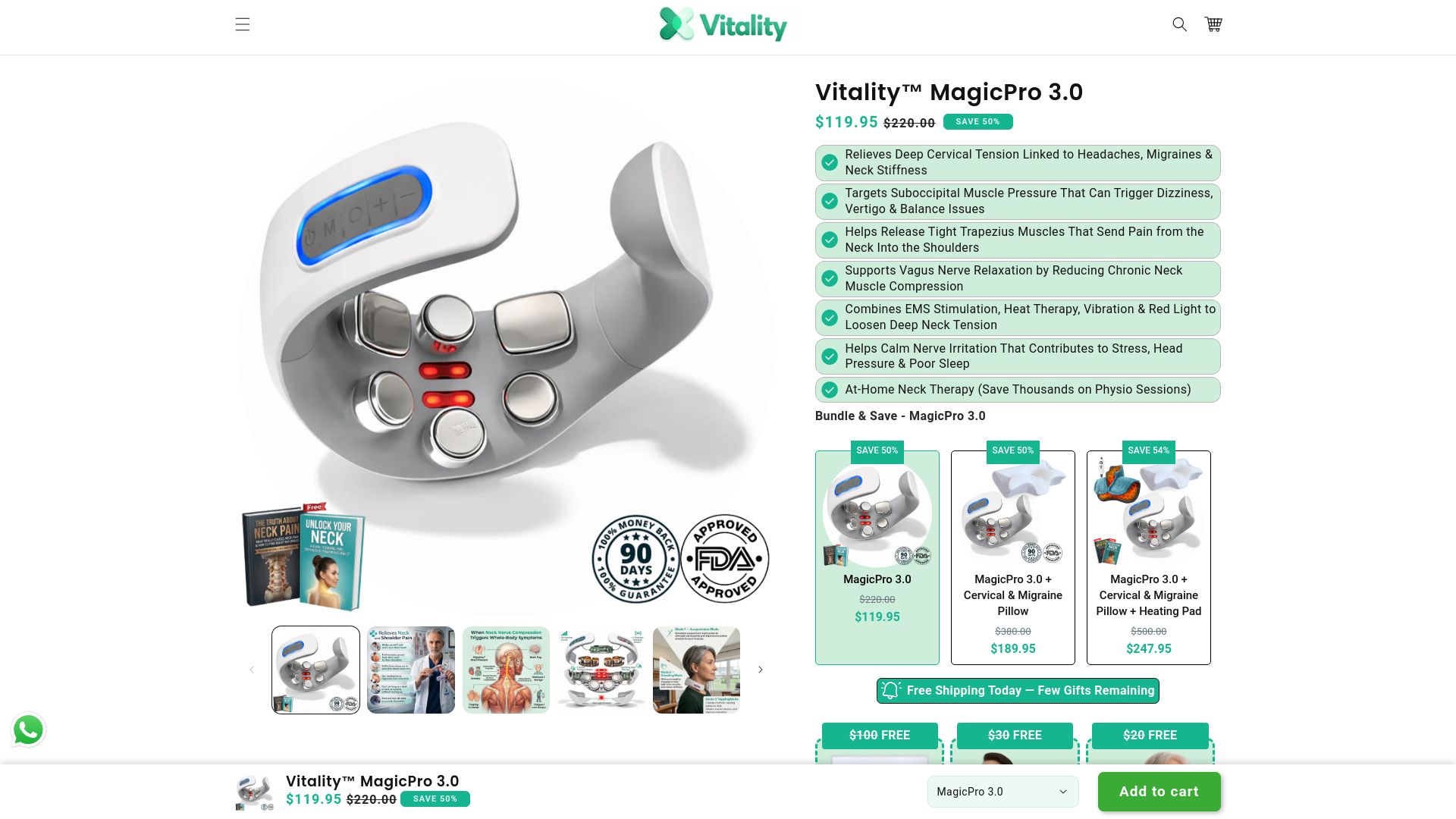
The Vitality™ MagicPro 3.0 adds vagus nerve stimulation and red-light therapy to that same compact form factor, making it the most versatile option for travelers who want to address neck pain, sleep quality, and tissue recovery with one device. Both units are USB-rechargeable, carry-on compliant, and doctor-recommended.
For travelers managing chronic neck pain or post-surgical recovery, a multi-modal device reduces total kit weight and simplifies your routine. One device, one charging cable, one case. Read about at-home neck therapy device benefits to understand how these modes work together before your next trip.
This section features My Vitality’s own products. As with any electrical therapy device, consult your physician or physical therapist before use if you have an implanted electrical device, are pregnant, or have a history of seizures. My Vitality products come with a satisfaction guarantee; see the product page for current warranty and return terms.
Visit the MagicPro collection to compare the 2.0 and 3.0 models and find the right fit for your travel routine.
Useful sources and further reading
The sources below support the clinical guidance and product recommendations throughout this guide. Consult them before changing your therapy routine, particularly for specialized conditions.
- Rehabilitation Toolkit: Essential Portable Tools for Home Health Therapists — PT and biomechanics guidance on graded resistance bands and versatile travel tools; foundational for the resistance section.
- Travel Recovery Kit: 5 Tools That Fit In A Carry-On (2026 Guide) — Cochrane DVT data, minimal-kit weight benchmarks, and carry-on configuration examples.
- 3 Gadgets That Make Chronic Pain Travel Bearable — Field cost and weight estimates for core gadget kits; white-noise device hardware guidance.
- Portable Massage Devices for Travelers — Micro-session guidance (60–90 seconds per spot) for percussion and vibrating tools.
- Travel Recovery Kit Field Review (2026) — Clinician guidance on travel mat consistency, sanitation kits, and modular repair accessories.
- Stanford Medicine: Red-Light Therapy — Clinical overview of red-light therapy applications in dermatology and musculoskeletal recovery.
- University of Utah Health: Is Red-Light Therapy Just a Fad? — Evidence-based assessment of red-light therapy efficacy and device irradiance considerations.
- Mayo Clinic: Jet Lag Diagnosis and Treatment — Primary clinical guidance on light management and sleep scheduling for circadian recovery.
- Cleveland Clinic: Delayed Onset Muscle Soreness — Background on DOMS mechanisms relevant to post-travel muscle recovery protocols.
This article provides general wellness information, not medical advice. Confirm any changes to your therapy routine with your physical therapist, speech-language pathologist, or physician.