

Do not place EMS electrodes over the front or sides of your neck, near the carotid sinus. That single placement error can trigger a vagal reflex that drops your heart rate and blood pressure fast enough to cause fainting. Anyone with a pacemaker or implanted device, uncontrolled epilepsy, or recent cervical surgery should skip neck EMS entirely until a doctor clears them.
TL;DR:
- Position electrodes on the back or sides of the neck, avoiding the front and areas where you can feel your pulse to prevent triggering vagal reflexes.
- Absolute contraindications include having a pacemaker, active cardiac instability, uncontrolled epilepsy, or recent neck surgery, with no exceptions.
- Use extreme caution if pregnant, on blood thinners, or with uncontrolled high blood pressure, and always seek medical clearance if in doubt.
- Keep session intensity low, progress gradually, and stop immediately if symptoms like dizziness or fainting occur during treatment.
- Evidence for EMS effectiveness on neck pain is low, so it should be part of a broader care plan rather than a standalone solution.
Table of Contents
- Quick EMS Neck Contraindications Checklist
- Why the Carotid Sinus Turns Neck EMS Into a Cardiac Risk
- Absolute Contraindications for Neck EMS Explained
- Relative Contraindications and When Clearance Changes the Answer
- Safe Placement, Intensity, and Session Rules for Neck EMS
- Warning Signs That Mean Stop Immediately
- What the Research Actually Shows About EMS Safety and Effectiveness
- What to Do If Symptoms Occur or You Need Medical Clearance
- An Honest Look at Where Neck EMS Risk Actually Lives
- Sources
Quick EMS Neck Contraindications Checklist
Before you turn on any neck stimulation device, run through this self-screen. If you answer yes to anything in the first group, stop. Neck EMS is not for you right now, and that is not a suggestion you should negotiate with yourself over.
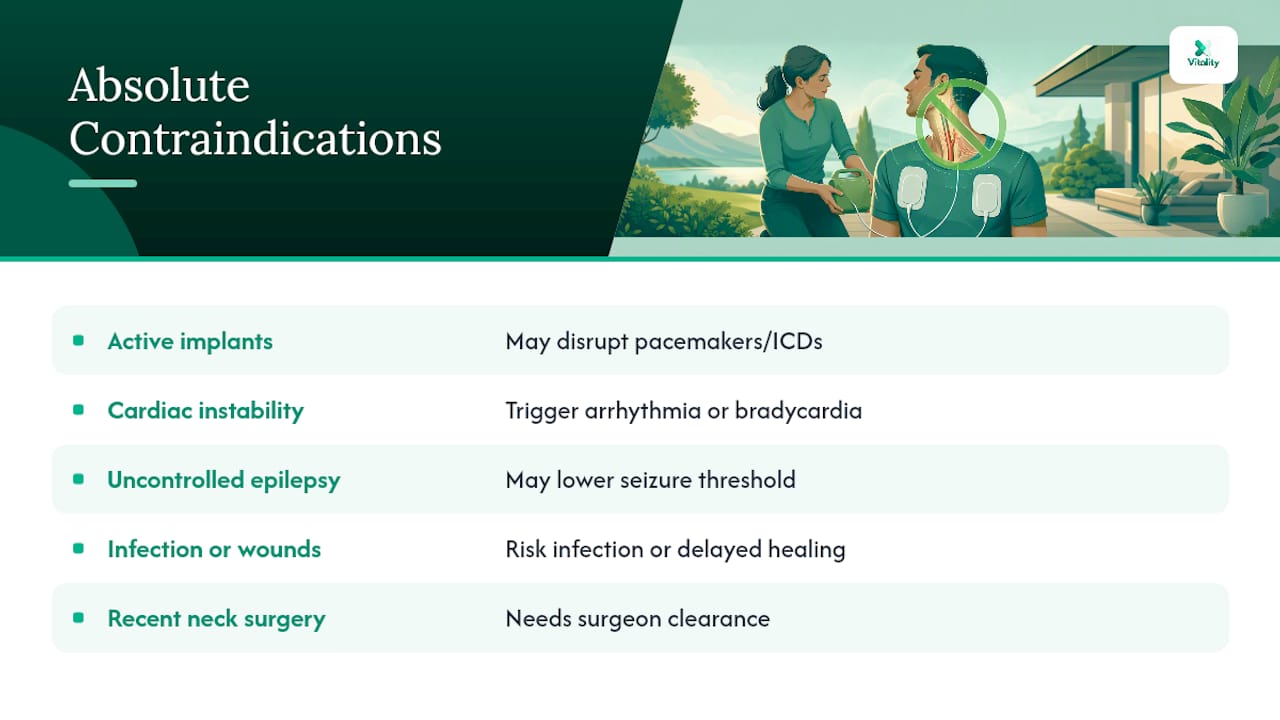
Absolute contraindications (avoid neck EMS entirely):
- You have a pacemaker, ICD, or any implanted neurostimulator.
- You have active cardiac instability, including recent arrhythmia or unstable angina.
- You have uncontrolled seizures or a poorly managed epilepsy diagnosis.
- You have an open wound, active infection, or skin breakdown where pads would sit.
- You had neck or cervical spine surgery within the past several weeks.
Relative contraindications (get medical clearance first):
- You are pregnant.
- You take anticoagulants or blood thinners.
- You have uncontrolled high blood pressure.
- You have active cancer in or near the treatment area.
- You manage a systemic illness like poorly controlled diabetes or peripheral vascular disease.
If any relative item applies, the answer is not automatically no. It means you call your doctor before your next session, not after a symptom shows up. This is where most people get it wrong. They treat “relative” as “probably fine” instead of “confirm first.”
Why the Carotid Sinus Turns Neck EMS Into a Cardiac Risk
Your carotid sinus sits at the fork where your common carotid artery splits into its internal and external branches, right at the front and side of your neck. It houses baroreceptors, pressure sensors that constantly report your blood pressure to the brainstem through the vagus nerve. That reporting system exists to keep you upright and conscious, and it reacts to more than blood pressure changes.
Electrical current applied over that spot can mimic a pressure spike. The baroreceptors fire, the vagus nerve responds, and your heart rate and blood pressure drop, sometimes abruptly enough to cause bradycardia, hypotension, or a fainting episode. This is a well-documented reflex arc, not a theoretical concern. The SAEM curriculum on cardiovascular reflexes covers exactly this mechanism as a core teaching point for emergency clinicians, because carotid sinus stimulation is a recognized cause of unexplained syncope.
A small electrical current near the carotid sinus can provoke a vagal reflex even when the sensation feels mild. Pad placement errors happen routinely with home devices, because users often position electrodes by feel rather than by anatomical landmark.
Here’s the part that surprises people: it doesn’t take much. Someone using a handheld unit at home, guessing at placement instead of following a diagram, can drift onto the anterior triangle of the neck without realizing it. The current intensity that feels “just right” for muscle relief has nothing to do with the intensity needed to trigger a baroreceptor response. That threshold can be crossed at settings well below what causes noticeable muscle contraction.
The practical rule is simple: keep electrodes on the back and sides of the neck, over the trapezius and paraspinal muscles, and never on the front where the carotid pulse is palpable. If you can feel your pulse under your fingers at that spot, that is exactly where the pads should not go. Give yourself a wide margin, not a narrow one. Clinical overviews on electrotherapy safety are direct about this: electrodes should never be applied over the front of the neck or chest, full stop, regardless of device brand or intensity setting.
Absolute Contraindications for Neck EMS Explained
Some conditions aren’t a judgment call. They rule out neck EMS entirely until a specialist says otherwise, and understanding why makes the rule easier to respect instead of resent.
Implanted pacemakers, ICDs, and neurostimulators. Electrical stimulation devices can interfere with the sensing circuits of implanted cardiac devices, potentially causing them to misread your heart’s natural rhythm or, in rare cases, malfunction. Clinical guidance on electrotherapy lists active implants as an absolute contraindication for good reason: the downside risk is a device failure in an organ you cannot afford to have fail.
Severe cardiac instability. If you have an active arrhythmia, recent heart attack, or unstable angina, your cardiovascular system is already working with a narrower margin than normal. Adding a stimulus that can independently trigger bradycardia or blood pressure swings, on top of an already unstable rhythm, stacks risk on risk.
Uncontrolled epilepsy. The relationship between electrical stimulation and seizure threshold is not fully settled, but the caution is consistent across sources. Applying NMES in people with uncontrolled seizure disorders requires extreme caution because of the theoretical possibility that stimulation could alter cortical activity near a seizure focus. Until your epilepsy is well controlled and a neurologist has weighed in, neck EMS stays off the table.
Active infection, open wounds, or cancer in the treatment area. Electrodes need intact, healthy skin to make safe contact. Placing them over a wound risks irritation, delayed healing, or infection spread. Active cancer in the stimulation zone is excluded out of caution about local tissue effects that haven’t been adequately studied for safety.
Recent cervical surgery. Fresh surgical sites need time to heal without added mechanical or electrical stress. Anyone within weeks of a cervical spine procedure, thyroid surgery, or lymph node dissection in the neck should get explicit sign-off from the surgeon before any device touches that area again.
None of these categories overlap with “maybe it’s fine if I’m careful.” They’re absolute because the failure mode, cardiac disruption, seizure, wound complication, isn’t something you can walk back once it starts.
Relative Contraindications and When Clearance Changes the Answer
Relative contraindications are different animals. They don’t automatically disqualify you from neck EMS, but they do mean the decision belongs to a clinician, not to you and the product manual.
- Pregnancy. Most device manufacturers exclude pregnant users as a precaution, since stimulation effects on the developing fetus and on maternal cardiovascular reflexes near the neck haven’t been studied enough to call it low risk.
- Anticoagulant or blood-thinner use. These medications don’t interact with electrical current directly, but they change how your body responds to any skin irritation or minor tissue trauma from adhesive pads, and they raise the stakes if a vagal episode leads to a fall.
- Uncontrolled hypertension. Blood pressure that’s already poorly managed adds unpredictability to a therapy that can independently swing blood pressure through the carotid reflex. Controlled hypertension is a different story, and many people manage it fine with clearance.
- Prior cancer outside the stimulation zone. A cancer history somewhere else in the body doesn’t carry the same caution as active disease at the treatment site, which is why recent consensus work has moved some cancer scenarios from absolute to relative status. The 2024 German consensus review on WB-EMS reclassified certain conditions, including some cancer contexts, as relative rather than absolute contraindications, while keeping neurologic disease and arterial circulation disorders firmly absolute.
- Stable cardiac disease or well-controlled diabetes. Once a condition is stable and monitored, the calculus shifts. That same consensus effort moved diabetes into the relative category for many patients, reflecting how far contraindication thinking has evolved from blanket exclusions toward individualized risk assessment.
Medical clearance for any of these usually means a short conversation, not a battery of tests. Your primary care doctor can handle most relative-contraindication clearances directly. For implant concerns or arrhythmia history, expect a referral to cardiology. For seizure history, neurology weighs in. For anyone recovering from neck surgery, the surgeon who performed the procedure has the final say on timing.
Pro Tip: Bring your device’s model number and intensity range to the clearance appointment. A doctor can give you a faster, more specific answer when they know exactly what current and frequency the device outputs, instead of evaluating “EMS” as a vague category.
Safe Placement, Intensity, and Session Rules for Neck EMS
Getting the physiology right means nothing if the practical setup is sloppy. Here’s how to keep neck EMS on the safe side of the line.
Forbidden zones, and why each one matters:
- The anterior and lateral triangle of the neck, where the carotid sinus sits: vagal reflex risk, covered above.
- Directly over the airway or trachea: risk of triggering coughing reflexes or discomfort with breathing.
- The thyroid gland area: insufficient safety data on stimulation effects on thyroid tissue, so it’s excluded out of caution.
Safe target zones sit on the back and sides of the neck, specifically the upper trapezius and the paraspinal muscles running alongside the cervical spine. Picture a horseshoe hugging the base of your skull and running down either side of your spine, that’s the zone where most legitimate neck-relief devices, including Vitality’s MagicPro 2.0, are engineered to sit. Pads placed there target the muscles that actually cause stiffness and tension headaches, without coming near the carotid sinus.
Start low, progress slowly. Your first session should run at the lowest intensity setting the device offers, for a shorter duration than the manual’s maximum. If you tolerate that without dizziness, unusual soreness, or skin irritation, you can increase intensity gradually over subsequent sessions. Supervised first use, meaning someone else is nearby or you’re seated somewhere safe, isn’t overcaution. It’s what lets you catch a vagal response before it becomes a fall. Our guide to EMS settings for neck pain breaks down specific intensity ranges and timing if you want a more detailed starting protocol.
Device and pad maintenance matters more than people assume. Cracked or worn pads create uneven current density, which can push stimulation into unintended areas, including drifting toward the chest or front of the neck if pads shift during use. Replace pads on the manufacturer’s schedule, and always check that adhesive is making full, even contact before starting a session.
Whole-body EMS sessions that include neck zones deserve extra caution. WB-EMS studios have documented cases of rhabdomyolysis, and a conservative progression, a single supervised session followed by 24 to 48 hours of spacing before increasing intensity, reduces that risk compared to aggressive weekly schedules used in some commercial settings. Neck-specific home devices operate at far lower intensities than studio WB-EMS rigs, but the same “go slow” logic applies.
Pro Tip: If you’re combining EMS with heat therapy for muscle relaxation, run the heat first to loosen the muscle, then apply EMS afterward at a lower intensity than you’d use on a cold, tense muscle. Heat therapy for neck pain explains the sequencing in more depth.
Warning Signs That Mean Stop Immediately
Most neck EMS sessions produce nothing worse than mild tingling or muscle fatigue. But a small set of symptoms mean you stop the session right now, not at the end of the timer.
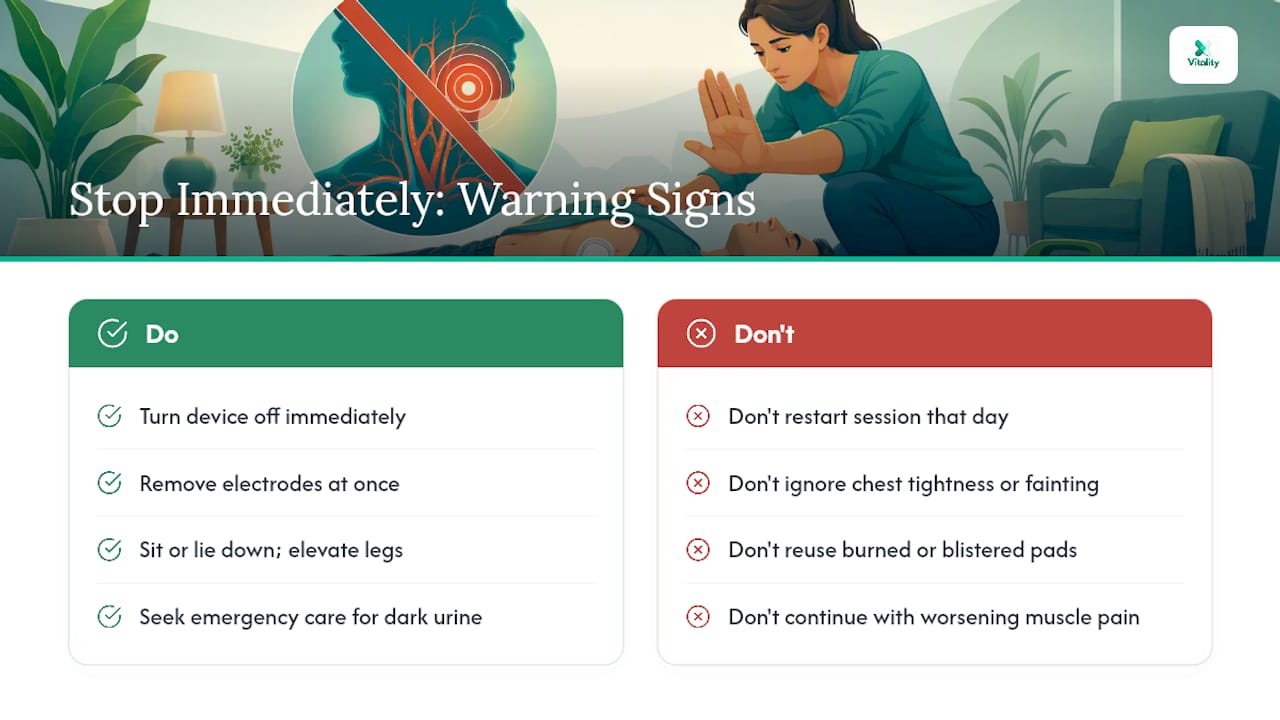
Vagal reaction signs: sudden dizziness, a noticeably slow or weak pulse, cold sweating, or graying vision. Turn the device off, remove the electrodes, and sit or lie down immediately with your legs elevated if you can. These symptoms typically resolve within minutes once the stimulus is removed, but don’t restart the session that day.
Rhabdomyolysis warning signs, more relevant to high-intensity or whole-body sessions than typical neck devices, include severe or worsening muscle pain well beyond normal soreness, dark brown or cola-colored urine, and significant weakness. Documented rhabdomyolysis cases following whole-body EMS exist in the medical literature, and creatine kinase testing is the standard way clinicians confirm it. Dark urine after an EMS session is not a “wait and see” symptom. It’s an emergency room visit.
Skin reactions range from mild adhesive irritation to genuine burns from a cracked pad or excessive intensity. Redness that fades within an hour is normal. Blistering, persistent burning, or a rash that spreads is not, and any of those mean you stop using that pad and switch to a fresh one, or stop entirely if irritation persists.
Cardiac emergency versus minor irritation comes down to what else is happening. Chest tightness, shortness of breath, or fainting are cardiac red flags that need emergency evaluation. Localized tingling, mild redness, or muscle fatigue are the ordinary, expected responses to stimulation and don’t require anything beyond adjusting your settings next time.
What the Research Actually Shows About EMS Safety and Effectiveness
The evidence on neck EMS is more modest than most product marketing suggests, and that gap matters when you’re deciding how much risk to accept for how much benefit.
Systematic reviews of electrotherapy for neck pain describe the quality of evidence as low to very low, meaning EMS hasn’t been reliably shown to outperform placebo or TENS in reducing neck pain or disability across the trials examined. That doesn’t mean EMS does nothing. It means the confidence level researchers have in “this definitely works better than doing nothing” is weak, and further studies could shift the conclusion in either direction.
| Evidence area | What was found | Practical implication |
|---|---|---|
| EMS vs. placebo/TENS for neck pain | Low to very low quality evidence of benefit | Use EMS as one part of a care plan, not a standalone fix |
| WB-EMS and muscle injury | Rhabdomyolysis cases documented in case reports | Conservative session spacing and intensity matter |
| Contraindication consensus | 2024 review reclassified some conditions (diabetes, certain cancers) as relative | Individualized medical clearance beats blanket exclusion lists |
| Absolute exclusions | Neurologic disease, arterial circulation disorders remain absolute | These categories haven’t loosened despite other revisions |
The rhabdomyolysis question deserves its own note. A BMJ Open Sport & Exercise Medicine viewpoint documented case reports of rhabdomyolysis tied to whole-body EMS, with creatine kinase elevations varying significantly between individuals. That’s part of why consensus groups keep revisiting contraindication lists instead of treating them as settled science.
The 2024 Frontiers consensus represents the most recent attempt to update those lists with evidence rather than tradition, moving some conditions toward relative status while holding firm on neurologic and vascular exclusions. The practical takeaway for anyone using neck EMS at home is straightforward: treat contraindication lists as living documents that favor caution, not as bureaucratic checkboxes to skim past.
What to Do If Symptoms Occur or You Need Medical Clearance
If something goes wrong during a session, or you’re not sure whether you qualify for neck EMS, here’s the sequence to follow.
- Stop the session immediately and remove the electrodes at the first sign of dizziness, chest discomfort, or an unusually slow pulse.
- Sit or lie down with your legs elevated if you feel faint, and wait for symptoms to pass before standing.
- Seek emergency care for fainting, chest pain, shortness of breath, or dark urine after a session, don’t wait for symptoms to improve on their own.
- Document the session: device model, intensity setting, pad placement, and how long you’d been using the device before symptoms started.
- Bring your medication list and any photos of skin reactions or pad placement to your appointment.
- Consult the right specialist: cardiology for implant or arrhythmia concerns, neurology for seizure history, your surgeon for postoperative clearance.
- Follow up within a few days even if symptoms resolved quickly, especially after any fainting episode, to rule out an underlying cardiac cause.
An Honest Look at Where Neck EMS Risk Actually Lives
Proper electrode placement, avoiding the anterior neck, is critical to EMS safety and prevents most serious risks.
What frustrates me about a lot of consumer guidance on this topic is how it either overstates the danger, treating every EMS device like a medical hazard, or understates it, burying the carotid sinus warning in fine print nobody reads. Both failures come from the same source: nobody wants to say plainly that this is a genuinely safe therapy for the overwhelming majority of people, provided a short list of absolute contraindications don’t apply and placement stays where it belongs.
The evidence quality issue matters too, and I think it gets dismissed too quickly by people selling devices. Low-quality evidence for effectiveness doesn’t mean EMS is useless. It means you should treat it as one tool in a broader approach to neck tension, alongside heat, movement, and posture correction, rather than expecting it to solve chronic pain on its own. My Vitality builds its devices, including the MagicPro line, around that same premise: combine modalities, keep electrode zones anatomically conservative, and start every new user at the lowest intensity with a short session before scaling up. That’s not marketing caution. It’s the same start low, progress slow principle the clinical literature keeps landing on.
If you fall into any absolute contraindication category, don’t treat this article as a substitute for that phone call to your cardiologist or neurologist. The device can wait. Your clearance conversation shouldn’t.
— Achraf
Sources
- SAEM curriculum: carotid sinus and cardiovascular reflexes
- Electrotherapy for neck pain (PMC)
- Side effects of and contraindications for whole-body electro-myo-stimulation (BMJ Open Sport & Exercise Medicine viewpoint)
- Revised contraindications for the use of non-medical WB-electromyostimulation. Evidence-based German consensus recommendations (Frontiers, 2024)
- Side effects and contraindications of electrotherapy — clinical overview
Ready to try neck relief built around these safety principles from the ground up? The Vitality MagicPro 2.0 combines EMS, heat, and massage in a device engineered to keep stimulation zones on the safe, effective areas of the neck, not the risky ones.
This article is general information, not a substitute for advice from a qualified doctor. Consult a qualified healthcare professional about your own circumstances before acting on anything here.