


A neck massager can be reimbursable through your HSA or FSA, but eligibility is not automatic. Therapeutic devices prescribed or recommended to treat a diagnosed condition, such as chronic neck pain, cervical tension, or muscle spasm, generally qualify as medical expenses under IRS guidelines. Devices purchased for general relaxation or wellness, without a clinical connection, typically do not.
Here are the three actions worth taking before you buy:
- Check your plan’s policy first. Call your plan administrator or log into your benefits portal to confirm whether therapeutic massage devices are covered under your specific plan.
- Save the SKU and receipt. Capture the product title, SKU, price, and any eligibility flag shown on the product page at the time of purchase.
- Ask your clinician about a Letter of Medical Necessity (LMN). If your plan requires one, a brief note from your doctor linking the device to treatment of a diagnosed condition can be the difference between approval and denial.
Both IRS rules and your plan administrator’s interpretation matter. The IRS sets the medical-necessity standard in Publication 502, but your plan administrator decides whether a specific product clears that bar.
Pro Tip: Request pre-approval from your plan administrator before purchasing. A quick call or online inquiry takes minutes and removes the guesswork from the reimbursement process.
Key Takeaways
Neck massagers with therapeutic features and complete documentation are reimbursable through HSA and FSA accounts when they meet the IRS medical-necessity standard and your plan administrator’s requirements.
| Point | Details |
|---|---|
| Eligibility requires medical purpose | The device must treat or mitigate a diagnosed condition, not serve general wellness. |
| LMN strengthens every claim | A brief clinician note linking the device to your diagnosis is the most effective way to prevent denial. |
| Capture SKU and receipt at checkout | Save the product title, SKU, price, and any eligibility flag before leaving the product page. |
| Confirm with your plan administrator | Retailer eligibility labels are helpful signals, not guarantees; your plan has final authority. |
| My Vitality provides claim-ready documentation | MagicPro orders include itemized receipts and spec sheets; additional clinical-use documents are available on request. |
This article is general information, not a substitute for advice from a qualified financial advisor. Consult a qualified financial professional about your own circumstances before acting on anything here.
Table of Contents
- How does HSA/FSA eligibility work for neck massagers?
- Which types of neck massagers are commonly reimbursable?
- How can you confirm a neck massager’s eligibility before buying?
- How do you submit an HSA/FSA claim for a neck massager?
- Why do plans deny massager claims, and how can you avoid it?
- Why are the MagicPro 2.0 and 3.0 positioned as HSA/FSA-friendly devices?
- The part of HSA/FSA reimbursement most buyers overlook
- Get your MagicPro device with full HSA/FSA documentation included
- Sources
How does HSA/FSA eligibility work for neck massagers?
Eligibility comes down to a two-part test: the IRS medical-necessity principle and your plan administrator’s own rules.
The IRS standard requires that an expense qualify as a medical expense, meaning it must be for the diagnosis, cure, mitigation, treatment, or prevention of disease, or for the purpose of affecting a body structure or function. A neck massager used to treat diagnosed cervical muscle tension, a herniated disc, or chronic pain fits that definition. One purchased because it feels good after a long day does not.
The plan administrator’s test is where things get practical. Even when a product meets the IRS standard in principle, your plan administrator decides whether the documentation you submit is sufficient. They look for:
- A clear medical diagnosis linking the device to a treatment need
- An itemized receipt showing the product name, SKU, and price
- An LMN or clinician note describing why the device is medically necessary
- A product spec sheet or description confirming therapeutic purpose, not general wellness
Plan administrators increasingly require documentation to prevent misuse of funds. An LMN from a clinician often makes the difference in audit-proofing a claim.
The heated neck rest eligibility listing on HSAstore confirms that heated neck-rest devices are recognized as reimbursable under HSA, FSA, and HRA accounts, which signals broad retailer-level acceptance. That said, HSAstore’s eligibility list is a helpful signal, not a guarantee. Your plan administrator has final authority.
Pro Tip: Ask your doctor to write a brief LMN that names your diagnosis and explains how the device treats or mitigates that condition. Two or three sentences are usually enough to satisfy most plan administrators.
Which types of neck massagers are commonly reimbursable?
Therapeutic neck devices with documented clinical features tend to clear eligibility reviews. General wellness gadgets rarely do.
The categories most commonly accepted by HSA/FSA plans include:
- Heated neck rests: Devices that apply therapeutic heat to the cervical region are listed as eligible on major HSA/FSA retailer platforms. Heat therapy has a well-established clinical rationale for muscle tension and stiffness.
- Wearable electrical muscle stimulation (EMS) devices: Devices that deliver EMS or transcutaneous electrical nerve stimulation (TENS) to the neck and shoulder muscles are widely recognized as therapeutic. Their clinical use in pain management supports reimbursement arguments.
- FDA-registered therapeutic devices: Products that carry FDA registration or list specific clinical-mode settings signal medical intent to plan administrators. That registration is one of the clearest indicators a product is designed for treatment, not recreation.
- Clinician-prescribed massage devices: Any device a licensed clinician specifically recommends for a diagnosed condition carries stronger eligibility standing, regardless of product category.
Devices that tend to get denied include novelty massagers with no clinical claims, products marketed purely as relaxation or stress-relief tools, and devices with no FDA registration or therapeutic documentation.
Vendor product pages that include FDA registration details, clinical-mode descriptions, or clinician-facing spec sheets materially improve your chance of reimbursement. When you are comparing devices, look for that language before you buy.
How can you confirm a neck massager’s eligibility before buying?
The safest approach is to verify eligibility at three levels: the product page, the retailer, and your plan administrator.
Pre-purchase checklist:
- Search the product on your plan’s eligible-expense list or benefits portal.
- Look for an “HSA/FSA eligible” badge or filter on the retailer’s product page. Large retailers often include searchable eligibility filters that make this quick.
- Confirm the product has FDA registration or clinical-use language in the description.
- Note the exact product title and SKU before checkout.
- Call or message your plan administrator to confirm the specific device is covered under your plan.
Questions to ask the seller:
- Does this device have FDA registration?
- Can you provide a product spec sheet or therapeutic-use statement?
- Is there documentation showing the device is intended for treatment of a medical condition?
What to capture at checkout:
- Screenshot the product page showing the product title, SKU, price, and any eligibility flag.
- Save the order confirmation email with the itemized line item.
- Download or print the product spec sheet if available.
- Store all documents in a single folder, digital or physical, labeled with the purchase date.
One important caveat: marketplace listings sometimes include “FSA/HSA eligible” language in product copy, but that label is not a guarantee of plan acceptance. Your plan administrator makes the final call. Capturing detailed documentation protects you if a claim is questioned later.
How do you submit an HSA/FSA claim for a neck massager?
The claim process is straightforward when your documentation is complete. Here is how it works from purchase to reimbursement.

Claim flow summary: Pay with your HSA or FSA card at checkout for the simplest path. If you pay out of pocket, submit a reimbursement claim to your plan administrator with supporting documents.
Step-by-step:
- Pay at checkout. Use your HSA or FSA debit card directly. Many online retailers accept these cards, and the transaction is recorded automatically. Keep the itemized receipt.
- Gather your documents. You need: an itemized receipt with the product name, SKU, and price; a product description or spec sheet confirming therapeutic use; and an LMN or clinician note if your plan requires one.
- Submit your claim. Log into your plan’s benefits portal or use the mobile app. Upload your receipt and any supporting documents. Some plans accept email submissions.
- Track claim status. Most plans process claims within 5–10 business days. Check your portal for status updates. If a claim is pending beyond two weeks, contact your plan administrator directly.
- Respond to requests promptly. If the administrator requests additional documentation, submit it within the window they specify, typically 30 days.
Sample LMN language to share with your clinician:
“[Patient name] has been diagnosed with [diagnosis, e.g., cervical muscle tension/chronic neck pain]. I recommend the use of a therapeutic neck massage device combining heat and electrical muscle stimulation to treat and mitigate symptoms. This device is medically necessary for the management of [patient’s condition].”
Typical reimbursement timelines run 5–10 business days for electronic claims and up to 30 days for paper submissions.
Pro Tip: Third-party LMN services, such as Truemed, can issue a Letter of Medical Necessity after a licensed-provider review of a brief health survey. This is useful when you do not have a current clinician relationship. However, not all plan administrators accept third-party LMNs. Confirm acceptance with your plan before using one.
- Keep copies of every document you submit.
- Note the claim reference number for follow-up.
- If your plan denies the claim, request the specific denial reason in writing before resubmitting.
Why do plans deny massager claims, and how can you avoid it?
Most denials come down to two issues: insufficient documentation of medical purpose, or a product classified as a general wellness item rather than a therapeutic device.
Common denial reasons and fixes:
- Missing LMN or clinician note. The plan cannot confirm medical necessity without one. Fix: contact your doctor and request a brief note linking the device to your diagnosis.
- Vague or incomplete receipt. A receipt showing only a dollar amount is not enough. Fix: request an itemized receipt from the seller that includes the product name, SKU, and description.
- Product classified as general wellness. If the product page emphasizes relaxation or stress relief rather than treatment, the plan may reject it. Fix: obtain the product’s clinical spec sheet or therapeutic-use statement and include it with your claim.
- Seller’s eligibility label not accepted. Marketplace listings sometimes claim FSA/HSA eligibility, but plan administrators make independent decisions. Fix: always confirm with your plan administrator before relying on a seller’s label.
- Claim submitted without supporting documents. Some portals allow submission without attachments, but claims without documentation are routinely flagged. Fix: attach all documents at the time of initial submission.
If your claim is denied:
Contact your plan administrator and ask for the denial reason in writing. Then address the specific gap: obtain the missing LMN, request a more detailed receipt from the seller, or provide the product’s therapeutic spec sheet. Most plans allow one resubmission within 30–60 days of the denial notice.
When contacting your clinician to fix a denial, a simple framing works well: “My HSA/FSA plan denied my claim for a therapeutic neck device. They need a note confirming the device is medically necessary for my [diagnosis]. Can you provide a brief letter to that effect?”
Why are the MagicPro 2.0 and 3.0 positioned as HSA/FSA-friendly devices?
My Vitality’s MagicPro 2.0 and MagicPro 3.0 are designed around the same clinical features that plan administrators look for when evaluating therapeutic device claims.
Both devices combine electrical muscle stimulation, targeted heat therapy, and massage in a single wearable unit. These are the same feature categories that support reimbursement arguments under the IRS medical-necessity standard. The therapeutic features of wearable neck devices directly align with the treatment-of-a-diagnosed-condition test that plan administrators apply.
Clinically relevant features of the MagicPro devices:
- Electrical muscle stimulation (EMS) for nerve signal modulation and muscle tension relief
- Targeted heat therapy to increase circulation and reduce stiffness
- Multiple therapy modes designed for different treatment intensities
- Compact, wearable design that supports consistent daily use, a factor clinicians often cite in LMNs
Documentation My Vitality provides:
- Itemized receipts at checkout with product name, SKU, and price
- Product spec sheets and clinical-use descriptions available on request
- Customer support to help you gather the documents your plan requires
The at-home neck therapy device benefits guide outlines how device features connect to therapeutic use cases, which is exactly the kind of supporting material that strengthens a reimbursement claim. Buyers can reference that guide when preparing documentation for their plan administrator.
The MagicPro 3.0 product page lists purchase details, device specifications, and support contact information, all of which are useful when assembling a claim package.
| Feature | Relevance to HSA/FSA Eligibility |
|---|---|
| Electrical muscle stimulation | Recognized therapeutic modality for pain treatment |
| Targeted heat therapy | Aligns with heated neck rest eligibility category |
| Multiple therapy modes | Signals clinical design intent to plan administrators |
| Itemized receipt at checkout | Satisfies documentation requirement for claim submission |
| Spec sheet available on request | Supports therapeutic-use classification in claim review |
The part of HSA/FSA reimbursement most buyers overlook
Most guides focus on whether a product is eligible. The more useful question is whether your documentation is complete enough to survive a plan administrator’s review.

A product can be genuinely therapeutic and still get denied because the receipt was vague, the seller’s eligibility label was taken at face value, or no one thought to attach a clinician note. The IRS standard is actually permissive for therapeutic devices. The bottleneck is almost always paperwork.
The practical implication: treat every HSA/FSA purchase like a small audit. Capture the SKU, save the product page, and get the LMN before you need it, not after a denial. Clinicians who understand the LMN process can write one in under five minutes. Most are willing to do it when you explain the context clearly.
One more thing worth saying: the LMN does not need to be elaborate. Plan administrators are not looking for a clinical essay. They need a diagnosis, a device description, and a sentence explaining why the device treats the condition. That is it. Buyers who overthink the LMN process often delay getting one and then scramble after a denial.
When documentation is complete from the start, reimbursement timelines are typically short and the process is low-friction. The devices that work best in this context are the ones that come with clear therapeutic documentation and responsive seller support, which is exactly what My Vitality builds into the MagicPro purchase experience.
Get your MagicPro device with full HSA/FSA documentation included
Neck pain that qualifies for HSA/FSA reimbursement deserves a device built for treatment, not just comfort. My Vitality’s MagicPro 2.0 and MagicPro 3.0 combine EMS, heat, and targeted therapy in a wearable format that aligns with the clinical features plan administrators look for.
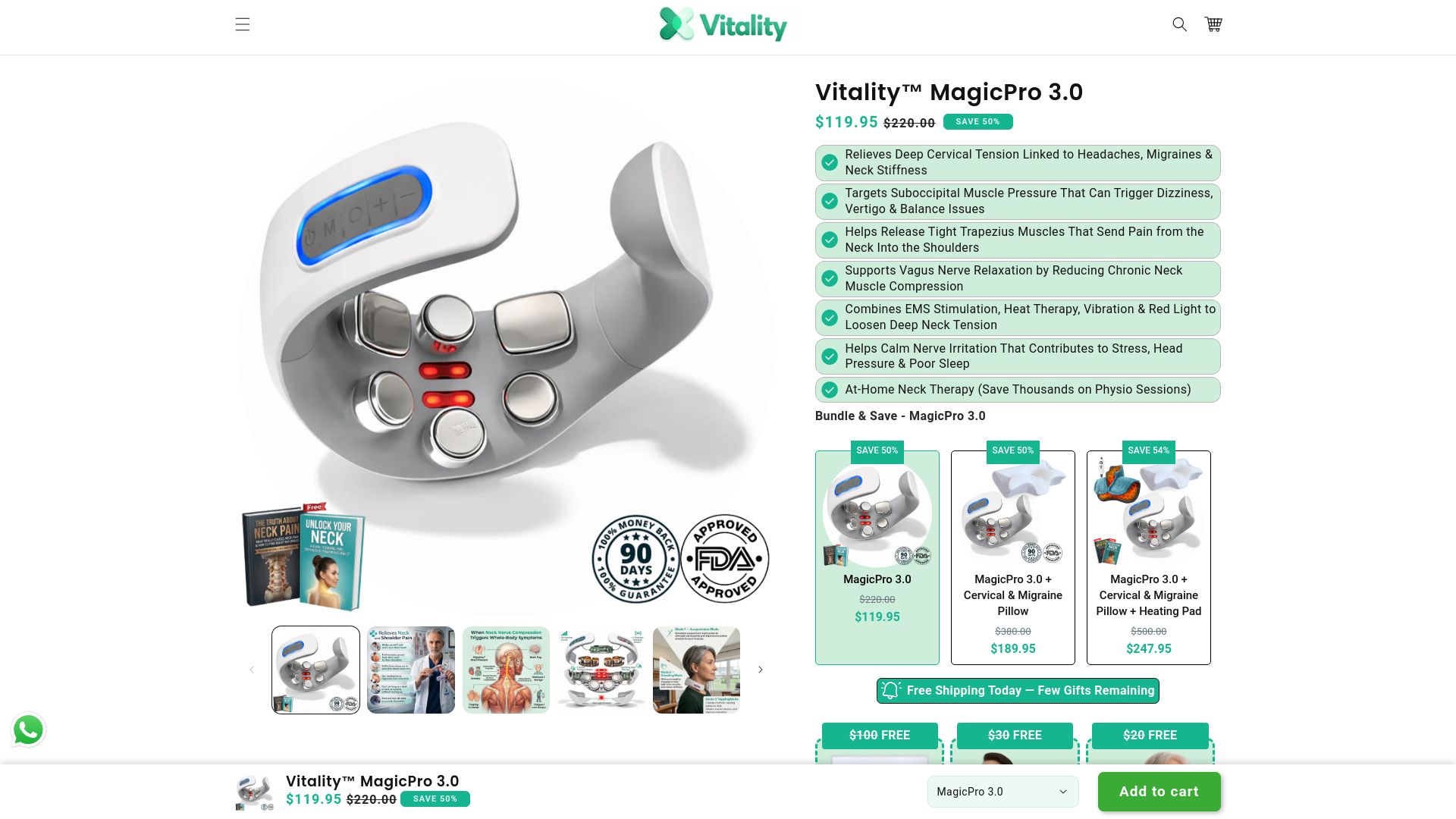
Every order includes an itemized receipt with product name, SKU, and price, ready to attach to your claim. Product spec sheets and clinical-use descriptions are available on request through customer support. If your plan requires additional documentation, the My Vitality team can help you pull together what you need.
Pay with your HSA or FSA card directly at checkout, or purchase and submit for reimbursement using the documents provided. Visit the MagicPro product page to review device specifications and place your order today.