


Most neck pain from driving comes down to posture and ergonomics, not injury, and it usually improves once you fix your seat and headrest setup, take regular microbreaks, and add a few targeted exercises. Right now, try three things: reset your headrest so it sits at ear level, relax your grip lower on the wheel to drop your shoulders, and set a timer to move every 45 to 60 minutes. The full setup guide and exercise routine are below.
TL;DR:
- Proper neck support requires adjusting the headrest to ear level and minimizing the gap behind the head to reduce strain during long drives.
- Seat and lumbar support should be set to maintain the spine’s natural curves, with a slightly reclined seatback and steering wheel positioned for relaxed elbows.
- Regular microbreaks every 45 to 60 minutes with simple neck stretches and posture resets are essential to prevent cumulative strain.
- Exercises like chin tucks, shoulder blade squeezes, and gentle neck rotations can activate deep neck muscles and restore mobility between drives.
- Persistent pain beyond two to three weeks may require professional evaluation, especially if accompanied by numbness, weakness, or coordination issues.
Table of Contents
- Why Does Your Neck Hurt When Driving?
- What In-Car Adjustments Reduce Neck Pain Fast?
- How Do You Set Up Your Car Seat for Neck Pain Relief?
- What Exercises Help Neck Pain From Driving?
- What Should You Do for Neck Pain After Driving?
- When Should You See a Doctor for Neck Pain?
- What Does the Research Say About Driving and Neck Pain?
- A Clinician-Minded Take on Fixing Driving Neck Pain
- A Portable Option for After-Drive Recovery
- Sources
- FAQ
Why Does Your Neck Hurt When Driving?
Your neck was not built to hold one position for an hour at a time, but that is exactly what driving asks of it. Forward head posture, common when the seat sits too far back or the mirrors force you to crane forward, puts sustained load on the muscles at the base of your skull. Add in road vibration and the constant small corrections your neck makes to keep your eyes level, and you get a slow, cumulative strain rather than a single dramatic injury.
A few specific mechanics make this worse behind the wheel:
- Reaching for a steering wheel that sits too far away elevates your shoulders and tightens your upper trapezius.
- Vibration from the road forces repetitive micro-adjustments in your neck muscles that most people never notice happening.
- A headrest set too low or too far back does nothing to support your neck during braking or long stretches of steady speed.
A cross-sectional study of 160 drivers found that those with neck pain showed a measurably smaller craniovertebral angle, meaning more forward head posture, along with reduced range of motion and weaker joint position sense compared to pain-free drivers. That is not a coincidence. It is your body adapting, poorly, to a repeated demand.
What In-Car Adjustments Reduce Neck Pain Fast?
Before you turn the key, run through this checklist. It takes less than two minutes and addresses the setup issues that cause most driving-related neck pain.
- Headrest height and depth. The top of the headrest should align with the top of your ears, and the gap between your head and the headrest should be small to provide adequate support.
- Seat and lumbar support. Set the lumbar support to fill the curve with your lower back, which takes pressure off your neck by keeping your spine stacked properly.
- Steering wheel reach. Tilt and extend the wheel so your elbows sit at a soft bend, not locked out straight, allowing comfortable arm positioning.
- Hand position. Rotate your grip periodically, holding the wheel lower rather than at the top, to keep your shoulders relaxed.
- Break timing. Take regular breaks to reset your posture and allow your neck muscles to recover during long drives.
Pro Tip: Set a recurring phone alarm for driving breaks instead of relying on memory. Neck strain builds gradually enough that most drivers do not notice it until the ache is already there.
How Do You Set Up Your Car Seat for Neck Pain Relief?
Ergonomic setup works best in a specific order, because each adjustment changes what the next one should be. Skip the sequence and you end up fixing one problem while creating another.
Start with seat height, high enough that you can see clearly over the dashboard without craning your neck forward. Next, set the seatback angle to roughly 100 to 110 degrees, slightly reclined rather than bolt upright, which naturally reduces the load on your cervical spine compared to a vertical seatback. Then dial in lumbar support so your lower back maintains its natural curve, followed by steering wheel reach for that soft elbow bend.
Adjust the headrest next, using the ear-level and 4-centimeter guidelines above. Mirrors come last, and that order matters more than most drivers realize:
- If you set your mirrors before finalizing your seat and headrest, you will unconsciously lean or crane to compensate once your real driving posture settles.
- Setting mirrors last forces you to confirm your neutral position is actually working, because you have to sit in your natural posture to see them correctly.
- Check that your feet reach the pedals without sliding forward in the seat, which undoes your lumbar and headrest work.
This sequence, detailed further here, gives you a repeatable setup you can run through in under a minute once it becomes habit.
What Exercises Help Neck Pain From Driving?
Five movements cover most of what a driver’s neck needs: activation, mobility, and release. None require equipment, and all fit into a rest stop or a few minutes before you start the car.
- Chin tucks. Pull your chin straight back, like making a double chin, without tilting your head down. Hold for 3 seconds, do 10 to 15 reps. This activates the deep neck flexors that forward head posture tends to shut off.
- Upper trapezius stretch. Tilt your ear toward your shoulder, use light hand pressure for a gentle pull, and hold 20 to 30 seconds per side. Follow with a slow self-massage along the top of the shoulder.
- Gentle rotation mobility. Turn your head slowly side to side, only as far as feels comfortable, for 8 to 10 reps per direction. This restores rotation that static driving posture gradually limits.
- Scapular retraction. Squeeze your shoulder blades together and hold for 5 seconds, 10 reps. This counters the rounded-shoulder position that steering wheel reach encourages.
- Side-bend and levator stretch. Tilt your head diagonally toward the opposite hip, holding 20 seconds per side. If you feel tingling or numbness radiating down an arm, stop and ease the stretch, or skip it and see a clinician.
Pro Tip: Do chin tucks at every red light. Ten seconds, no one notices, and it directly counters the posture your neck holds for the rest of the drive. For a fuller pre and post-drive routine, this quick commute guide walks through timing for each stretch.
What Should You Do for Neck Pain After Driving?
Heat and ice both work, but for different situations. Ice suits the first 48 hours after a flare or a sudden strain, applied for 10 to 20 minutes at a time. Heat works better for lingering stiffness without acute inflammation, and it relaxes tight muscle tissue before stretching.
- Over-the-counter anti-inflammatories can help with short-term discomfort, but check with your provider first if you take other medications regularly.
- TENS units and similar electrical stimulation devices can ease pain for some people, though they should never be used while driving and always require following the manufacturer’s guidance.
- If pain persists more than two to three weeks despite consistent self-care, a physical therapy evaluation can identify mobility or strength deficits that generic stretching will not fix on its own.
When Should You See a Doctor for Neck Pain?
Most driving-related neck pain responds to self-care within a couple of weeks. Certain symptoms mean it is time to stop self-treating and get evaluated.
- Progressive numbness or weakness in your arms or hands
- Loss of coordination or difficulty gripping objects
- Severe pain that starts suddenly after a collision or hard stop
- Any change in bowel or bladder function
The Mayo Clinic notes that most nontraumatic neck pain improves with posture correction, exercise, and basic self-care, while pain following an accident with severe symptoms warrants urgent evaluation. When you do see a clinician, bring your symptom timeline, what activities worsen it, and any prior imaging.
What Does the Research Say About Driving and Neck Pain?
The connection between driving posture and physical changes in the neck is not theoretical. It shows up in imaging and physical testing.
Drivers with neck pain in a 160-person cross-sectional study showed a craniovertebral angle roughly 6.3 degrees smaller than pain-free drivers, along with reduced flexion, reduced rotation, and measurably worse proprioception, the sense of where your head is positioned in space.
That gap between drivers with and without pain lines up closely with what ergonomic fixes and chin tuck exercises target directly: forward head posture and diminished neck awareness. The study’s authors note their sample size limits how broadly the findings generalize, but the pattern matches what physical therapists see clinically far more often than it contradicts it.
A Clinician-Minded Take on Fixing Driving Neck Pain
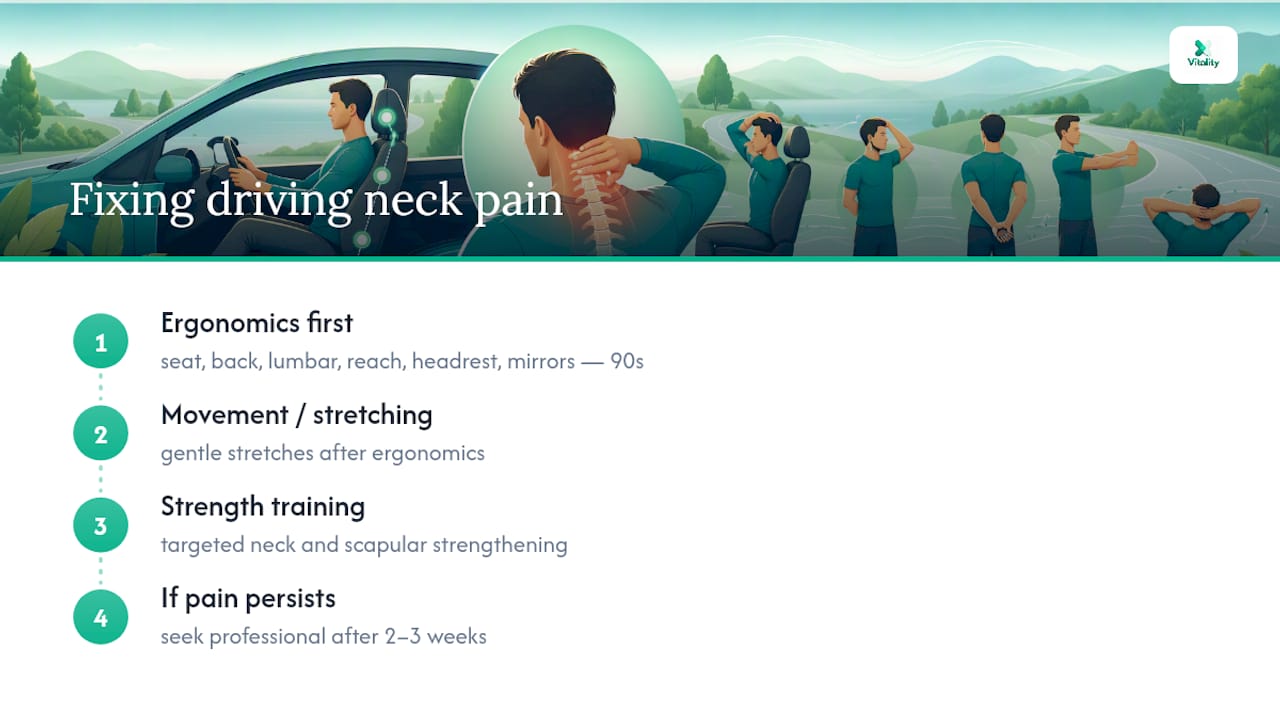
Fix things in order: ergonomics first, then movement, then strength. Skipping straight to exercises while your seat and headrest are still misconfigured is like stretching a muscle you keep re-injuring every drive.
Before you start the car, run this: seat height, seatback angle, lumbar support, wheel reach, headrest, mirrors. Ninety seconds, done. If pain persists past two to three weeks despite consistent setup changes and stretching, that is your signal to get a professional evaluation rather than pushing through it.
— Achraf
A Portable Option for After-Drive Recovery
Ergonomic fixes and stretching handle most driving-related neck strain, but there are days when your neck still feels tight after a long commute or a stretch of highway driving. That is where a portable device like the MagicPro 2.0 fits in, not as a replacement for the setup and exercises above, but as an added step once you have parked and stepped out of the car.
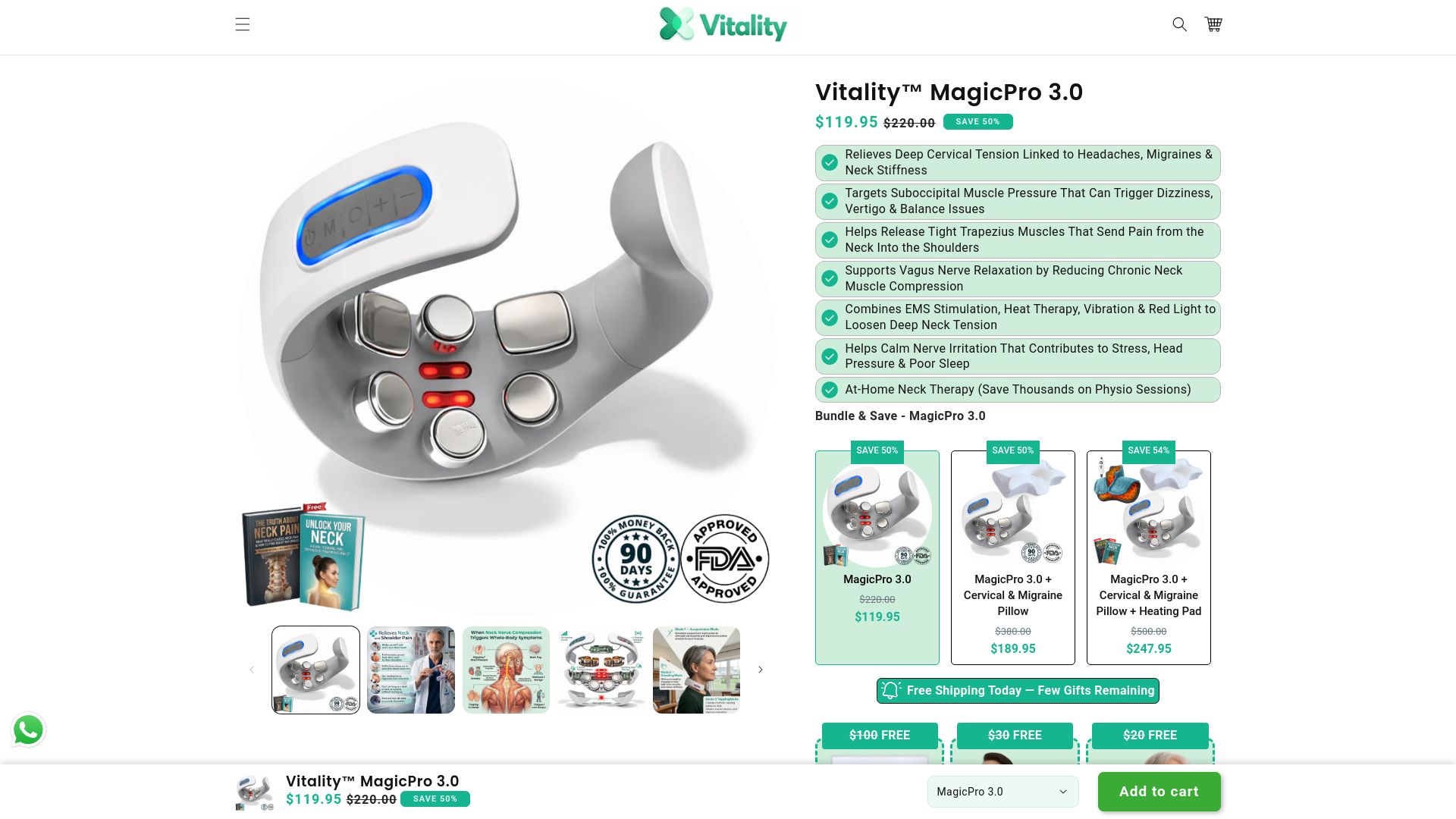
The device combines electrical muscle stimulation, heat, and massage in a single unit you can use at home, at your desk, or wherever you land after driving, in about 15 minutes. It will not correct a poorly adjusted headrest or fix your seatback angle, but for muscle tension that lingers after you have addressed the mechanics, it adds a heat and stimulation option without a trip to a clinic. Check the MagicPro product page for current warranty and return details before you buy, and use it only after you have stopped driving for the day, never behind the wheel.
Sources
- Neck pain - Symptoms and causes - Mayo Clinic
- Cervical Health Parameters in Car Drivers: Assessing the Influence of Driving on Neck Pain, Mobility, Proprioception and Craniovertebral Angle - PMC
This article is general information, not a substitute for advice from a qualified doctor. Consult a qualified healthcare professional about your own circumstances before acting on anything here.
FAQ
What Is a Red Flag for Neck Pain?
Progressive numbness, weakness, loss of coordination, or bowel and bladder changes are red flags that call for prompt medical evaluation rather than home care.
How Long Does Neck Pain Take to Go Away After a Car Accident?
Muscle strain from everyday driving posture often eases within one to two weeks of consistent self-care, but pain following a collision can take longer and needs a clinical evaluation to rule out more serious injury.
Can You Drive With a Pinched Nerve in Your Neck?
It depends on severity. Mild nerve irritation may not prevent driving, but numbness, weakness, or reduced grip strength in your arms can impair your ability to control the wheel safely, so a clinician should assess this before you get back behind the wheel.
How Do You Support Your Neck While Driving?
Set your headrest at ear level with minimal gap behind your head, keep your seatback around 100 to 110 degrees, and take breaks every 45 to 60 minutes to reset your posture and stretch.