


Pain between your neck and shoulder blade almost always comes from one of three sources: a strained levator scapulae or other neck muscle, scapular dyskinesis (poor shoulder blade movement), or a pinched nerve in your cervical spine sending pain down to the scapula. If your pain is dull, achy, and worse by the end of the workday, self-care usually works. If it’s sharp, electric, or paired with numbness, tingling, or arm weakness, you need a clinician to look at it.
Here’s what to do right now, before anything else:
- Pause and check your posture. If you’ve been hunched over a screen, that’s often the trigger.
- Apply heat if the pain feels tight and achy; use ice if it started suddenly or feels inflamed.
- Move gently. Slow neck rotations and shoulder rolls, not aggressive stretching.
- Skip heavy lifting or overhead reaching until you know what you’re dealing with.
Thoracic and upper back pain, including the region between the shoulder blades, affects an estimated 15% to 35% of adults every year, according to a widely cited prevalence study. Most of it is muscular and temporary. The Cleveland Clinic and the American Academy of Orthopaedic Surgeons both note that this pain zone is a common site of diagnostic confusion, because neck problems, shoulder problems, and pure muscle strain all overlap right where your scapula sits.
If your pain came on gradually with no injury and doesn’t shoot down your arm, it’s probably muscular. If it arrived suddenly with numbness or weakness, treat it as a nerve issue until proven otherwise.
Key Takeaways
Most neck-to-scapula pain traces back to levator scapulae strain, scapular dyskinesis, or cervical nerve root irritation, and matching the pattern to the cause determines which treatment actually helps.
| Point | Details |
|---|---|
| Identify the pattern first | Dull, day-long ache suggests muscle strain; sharp, radiating pain with numbness suggests a nerve issue. |
| Levator scapulae is the usual suspect | This neck-to-shoulder-blade muscle tightens easily from poor desk posture and screen habits. |
| Give conservative care time | Muscular pain often improves in 2 to 4 weeks; radiculopathy may take 8 to 12 weeks with proper care. |
| Know your red flags | Chest pain, progressive weakness, or loss of bladder control need urgent same-day evaluation. |
| Combine exercise with support tools | Devices like the Vitality™ MagicPro 2.0 and MagicPro 3.0 add heat, EMS, and massage between PT sessions to ease muscle guarding. |
Table of Contents
- What Anatomy Explains Neck Scapula Pain
- Common Causes of Pain Between the Neck and Shoulder Blade
- Is It Your Neck, Shoulder, or Shoulder Blade Causing the Pain?
- When to See a Doctor for Neck and Shoulder Blade Pain
- What Happens During a Neck and Scapula Exam
- Treatment Options That Actually Work for Neck Scapula Pain
- Exercises for Neck and Scapula Pain Relief
- Self-Care Techniques for Scapular Pain Relief
- How to Prevent Neck and Shoulder Blade Pain From Coming Back
- An At-Home Device Option Worth Considering for Neck Scapula Pain
- Let My Vitality Support Your Recovery Between Sessions
- Frequently Asked Questions
- Sources
What Anatomy Explains Neck Scapula Pain
Your shoulder blade doesn’t float in isolation. It’s anchored by a web of muscles that also attach to your cervical spine, which is exactly why pain in one area so often shows up in the other.
The levator scapulae is the main culprit in most cases. It runs from the top four cervical vertebrae down to the upper inner corner of your scapula, and its job is to lift the shoulder blade and help rotate your neck. Sit at a desk with your head tilted toward a phone for eight hours, and this muscle stays in a low-grade contraction the entire time. That’s why so many people describe a tight, ropy knot right at the top inside edge of the shoulder blade.
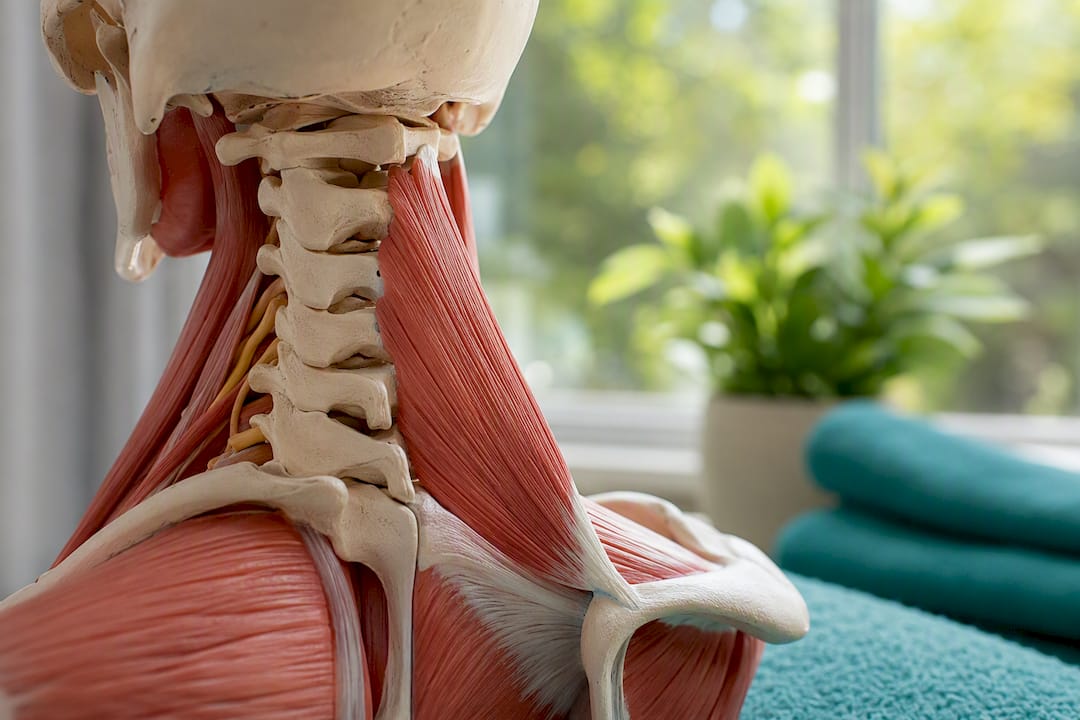
The rhomboids sit lower, connecting your spine to the inner border of the scapula, and they’re responsible for pulling your shoulder blades together. Weak or overstretched rhomboids let your shoulders round forward, which drags the levator scapulae into overtime. The trapezius, particularly its upper and middle fibers, layers over both and connects the base of your skull down through your shoulder girdle.
Then there’s the nerve piece, which explains why some scapular pain has nothing to do with a tight muscle at all. Your cervical nerve roots, especially C5 through C7, exit the spine and travel toward the shoulder and arm. When one of these roots gets irritated or compressed, scapular pain can appear before arm symptoms ever show up, with C6 and C7 most frequently implicated in radicular patterns that reach the scapula.
- Levator scapulae: neck-to-scapula connector, most common source of muscular pain here.
- Rhomboids: pull shoulder blades together; weakness contributes to rounded posture.
- Trapezius: broad coverage from skull to shoulder girdle.
- Cervical nerve roots (C5 to C7): can refer pain to the scapula before any arm symptoms appear.
One more mechanical detail matters: scapular rhythm, the coordinated way your shoulder blade glides across your rib cage as you raise your arm. When that rhythm breaks down, a pattern called scapular dyskinesis, the stabilizing muscles pick up load they weren’t built to carry, which is a direct path to chronic discomfort.
Common Causes of Pain Between the Neck and Shoulder Blade
Most people land in one of six categories. Matching your pattern to the right one saves time and guesswork.
Muscle strain and levator scapulae trigger points. This is the most frequent cause by far, especially in desk workers. A tight band of muscle develops a hyperirritable trigger point, often right at the corner of the shoulder blade, and pressing on it reproduces the familiar ache. Poor posture, sleeping in an awkward position, or carrying a heavy bag on one shoulder all feed this pattern.
Scapular dyskinesis. When your shoulder blade doesn’t track correctly during arm movement, the stabilizing muscles around it get overloaded, and pain often shows up at the shoulder blade before the shoulder joint itself becomes a problem. Athletes who throw or swing overhead, along with people who spend hours reaching forward at a keyboard, are especially prone to this.
Cervical radiculopathy. A compressed or irritated nerve root in the neck can send pain straight to the scapula. This tends to feel different from muscular pain: sharper, sometimes electric, and it may come with numbness or tingling down the arm.
Referred pain from the cervical spine. Even without a true pinched nerve, arthritic changes in the small facet joints of the neck can refer pain to the shoulder blade area. Neck problems are a frequent hidden cause of what feels like shoulder pain, which is why a thorough exam matters more than guessing.
Shoulder-origin conditions. Rotator cuff tendinopathy, subacromial impingement, and bursitis can all refer discomfort to the scapula, particularly with overhead activity or when lying on the affected side at night.
Less common causes. Restricted movement in the thoracic spine joints can mimic scapular pain. Rarely, pain in this region has a visceral origin (gallbladder or cardiac issues, for instance), which is one reason sudden, severe, or unusual pain warrants medical attention rather than a foam roller.
Two quick scenarios show how different these can look:
- A desk worker with a burning, fatigued ache that builds through the afternoon and eases over the weekend: classic muscular/postural pattern.
- Someone with sudden, sharp, electric pain radiating down the arm with tingling in the fingers: think cervical radiculopathy, not a strained muscle.
Is It Your Neck, Shoulder, or Shoulder Blade Causing the Pain?
Pinning down the source matters because the treatment for a strained muscle looks nothing like the treatment for a pinched nerve. Three patterns tend to separate cleanly if you know what to look for.
Nerve-related pain tends to be sharp, electric, or burning, and it often radiates from the neck down toward the scapula or arm. Numbness, tingling, or noticeable weakness in the hand or arm are the biggest tells. This pattern can also worsen with certain neck positions, particularly tilting the head back and toward the painful side.
Muscular or postural pain feels duller and more diffuse. It’s usually worse by the end of the day, improves with movement and stretching, and stays localized without radiating past the shoulder. Desk-based postural pain in particular tends to build steadily through work hours and eases with position changes and rest.
Shoulder-origin pain shows up most with overhead reaching, and it frequently disrupts sleep when you lie on that side. Weakness with specific shoulder movements, rather than the whole arm, points here rather than to the neck.
A few simple self-checks can help you sort this out before you ever see a clinician:
- Hand-on-head test: Rest your hand on top of your head. If this relieves nerve-type pain, it’s a strong sign of cervical nerve root involvement.
- Neck movement provocation: Tilt your head back and toward the painful side. Reproducing sharp or radiating pain suggests a cervical source rather than a purely muscular one.
- Reach and overhead test: Raise your arm overhead. Pain specifically with this movement, especially at night, points toward the shoulder joint rather than the neck or scapula muscles.
Before any appointment, jot down answers to these questions. Clinicians move faster with a clear symptom timeline than with a vague description of “it hurts.”
- When did the pain start, and was there a specific triggering event?
- Is the pain constant or does it come and go with activity or position?
- Does it radiate anywhere, and if so, where?
- Any numbness, tingling, or weakness in the hand or arm?
- What makes it better or worse?
When to See a Doctor for Neck and Shoulder Blade Pain
Most neck-to-scapula pain is safe to manage at home for a few weeks. A smaller subset needs faster attention, and a few signs need it immediately.
Treat these as urgent, same-day or emergency-level symptoms:
- Chest pain, pressure, or shortness of breath alongside the discomfort.
- Sudden, severe weakness in the arm or hand.
- Loss of bowel or bladder control.
- Progressive, worsening arm weakness over days.
- Numbness spreading rather than staying in one spot.
Pain that shows up with chest tightness or breathing trouble is never a “wait and see” situation, regardless of how much it resembles a pulled muscle.
For everything else, timeline matters. Give straightforward muscular pain one to two weeks of self-care, heat, gentle movement, posture correction, before deciding it needs more. If you’re not improving after two to three weeks, or if you suspect nerve involvement from the start, book a physical therapy evaluation. Conservative treatment resolves many cases of cervical radiculopathy within 8 to 12 weeks, so that window is a reasonable benchmark before pushing for imaging or a specialist referral.
A sensible path for most readers: start with your primary care provider or a physical therapist directly (many states allow direct PT access), and escalate to spine orthopedics or neurology only if conservative care stalls or red flags emerge.
What Happens During a Neck and Scapula Exam
A thorough exam usually takes fifteen to twenty minutes and relies more on physical tests than machines. Expect a clinician or physical therapist to move through several checks.
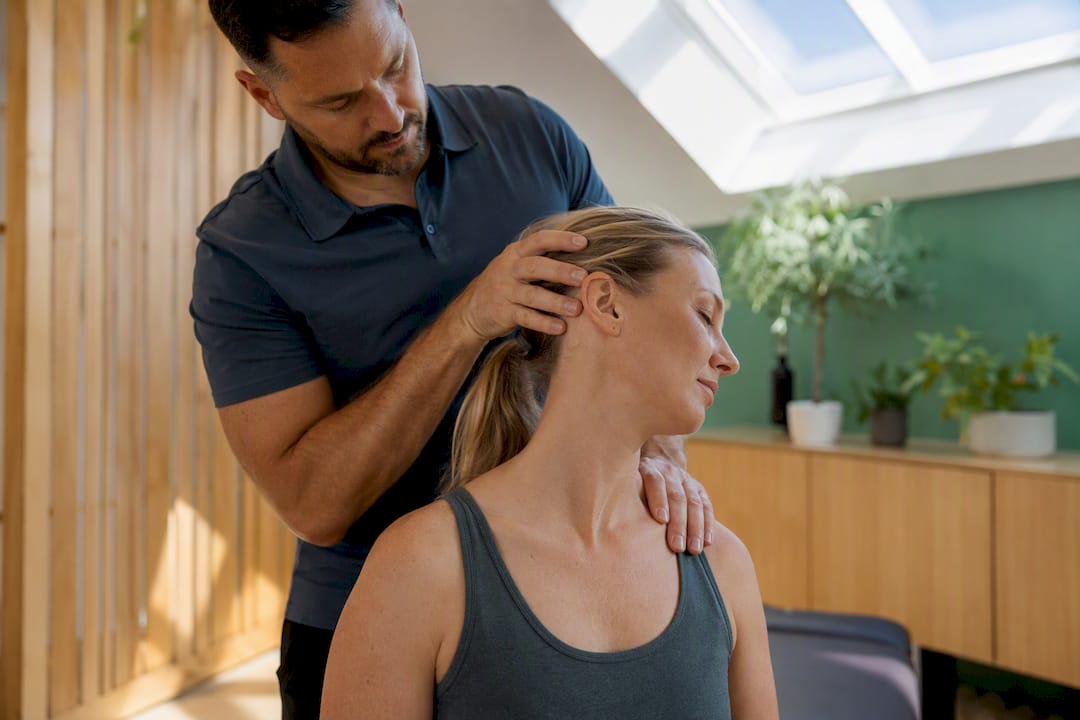
Range of motion testing comes first: how far you can turn, tilt, and extend your neck, and whether any direction reproduces your pain. Strength testing follows, checking specific muscle groups tied to different nerve roots, since weakness in one muscle but not another helps localize the problem.
Spurling’s test is a classic maneuver where the clinician gently tilts and rotates your head while applying light downward pressure. Reproducing arm or scapular pain suggests nerve root compression. Provocative shoulder tests, movements that stress the rotator cuff or impingement space, help rule the shoulder joint in or out. Finally, scapular movement assessment watches how your shoulder blade tracks as you raise your arm, catching dyskinesis that wouldn’t show up on a strength test alone.
Imaging isn’t the first step for most people, and that’s intentional. X-rays, MRI, and other imaging are generally reserved for cases involving trauma, progressive neurologic signs, or pain that persists despite weeks of appropriate conservative care. An X-ray shows bone alignment and arthritic changes. An MRI reveals disc herniation, nerve compression, and soft tissue detail. EMG (electromyography) tests how well nerves are conducting signals to muscles, useful when radiculopathy is suspected but not confirmed by exam alone.
In ambiguous cases, a diagnostic injection, numbing a specific nerve root or joint, can confirm the pain source by temporarily eliminating it. If the injection relieves your scapular pain, that nerve root or joint is very likely the cause.
Treatment Options That Actually Work for Neck Scapula Pain
Treatment follows a logical order: start conservative, escalate only if needed, and reserve procedures for cases that don’t respond or that show clear neurologic involvement.
First-line self-care covers the first one to two weeks for most muscular pain:
- Modify the activity that’s aggravating it, whether that’s screen posture, a heavy bag, or a repetitive lifting task at work.
- Apply heat for tight, achy muscle pain, or ice if the onset was sudden or feels inflamed.
- Use over-the-counter NSAIDs short-term if appropriate for you, following label guidance.
- Add gentle mobility work: slow neck rotations, shoulder rolls, and light scapular squeezes.
Physical therapy is the next tier, and it’s where most people see real, lasting change. Manual therapy combined with a home exercise program consistently outperforms passive treatment alone for this type of pain. A physical therapist typically works through:
- Manual therapy to release tight tissue and restore joint mobility.
- Scapular stabilization exercises targeting the muscles that control shoulder blade position.
- Progressive strengthening once acute pain settles.
- Movement retraining so the faulty pattern that caused the problem doesn’t just come right back.
Injections and surgery sit at the far end of the spectrum, and they’re appropriate only after conservative care has failed or when there’s progressive neurologic weakness. Epidural steroid injections can calm severe nerve root inflammation. Discectomy or spinal fusion are reserved for structural problems that don’t respond to anything else, a small minority of cases.
Recovery timelines vary by cause, but a rough guide holds up well: muscular strain typically improves within two to four weeks of consistent self-care. Cervical radiculopathy often takes longer, with many cases resolving within 8 to 12 weeks of conservative management.
Exercises for Neck and Scapula Pain Relief
These exercises target the two things that go wrong most often: a tight, overworked levator scapulae and weak scapular stabilizers that let your shoulder blade drift out of position. Do them slowly, and stop immediately if anything produces sharp or radiating pain rather than a mild, tolerable stretch or muscle burn.
- Chin tucks. Sit tall, gently draw your chin straight back like you’re making a double chin, hold for 5 seconds, repeat 10 times. This retrains neck posture and takes pressure off the levator scapulae.
- Levator scapulae stretch. Turn your head 45 degrees, then look down toward your armpit while gently pulling the back of your head with one hand. Hold 20 to 30 seconds, twice per side.
- Scapular squeezes. Pull your shoulder blades together as if pinching a pencil between them, hold 5 seconds, release. Do 2 sets of 15.
- Prone Y, T, and I raises. Lying face down, lift your arms into a Y shape, then a T, then straight overhead (I), each for 10 reps. This builds the mid and lower trapezius, which most desk workers badly need.
- Band rows. Anchor a resistance band, pull toward your torso while squeezing your shoulder blades together, 2 to 3 sets of 12.
- Wall slides. Stand with your back against a wall, arms in a goalpost position, slide them overhead while keeping contact with the wall. 2 sets of 10.
- Serratus anterior slides (wall push-up plus). From a wall push-up position, push your upper back away from the wall at the top of the movement. 2 sets of 12.
Progress gradually. Add resistance or reps only once the current level feels easy and pain-free for several days in a row. Stop any exercise that triggers sharp pain, numbness, or tingling, and check in with a physical therapist rather than pushing through it.
Pro Tip: Pair one stretch with one strengthening move every morning, chin tucks and scapular squeezes take under two minutes combined, and you’ll cover both sides of the muscular imbalance that causes most of this pain.
Self-Care Techniques for Scapular Pain Relief
Beyond structured exercise, a handful of daily habits make a measurable difference in how your neck and scapula feel by evening.
Use heat for tight, chronically tense muscles, a warm compress for 15 to 20 minutes loosens the levator scapulae and improves blood flow. Reach for ice instead if pain started suddenly or feels swollen and acute, 10 to 15 minutes at a time.
Self-massage and trigger-point work target the exact spots where levator scapulae and rhomboid pain concentrate. Press a lacrosse ball or firm foam roller against the inner edge of the shoulder blade, lean into a wall, and hold gentle sustained pressure on any tender spot for 30 to 60 seconds. Avoid pressing directly on bone or rolling aggressively over the spine itself.
Desk setup matters more than most people realize:
- Raise your monitor so the top of the screen sits at eye level, this alone reduces forward head posture significantly.
- Keep your keyboard close enough that your elbows stay near your sides, not reaching forward.
- Set a timer for a two-minute posture break every 45 to 60 minutes.
- Sleep on your back or side with a pillow that keeps your neck neutral, avoid stomach sleeping, which twists the cervical spine for hours at a time.
Pro Tip: A tennis ball works in a pinch, but a firm lacrosse ball holds its shape under pressure and targets trigger points more precisely, keep one in your desk drawer for a quick midday reset.
How to Prevent Neck and Shoulder Blade Pain From Coming Back
Preventing a repeat episode comes down to consistency, not intensity. A five-minute daily routine beats an occasional intense session every time.
Build a simple daily rhythm: a two-minute posture check and micro-break every hour, five minutes of scapular activation (squeezes, wall slides, or band rows) once a day, and a brief mobility warm-up before any activity that involves reaching or lifting. Aim for two to three dedicated strength sessions per week targeting the rhomboids, mid-trapezius, and serratus anterior, the muscles that keep your scapula tracking properly.
Your workspace setup deserves a real audit, not just a mental note:
- Monitor at eye level, roughly an arm’s length away.
- Keyboard and mouse close enough to keep elbows at your sides.
- Phone calls on speaker or headset instead of cradled between ear and shoulder.
- Chair with lumbar support that keeps your spine in a neutral, upright position.
Load management matters just as much for a desk job as it does for lifting weights. If you’re returning to activity after a flare-up, addressing thoracic spine mobility often solves the piece that posture correction alone misses, and increasing intensity gradually, rather than jumping back to full activity, cuts recurrence risk substantially. Sleep setup rounds this out: a supportive pillow that keeps your cervical spine neutral prevents the overnight strain that shows up as morning stiffness.
An At-Home Device Option Worth Considering for Neck Scapula Pain
Exercise and posture correction do the heavy lifting for most neck and scapula pain, but a well-designed at-home device can support that work between sessions. Devices that combine massage, heat, and electrical stimulation can help ease muscle guarding when used alongside an active exercise routine, though they’re not a replacement for medical evaluation if you have numbness, weakness, or other nerve symptoms.
My Vitality’s Vitality™ MagicPro 2.0 and Vitality™ MagicPro 3.0 both combine electrical muscle stimulation, heat, and massage into a single wearable unit, with the MagicPro 3.0 adding vibration therapy for a broader range of sensory input. The idea is straightforward: instead of juggling a heating pad, a massage ball, and a separate TENS unit, one device handles all three in a 15-minute session.
Practical use looks like this for neck-to-scapula discomfort:
- Position the device across the base of the neck and upper shoulders, covering the upper trapezius and levator scapulae attachment points.
- Start with a single 15-minute session daily, adjusting intensity to a level that feels strong but never painful.
- Use it after your stretching and strengthening routine, not as a replacement for it, to help muscles relax before or after active work.
Realistic expectations matter here: most customers report improvement in tension and comfort over days to weeks of consistent use, alongside, not instead of, movement and posture correction.
A few contraindications apply. Skip EMS-based devices if you have a pacemaker or other implanted electrical device, open wounds or active skin infections at the placement site, or are pregnant, unless your clinician has specifically cleared it. If you have numbness, tingling, or arm weakness, see a clinician before starting any device-based therapy, since those symptoms suggest a nerve issue that heat and massage alone won’t resolve.
Pro Tip: Use a device session right before your evening stretches, warm, relaxed muscle tissue stretches more effectively than cold, tense tissue.
A practical take on managing neck-to-scapula pain
Most people overcorrect in one direction or the other: either they ice and rest indefinitely, hoping the pain disappears on its own, or they push through sharp, nerve-type symptoms because “it’s probably just tight muscles.” Neither serves you well. The evidence consistently favors early, gentle movement over prolonged rest for muscular pain, and equally consistently favors caution and evaluation the moment numbness or weakness enters the picture. The skill isn’t picking one approach and sticking with it. It’s knowing which category your pain falls into, then matching your response to it.
Let My Vitality Support Your Recovery Between Sessions
Stretching and posture fixes handle the root cause, but the hours between exercise sessions are where a lot of people lose ground, especially if you’re back at a desk for eight hours right after a good stretch routine. My Vitality’s MagicPro devices give you a 15-minute reset you can use at your desk, in the car, or before bed, without the cost or scheduling hassle of a standing massage therapy appointment.
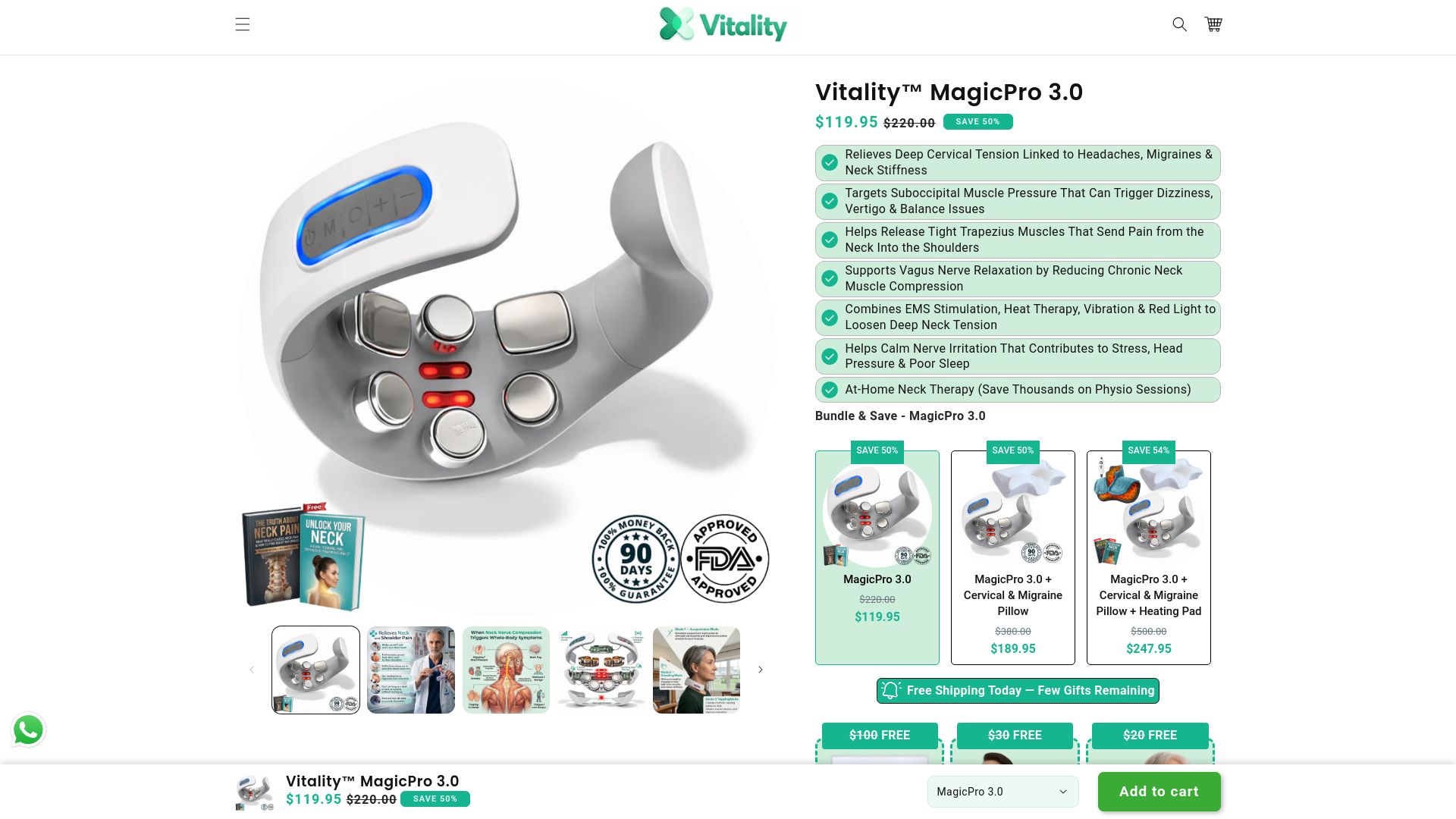
The Vitality™ MagicPro 2.0 combines EMS, heat, and massage in one wearable unit built for daily use around the neck and upper shoulders. If you want the added vibration therapy layer, the Vitality™ MagicPro 3.0 extends that same core approach with a broader range of sensory input for deeper relaxation. Both ship with warranty coverage and customer support if you have questions about fit or settings.
If your discomfort extends lower into your back, the Vitality™ Adaptive Therapy System applies the same combined therapy approach to the lumbar region. Pair either neck device with the stretching routine covered earlier, and check the full guide to at-home neck therapy devices if you want a deeper look at how daily use fits into a broader recovery plan. Ready to try it for yourself? Pick the MagicPro that fits your routine and start your first 15-minute session tonight.
Frequently Asked Questions
What does it mean when pain is between your neck and shoulder blade?
It usually points to a strained levator scapulae muscle, a movement imbalance in the shoulder blade called scapular dyskinesis, or referred pain from a cervical nerve root. Dull, day-long pain leans muscular; sharp or radiating pain leans nerve-related.
Can a pinched nerve in the neck cause shoulder blade pain?
Yes. Cervical radiculopathy, most often involving the C6 or C7 nerve root, can send pain directly to the scapula, sometimes before any arm symptoms appear at all.
How long does neck and scapula muscle strain take to heal?
Most muscular strain improves within two to four weeks of consistent self-care, gentle movement, heat, and posture correction. Nerve-related pain can take longer, often resolving within 8 to 12 weeks with conservative treatment.
When should I worry about neck and shoulder blade pain?
Seek urgent care if you have chest pain, shortness of breath, sudden severe weakness, spreading numbness, or loss of bladder or bowel control. Otherwise, two to three weeks without improvement is a reasonable point to see a physical therapist.
What exercises help pain between the neck and shoulder blade?
Chin tucks, levator scapulae stretches, scapular squeezes, prone Y-T-I raises, band rows, and wall slides address both the tight muscle and the weak stabilizers that usually drive this pain.
Can a device like the MagicPro help with scapular pain?
Combined heat, massage, and EMS can ease muscle tension and support an exercise routine, but they don’t replace medical evaluation if you have numbness, tingling, or arm weakness.
This article is general information, not a substitute for advice from a qualified doctor. Consult a qualified healthcare professional about your own circumstances before acting on anything here.
Sources
- Thoracic back pain prevalence study
- Scapular and shoulder‑blade disorders — OrthoInfo (AAOS)
- Scapular pain in cervical radiculopathy: scoping review (PMC)
For at-home relief options, visit My Vitality to explore the full MagicPro lineup.