


Start this week with a simple, multi-part routine: a 10–15 minute neck exercise session each morning, a microbreak every 30–45 minutes, one quick workstation check, and energy-aligned task scheduling. These four steps, drawn from clinical guidance and peer-reviewed trials, are the most direct way to reduce neck pain productivity impact and get your focus back.
Your week-one plan:
- Set a timer every 30–45 minutes to stand, roll your shoulders, and do two or three gentle neck movements.
- Spend 10–15 minutes on targeted neck exercises before or during your workday (chin tucks, isometric holds, scapular retractions).
- Raise your monitor so the top of the screen sits at eye level — this single fix reduces forward-head loading immediately.
Daily checklist for week one:
- Morning: 10–15 minute neck routine before sitting down
- Every 30–45 minutes: 60-second movement break (stand, walk, shoulder rolls)
- Midday: quick workstation check (screen height, chair back, keyboard position)
- Pain days: OTC ibuprofen or acetaminophen as directed; ice for the first 48–72 hours, then heat in 15-minute intervals
- Schedule deep-focus work during your highest-energy window, not your first available slot
Pro Tip: Schedule your two hardest tasks during your personal energy peak, not just your first open calendar slot. When neck pain raises your cognitive load, protecting that peak window preserves more output than working longer hours.
Table of Contents
- How much does neck pain actually cost your workday?
- What to do in the first 2–3 weeks of acute neck pain
- Practical workstation fixes that reduce neck strain
- How to build a neck exercise program that actually holds
- Work strategies that protect your output on pain days
- When self-care isn’t enough: red flags and care pathways
- Key Takeaways
- The part most guides skip: consistency beats intensity
- A 15-minute daily option to support your recovery
- Authoritative sources and further reading
How much does neck pain actually cost your workday?
Neck pain is one of the most common reasons office workers lose productive time, and the numbers are specific enough to take seriously. Among office workers in employer-focused studies, prevalence varies widely among office workers in employer-focused studies, and baseline productivity loss in the NEXpro randomized controlled trial was significant before any intervention. A cross-sectional study of office workers found that 16.4% reported missing work in the prior year due to neck pain, with a meaningful share losing more than a week.
The Work Productivity and Activity Impairment Questionnaire (WPAI) captures both absenteeism (days missed) and presenteeism (reduced output while present). Presenteeism is the larger, less visible cost: workers show up but operate at reduced capacity, and that lost output rarely gets counted.
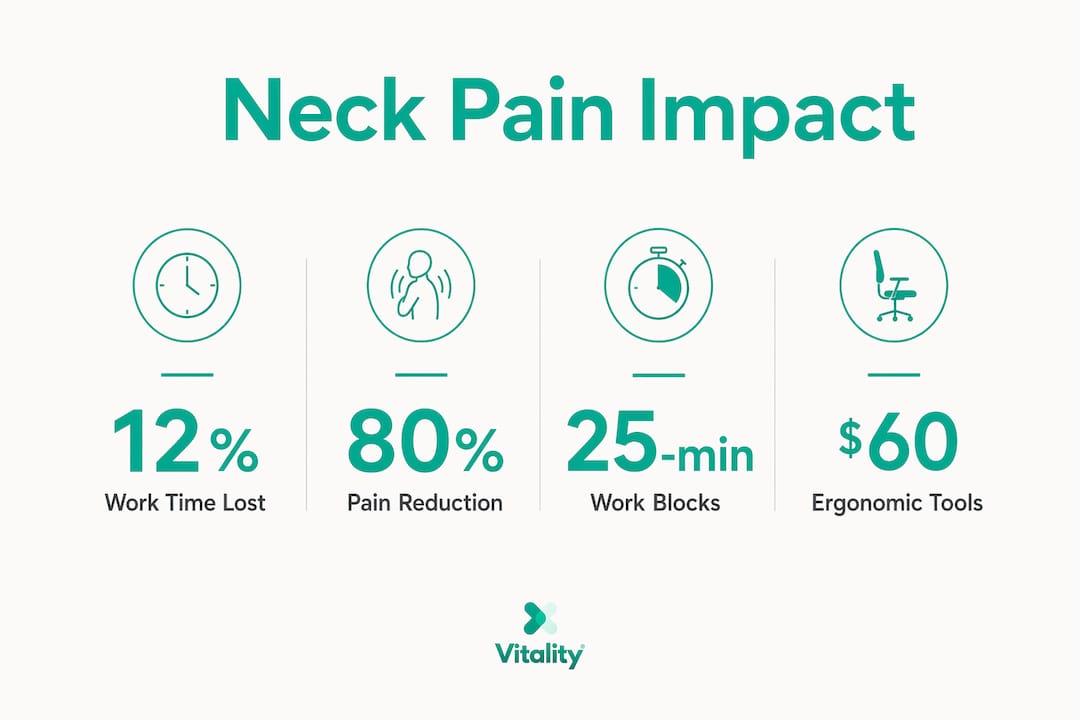
12% of working time — the average productivity loss at baseline among office workers enrolled in the NEXpro multi-component intervention trial.
After a 12-week multi-component program combining ergonomics, neck-specific exercises, and health promotion, the NEXpro trial recorded a 2.8 percentage point reduction in neck pain–related productivity loss. A companion cost-utility analysis found the program broke even roughly six days after the intervention ended, with favorable quality-adjusted life year (QALY) outcomes.
| Metric | Baseline | Post-Intervention |
|---|---|---|
| Productivity loss (% of working time) | 12% | 9.2% (2.8 percentage points reduction) |
| Weekly saved cost per participant | — | CHF 27.40 |
| Program break-even point | — | ~6 days post-program |
Outcomes employers track:
- Absenteeism (days missed)
- Presenteeism (reduced on-the-job output)
- QALYs (quality-adjusted life years)
- ROI and cost-benefit break-even
What to do in the first 2–3 weeks of acute neck pain
Self-care is the appropriate first response for non-serious neck pain. Mayo Clinic guidance recommends a 2–3 week window of conservative self-management before escalating to professional care, unless red flags appear (covered below).
Step-by-step first-line care:
- Ice first. Apply cold for the first 48–72 hours in 15-minute intervals to reduce inflammation and numb acute pain.
- Switch to heat. After the initial acute phase, a heating pad or warm compress in 15-minute sessions helps relax tight muscles.
- OTC pain relief. Ibuprofen (Advil, Motrin), naproxen (Aleve), or acetaminophen (Tylenol) can manage mild to moderate pain. Follow package dosing.
- Stay gently active. Short walks and gentle range-of-motion movements support recovery. Prolonged immobilization — including extended collar use or complete bed rest — weakens muscles and delays healing.
- Adjust your sleep setup. A supportive pillow that keeps your neck neutral reduces overnight strain. Avoid sleeping on your stomach.
Two responses to avoid: lying in bed all day and wearing a cervical collar for extended periods. Both feel protective but work against recovery by reducing muscle activation and circulation.
Daily symptom-control checklist:
- Ice or heat in 15-minute intervals (not longer)
- OTC analgesic as directed on the label
- Two or three short walks spread through the day
- Gentle neck movements within a pain-free range
- Sleep on your back or side with a neutral-support pillow
Pro Tip: Pair symptom control with short, focused work blocks of 25–30 minutes. Completing one meaningful task, even on a pain day, reduces the mental fatigue that comes from feeling unproductive.
Practical workstation fixes that reduce neck strain
Small, focused workstation changes combined with frequent movement outperform expensive equipment alone; for additional tips on easing muscle tension caused by workplace stress, see how to reduce work pressure and muscle tension effectively. Harvard Health is direct on this point: the biggest ergonomic risk is prolonged static posture, and no chair or monitor arm eliminates that risk without regular movement.
60-second workstation check:
- Monitor height: Top of screen at or just below eye level. If you’re looking down at a laptop, add a riser and an external keyboard.
- Monitor distance: Roughly arm’s length (18–24 inches) from your face.
- Chair back: Lumbar support contacting your lower back; backrest reclined slightly (100–110°).
- Armrests: Elbows at roughly 90°, shoulders relaxed, not shrugged.
- Keyboard and mouse: Close to the body, wrists neutral, not bent upward.
- Phone: Use a headset or speakerphone. Cradling a phone between ear and shoulder is one of the fastest ways to load the neck asymmetrically.
For hybrid workers, a laptop stand, external keyboard, and a wireless mouse cost under $60 combined and eliminate the most common neck-loading posture in remote work.
| Workstation Element | Quick Fix | Low-Cost Tool |
|---|---|---|
| Monitor too low | Stack books or use a riser | Monitor riser ($15–30) |
| Laptop-only setup | Add external keyboard + mouse | Keyboard + mouse bundle ($25) |
| Phone cradling | Switch to hands-free | Wired or Bluetooth headset ($20–50) |
| Chair without lumbar support | Roll a towel for lumbar curve | Lumbar cushion ($20–35) |

Sit/stand and movement: Alternating between sitting and standing every 30–45 minutes reduces cumulative neck loading. You don’t need a motorized desk — standing for one or two minutes during a call or while reading an email achieves a similar postural reset.
Pro Tip: Do your 60-second workstation check during the first minute of a recurring meeting, while you’re waiting for others to join. It takes no extra time and keeps your alignment consistent across the day.
How to build a neck exercise program that actually holds
A structured neck-strengthening and endurance program, combined with ergonomic changes, produces measurable productivity gains. The NEXpro trial used a 12-week program with group workshops and supervised exercises; a cluster-randomized trial confirmed that adding neck-specific exercise to ergonomics reduced pain intensity more than ergonomics plus health promotion alone at 12 weeks.
Sample program (3 formal sessions per week + daily mobility):
- Warm-up (2 min): Slow shoulder circles, gentle head turns left and right, ear-to-shoulder tilts.
- Chin tucks (2 sets × 10 reps): Draw the chin straight back, hold 5 seconds. Targets deep cervical flexors.
- Isometric holds (2 sets × 8 reps each direction): Press your palm against your forehead, temple, or the back of your head; resist with your neck muscles for 5–7 seconds without moving.
- Scapular retractions (2 sets × 12 reps): Squeeze shoulder blades together and hold 3 seconds. Reduces upper-trap dominance.
- Resisted neck extension/flexion (2 sets × 10 reps): Use a resistance band or your own hand for gentle resistance through full range.
- Cool-down (2 min): Upper trapezius stretch (ear to shoulder, 20–30 seconds each side), chest opener.
For full video-guided routines, the neck mobility guide for seated workers from My Vitality walks through each movement in detail.
| Program Variable | Trial Protocol | Practical Minimum |
|---|---|---|
| Program length | 12 weeks | 8 weeks to see change |
| Formal sessions per week | 2–3 supervised | 3 self-directed |
| Daily mobility | Encouraged | 5–10 min every morning |
| Long-term maintenance | Required to sustain gains | Ongoing, habit-based |
The adherence problem is real. The cluster-randomized trial found that benefits at 12 weeks did not hold at 12 months when exercise adherence dropped. Habit-building strategies matter as much as the exercises themselves.
Adherence tips:
- Pair the morning routine with an existing habit (coffee, before logging in)
- Block 15 minutes on your calendar as a recurring appointment
- Keep a resistance band at your desk as a visual cue
- Use the active recovery guide for step-by-step progressions when returning after a flare-up
Work strategies that protect your output on pain days
Managing energy and task design reduces the cognitive cost of working with neck pain. Energy management — scheduling high-focus work during peak energy windows and lower-cognitive tasks during pain or low-energy periods — outperforms simply trying to push through. When pain raises your cognitive load, reducing context switching and task fragmentation produces more durable output than working longer.
Daily schedule example:
- 7:30–8:00 AM: Neck exercise routine before sitting down
- 8:00–10:00 AM: Deep-focus work block (your energy peak)
- 10:00 AM: 5-minute movement break, workstation check
- 10:05–11:30 AM: Second focused block or collaborative work
- 12:00 PM: Lunch + 10-minute walk
- 1:00–3:00 PM: Lower-cognitive tasks (email, scheduling, reviews) if this is your pain or low-energy window
- Every 30–45 min throughout: 60-second standing or movement break
Simple accommodations to propose to your manager:
- Temporary reduction in back-to-back meeting load during a flare-up
- Access to a headset for all calls
- Permission to stand or move during virtual meetings
- Task reprioritization so deep-focus work lands in your peak-energy window
Pro Tip: Use a Pomodoro-style timer (25 minutes on, 5 minutes off) with a movement prompt built into the break. Apps like Forest or a simple phone timer work fine. The break is not optional — it is the mechanism that keeps the next block productive.

When self-care isn’t enough: red flags and care pathways
Seek professional care immediately if any of the following appear. These are not “wait and see” situations.
Red flag checklist:
- Radiating pain, numbness, or tingling down one or both arms
- Weakness in the hands or arms
- Progressive neurological symptoms (dropping objects, coordination changes)
- Fever with neck stiffness (possible meningitis — call 911 or go to an ER)
- Neck pain following trauma (fall, collision)
- Pain that worsens steadily over several weeks despite self-care
Mayo Clinic and MedlinePlus both flag neurological symptoms and systemic signs as requiring prompt evaluation, not continued self-management.
Care pathways:
- Primary care: First stop for persistent pain beyond 2–3 weeks, or any red flag. Your physician can rule out serious causes and refer appropriately.
- Physical therapy: The most evidence-supported option for mechanical neck pain. A PT will combine therapeutic exercise, manual therapy, and posture retraining. Request a therapist with musculoskeletal or occupational health experience.
- Imaging or specialist referral: Indicated when neurological symptoms are present or when pain does not respond to conservative care after 4–6 weeks.
- Employer-sponsored programs: Multi-component workplace programs (ergonomics + exercise + health promotion) have demonstrated favorable ROI. Ask your HR or occupational health contact whether one is available.
Pro Tip: Use telehealth for your initial triage if in-person scheduling delays are a barrier. Many primary care and PT practices offer video visits that can confirm whether your symptoms need urgent attention or can safely continue with self-care.
Key Takeaways
A structured routine combining daily microbreaks, targeted neck exercises, and workstation adjustments is the most evidence-backed way to reduce neck pain’s impact on work output.
| Point | Details |
|---|---|
| Productivity loss is measurable | Baseline neck pain accounts for 12% of working time lost; a 12-week program reduced that by 2.8 percentage points to 9.2%. |
| Movement beats equipment | Frequent movement breaks every 30–45 minutes reduce neck loading more than any single ergonomic tool. |
| Exercise needs to continue | Benefits from 12-week programs fade without ongoing exercise; build it as a permanent habit, not a short fix. |
| Energy alignment protects output | Schedule deep-focus tasks during your energy peak and low-cognitive work during pain windows to preserve your best output. |
| My Vitality as an adjunct | The MagicPro 2.0 combines EMS, heat, and massage in 15-minute daily sessions to support recovery alongside exercise and ergonomic changes. |
The part most guides skip: consistency beats intensity
Most neck pain advice focuses on what to do. The harder problem is keeping it going after the pain subsides. That is where the research is clear and most workers fall short.
The cluster-randomized trial data is worth sitting with: measurable pain reduction at 12 weeks, but those gains largely disappeared at 12 months when exercise adherence dropped. The intervention worked. The habit did not stick. That gap between a successful program and a sustainable routine is where most productivity loss quietly returns.
Employer-sponsored multi-component programs help because they remove the burden of self-organization. When ergonomics, exercise, and scheduling support are built into the workday structure, adherence improves without relying on individual willpower. If your organization does not offer such a program, the practical equivalent is making your exercise and movement breaks non-negotiable calendar items, the same way a meeting is.
Flare-ups will happen. The goal is not to eliminate them entirely but to shorten their duration and reduce their impact on your output. A worker who has a consistent baseline routine recovers from a flare-up faster than one who only acts when the pain becomes severe. That is the realistic expectation: not pain-free, but resilient.
A 15-minute daily option to support your recovery
Exercise and ergonomics are the foundation. For flare-up days or end-of-day tension that lingers after your workstation adjustments, a device-based approach can serve as a useful adjunct.
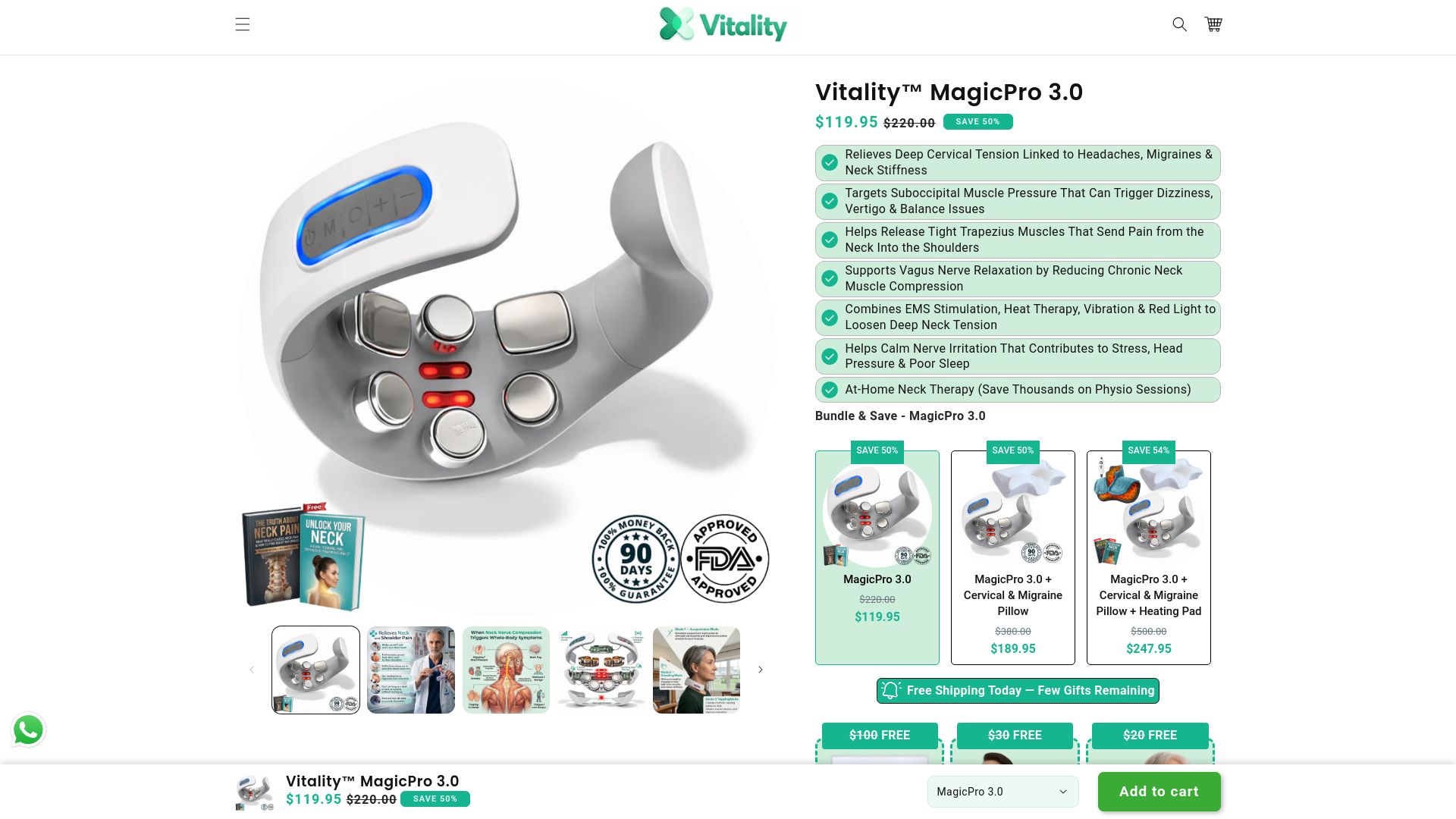
My Vitality’s MagicPro 2.0 combines electrical muscle stimulation (EMS), heat, and massage in a single compact device designed for 15-minute daily use. It is doctor-recommended and built to be used at home, at your desk, or in transit — which means it fits into the workday without requiring a separate appointment or a commute. The device does not replace the neck-strengthening exercises or the workstation fixes described above; it works alongside them, particularly during acute flare-ups when active exercise may be temporarily uncomfortable.
If you want to explore the full range of Vitality™ devices, including the MagicPro 3.0, the collection page has full specifications and usage guidance. Start with 15 minutes today and see how your neck responds.
Authoritative sources and further reading
The claims in this article draw from peer-reviewed trials and clinical guidance. These are the primary sources worth bookmarking:
- NEXpro RCT (PMC) — The randomized controlled trial measuring productivity loss and the 2.8 percentage point improvement after a 12-week multi-component program among Swiss office workers.
- NEXpro cost-utility analysis (BMC Public Health) — Cost-benefit and QALY analysis showing break-even roughly six days post-program; prevalence data (42–68%) sourced here.
- Cluster-randomized trial (BMC Musculoskeletal Disorders) — Confirms exercise + ergonomics outperforms ergonomics alone at 12 weeks; documents the adherence-dependent fade at 12 months.
- Mayo Clinic — Neck pain diagnosis and treatment — Clinical guidance on self-care duration, OTC medications, ice/heat protocols, and red flags.
- Harvard Health — 6 ways to ease neck pain — Movement-first ergonomic guidance; source for the static posture risk framing.
- MedlinePlus — Neck pain patient instructions — Guidance on avoiding prolonged immobilization and safe activity progression.
- Cross-sectional study, Jazan office workers (PMC) — Absenteeism and QALY impact data; 16.4% reported missing work due to neck pain.
If your symptoms persist beyond 2–3 weeks or include any neurological signs, consult a licensed clinician. This article is general health information, not medical advice. For product information, visit the My Vitality product page.
Statistic to remember: Neck pain affects 42–68% of office workers in employer-focused studies — making it one of the most common and most addressable sources of workplace productivity loss.