


Side sleepers usually need a compressed loft in the range that typically covers 4 to 6 inches with a medium-firm fill to bridge the shoulder gap. Back sleepers do better with a loft generally recommended between 3 and 5 inches and a softer cradle. Stomach sleepers generally need a loft under 3 inches, if stomach sleeping continues at all. Broader shoulders and heavier body weight push those numbers up; petite frames push them down. Measure your shoulder-to-ear distance tonight, then commit to a two-week calibration before judging the result.
TL;DR:
- Proper pillow loft varies by sleep position: 4 to 6 inches for side sleepers, 3 to 5 inches for back sleepers, and under 3 inches for stomach sleepers, adjusted for body build.
- Using a pillow that is too high or too low shifts the neck out of neutral alignment, causing muscle strain or joint compression over time.
- Accurate measurement of shoulder-to-ear distance and testing with calibrated pillows can help identify the ideal loft for individual anatomy.
- Fill material influences loft retention overnight, with buckwheat and shredded latex providing more consistent support than memory foam or down.
- Adjustable-fill pillows enable fine-tuning over two weeks, and persistent neck pain may require medical evaluation beyond pillow calibration.
Table of Contents
- What Does Pillow Loft Have to Do With Neck Pain?
- What Pillow Height Should You Use for Your Sleep Position?
- How Do You Measure Your Ideal Pillow Loft at Home?
- Which Fill Material Holds Its Loft Best Overnight?
- How Does an Adjustable Pillow Calibration Protocol Work?
- What Should You Track During a Two-Week Pillow Trial?
- When Should You See a Doctor Instead of Adjusting Your Pillow?
- Where Do Neck Devices Fit Once Loft Is Dialed In?
- A Complementary Option Once Your Pillow Fit Is Right
- Sources
What Does Pillow Loft Have to Do With Neck Pain?
Pillow loft is the compressed height of a pillow once your head is resting on it, not the fluffed-up height on a store shelf. That distinction trips up more shoppers than anything else. A pillow that looks tall in the box might compress to almost nothing once real weight presses down on it, which is exactly why loft has to be measured under load, not eyeballed.
Your neck is a chain of small vertebrae designed to sit in a gentle, neutral curve. When you lie down, the pillow’s job is to fill the space between your head and the mattress so that curve stays intact. Too much loft tips your chin toward your chest and stretches the muscles at the back of your neck all night. Too little loft lets your head drop back, which compresses the same facet joints on the opposite side. Neither position causes acute injury by itself, but hold either one for seven or eight hours a night, every night, and the small muscles and ligaments around your cervical spine start protesting.
The Cleveland Clinic frames this plainly: what matters is keeping the neck in neutral alignment relative to the spine, not the brand name on the tag or whether the fill is memory foam or down. That single principle should override almost every marketing claim you read on a pillow’s packaging.
Mattress firmness changes the math. A firm mattress holds your shoulder close to the surface, so you need more pillow loft to fill the gap on your side. A soft mattress lets your shoulder sink in, which reduces the gap and means the same pillow can suddenly feel too tall. Clinical guidance on pillow selection notes that mattress compliance directly modulates the loft your neck actually needs, which is why a pillow that worked perfectly on your old mattress can fail on a new one even if nothing else changed.
A few mechanical patterns show up again and again in sleep clinics and physical therapy notes:
- Excess loft on the side or back tilts the head forward, straining the upper trapezius and levator scapulae muscles.
- Insufficient loft lets the head tip backward, compressing cervical facet joints and sometimes narrowing the space nerves pass through.
- A mismatch between mattress firmness and pillow height is one of the most overlooked causes of a pillow that “used to work fine.”
- Loft that changes overnight, because the fill compresses unevenly, creates the same strain as starting with the wrong loft.
A 2021 systematic review of 35 studies found that pillow shape and height influence cervical alignment more than fill material does. That finding reorders the whole shopping process: get the geometry right first, then worry about what the pillow is stuffed with.
What Pillow Height Should You Use for Your Sleep Position?
Numbers help more than adjectives here. “Medium loft” means something different to every manufacturer, but inches on a tape measure do not lie. The ranges below reflect what sleep researchers and clinical reviewers generally recommend, adjusted for body build.
Side sleepers need the most loft of any position, because the shoulder pushes the head furthest from the mattress surface. A typical target runs 4 to 6 inches, though Sleep Foundation testing points toward the higher end of that range for anyone with broad shoulders or a heavier build, sometimes up to 7 inches. Firmness should be medium to firm. A soft pillow collapses under shoulder pressure exactly when you need it to hold its shape.
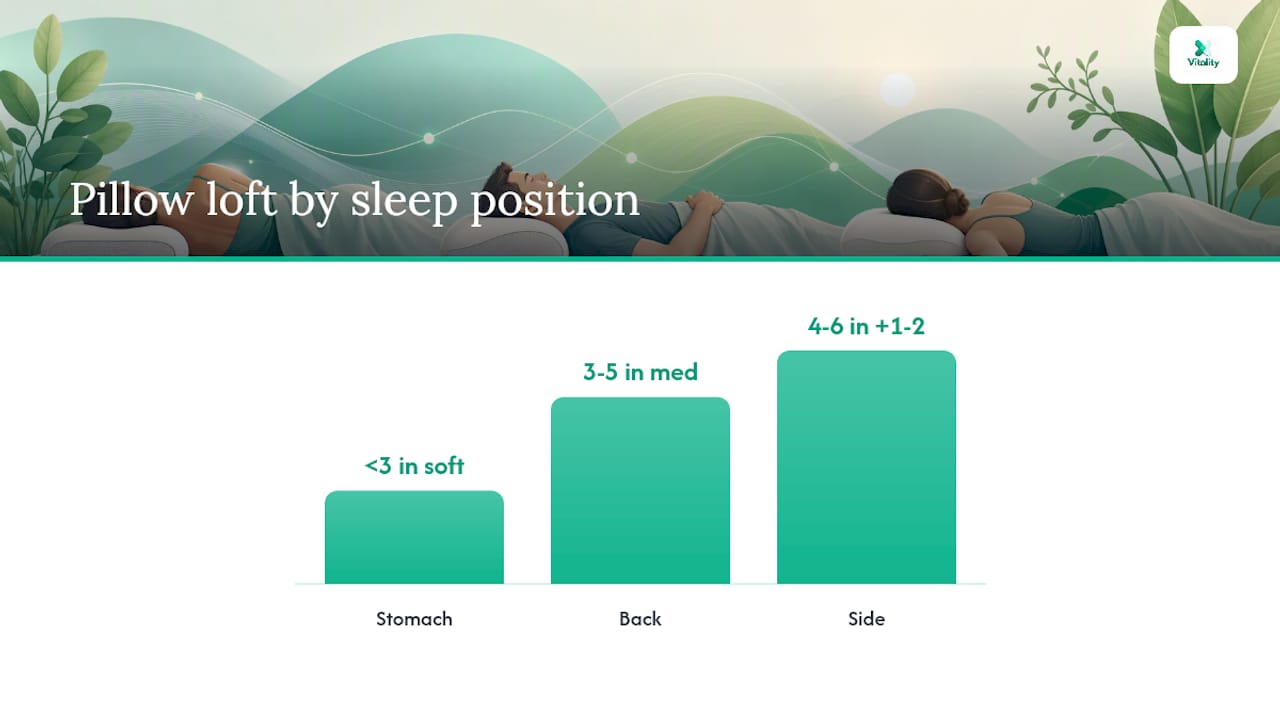
Back sleepers need less loft and a gentler curve, generally 3 to 5 inches. The goal isn’t height so much as cradle. You want the pillow to fill the small hollow behind your neck without pushing your chin toward your chest. Medium firmness usually works best. Too firm and the pillow won’t yield to the natural curve of your neck; too soft and it flattens out by 2 a.m.
Stomach sleepers need the least loft by far, ideally under 3 inches, and a soft compressible fill or none at all under the head. This position rotates the neck to one side for hours, which is hard on the cervical spine regardless of pillow height. If neck pain persists despite a low-loft pillow, the more durable fix is often retraining toward side or back sleeping rather than chasing a thinner pillow.
Combination sleepers, who shift positions through the night, face a harder problem: no single fixed loft suits every position. The practical answer is a responsive, adjustable-fill pillow set to a mid-range loft, generally 4 to 5 inches, that can flex slightly as you move. Calibration matters more for this group than any other, since the “right” loft is really a compromise across two or three positions.
A few build-specific modifiers apply across all positions:
- Broader shoulders or a heavier frame generally need 1 to 2 inches more loft than the base range for a given position.
- A smaller frame or narrower shoulders often does better 1 inch below the stated range.
- Anyone switching mattress firmness levels should expect to re-measure loft, not assume the old pillow still fits.
- If you’re between two ranges, start at the lower number. It’s easier to add loft with a topper or extra fill than to remove it from a fixed pillow.
Sleep Foundation’s position-specific research backs the same general ranges for back and side sleepers, and clinicians cited by AARP note that a pillow supporting neutral posture measurably reduces morning stiffness and related headaches, which is worth remembering if your neck pain shows up as a dull morning headache rather than isolated stiffness.
How Do You Measure Your Ideal Pillow Loft at Home?
You don’t need a sleep lab for this. A soft tape measure, a phone camera, and five quiet minutes will get you a real number instead of a guess.
- Sit against a wall with good posture, shoulders back and relaxed, looking straight ahead. Have someone take a photo from the side, or prop your phone on a stack of books at shoulder height.
- Measure the horizontal distance from the outer edge of your shoulder to the bottom of your ear, using the photo as a reference if it’s hard to judge by feel. This is your rough shoulder-to-ear gap.
- Subtract about half an inch to an inch to account for mattress give and the way soft tissue compresses once you’re actually lying down. That adjusted number is your target compressed loft, not the loft on the pillow’s tag.
- Photograph your current sleep position from the side, ideally with a partner’s help or a propped-up phone on a nightstand, so you have a before picture to compare against later.
- Check the result against the standard ranges for your sleep position. If your measured target and the standard range disagree by more than an inch, trust the measurement. Bodies vary.
Sleep and pillow researchers, including the guidance behind the Circadian calibration method, rely on this same shoulder-to-ear approach because it turns a subjective feeling into a repeatable number you can act on.
Verification takes less effort than the measurement itself. Lie in your normal sleep position and have someone check, or use a mirror if you sleep on your back, whether your nose, chin, and sternum line up in a straight vertical column. On your side, your ear, shoulder, and hip should stack in one line without your head tilting up or down. In the morning, pay attention to where stiffness shows up. A stiff neck alone often points to loft that’s off in one direction; stiffness paired with a headache more often points to loft that’s too high.
Pro Tip: Keep the “before” photo from step 4 on your phone. Two weeks from now, a side-by-side comparison will show postural changes you won’t notice night to night.
Which Fill Material Holds Its Loft Best Overnight?
Getting the right number tonight means nothing if the pillow collapses to a different number by 3 a.m. Fill material controls loft retention, and the differences between materials are larger than most shoppers expect.
Buckwheat holds loft with almost no compression, because you’re sleeping on thousands of small hulls rather than a single compressible mass. It’s the most reliable choice for chronic side sleepers who need a consistent 5 or 6 inches held all night, though it’s heavier, noisier when you move, and firmer underfoot than most people expect on a first try.

Shredded latex rebounds quickly after a shift in position, which makes it a strong fit for combination sleepers who need loft that adjusts as they move without flattening permanently. It sleeps cooler than solid memory foam and holds shape better than shredded foam blends.
Memory foam, whether solid or shredded, contours closely around the head and neck, which some side and back sleepers find genuinely relieves pressure points. The trade-off is heat retention, since dense foam traps warmth against the head, and slower rebound, which can feel like the pillow “remembers” the wrong position if you move a lot.
Down and feather fill starts soft and flattens fast, often losing a meaningful fraction of its loft within the first few hours of pressure. It requires nightly refluffing and rarely holds a measured loft target through a full sleep cycle, making it a poor match for anyone actively managing neck pain, however comfortable it feels at bedtime.
A general mapping between fill and use case, drawn from pillow-design research on how loft affects cervical alignment, looks like this:
- Chronic side sleepers with consistent shoulder width: buckwheat or firm shredded latex for maximum loft retention.
- Combination sleepers who shift positions: shredded latex or a hybrid adjustable fill for responsiveness.
- Back sleepers seeking pressure relief without overheating: a lower-density memory foam or a latex and fiber blend.
- Anyone with allergies: latex and buckwheat generally resist dust mites better than down.
- Hot sleepers: avoid dense solid memory foam regardless of position; look for shredded or gel-infused versions instead.
Body weight matters here too. Heavier sleepers compress any fill more than lighter sleepers, which means a pillow rated for “5 inches of loft” may deliver closer to 4 inches once real weight settles in. If you’re on the heavier end of your sleep position’s target range, lean toward firmer, less compressible fills like buckwheat or dense latex rather than soft down alternatives, even if the marketing height numbers look similar on paper.
How Does an Adjustable Pillow Calibration Protocol Work?
Adjustable-fill pillows exist because no fixed-height pillow fits every body, and guessing your loft from a store display rarely works. They’re the right call in three situations: you’re a combination sleeper who shifts position through the night, you’re not confident in your shoulder-to-ear measurement, or you’ve already tried two or three fixed pillows without success.
Most adjustable pillows ship overstuffed on purpose. That extra fill lets you remove material in small increments until you land on your measured target, and sleep-product testing suggests overstuffed adjustable pillows succeed faster than fixed-height pillows, simply because you’re subtracting from a known starting point instead of guessing a whole new pillow.
Here’s a calibration plan that turns two weeks of trial and error into a structured protocol:
- Nights 1 through 3: establish your baseline. Sleep on the pillow at its factory fill level without adjusting anything. Each morning, rate neck pain and stiffness on a simple 0 to 10 scale and note where the discomfort sits, chin, shoulder, or base of the skull.
- Nights 4 through 7: make one change. Remove a single handful of fill, or take out one removable insert panel if your pillow uses that design. Change only one variable at a time, then sleep on it for at least three nights before judging the result.
- Nights 8 through 14: fine-tune. Based on how nights 4 through 7 felt, add back a small amount of fill or remove a bit more. This is usually a half-adjustment, smaller than the first change.
- Day 30: check cumulative progress. A 2025 SLEEP journal study found that about 50% of participants saw a clinically meaningful reduction in neck pain using millimeter-precision height adjustment sustained over three months, which is a useful reminder that some benefits compound well past the two-week mark.
Reading your own morning signs correctly is the part people skip. A chin that’s tucked toward your chest on waking, or stiffness concentrated at the base of the skull, usually means your loft is set too high. Waking with your head tipped back, or a dull ache across the top of the shoulders, usually points to loft that’s too low. Pain that’s sharp and localized to one side of the neck, rather than the general stiffness both scenarios produce, deserves attention regardless of what your pillow log shows.
Pro Tip: Keep your morning log in your phone’s notes app instead of a paper notebook. You’re more likely to log symptoms consistently for 14 straight days if the tool is already in your hand when you wake up.
What Should You Track During a Two-Week Pillow Trial?
Before night one, take two baseline steps: measure your shoulder-to-ear distance as described earlier, and photograph your sleep position so you have a real comparison point. Rate your current neck pain and morning stiffness on a 0 to 10 scale before you change anything, since it’s easy to forget how bad the baseline actually was once you’re two weeks into feeling better.
Each morning during the trial, track four things:
- Pain rating on a 0 to 10 scale, recorded before you get out of bed if possible.
- Where the discomfort sits: chin, shoulder, base of skull, or general stiffness.
- Whether you woke in the same position you fell asleep in, or shifted significantly overnight.
- Any new symptoms, particularly tingling, numbness, or pain radiating into an arm.
Decision rules keep the trial from dragging on indefinitely. If your pain rating drops by two or more points within the first week, keep the current setting and let the second week confirm the trend. If nothing changes by night seven, make one adjustment per the calibration plan above rather than switching pillows entirely. If two full adjustment cycles, roughly four weeks, produce no improvement at all, the issue may be the fill material rather than the loft number, and it’s worth switching to a different fill category entirely. Sleep survey data suggests a majority of people who replace a poorly fitting pillow do see improvement after switching, so persistence through one full trial cycle is usually worth it before concluding a pillow adjustment won’t help.
When Should You See a Doctor Instead of Adjusting Your Pillow?
Pillow loft solves a mechanical alignment problem. It does not solve nerve compression, disc injury, or inflammatory conditions, and pretending otherwise can delay care that actually matters.
Watch for these signs, and treat any of them as a reason to stop experimenting with pillows and see a clinician instead:
- Numbness or tingling that spreads down an arm or into the fingers, especially if it’s progressive rather than occasional.
- Weakness in your hand or arm, such as dropping objects or struggling to grip.
- Shooting or electric pain that radiates from your neck down one arm.
- Loss of fine motor control, like trouble buttoning a shirt or handling small objects.
- Severe pain that doesn’t ease with position changes, over-the-counter pain relief, or a night of rest.
- Neck pain following any kind of trauma, fall, or forceful impact.
A reasonable path through the healthcare system starts with your primary care provider, who can rule out red flags and refer you onward. Physical therapy is often the next step for mechanical neck pain that doesn’t resolve with pillow and posture changes alone. A spine specialist becomes relevant if symptoms include the neurological signs listed above, or if pain persists for more than several weeks despite consistent pillow calibration and physical therapy. Bring your morning symptom log and your before-and-after photos to any of these appointments. Objective notes over two weeks are far more useful to a clinician than “my neck has hurt for a while.”
Numbness, weakness, or dexterity loss that appears suddenly or worsens quickly warrants prompt medical attention rather than waiting to see if it improves on its own.
Where Do Neck Devices Fit Once Loft Is Dialed In?
Get the geometry right before you spend money on anything else. That’s the order of operations I’d defend against almost any pushback: loft and fit first, fill material second, adjunct therapies a distant third. A pillow that holds your neck in neutral alignment does more for chronic morning stiffness than any device, heating pad, or massage tool applied afterward, because it addresses the problem for eight hours instead of fifteen minutes.
Where I’d push back on the common narrative is the idea that pillow shopping alone fixes everything. It doesn’t, and treating it as a one-time purchase decision misses how much daytime posture and muscle tension carry into the night. Once your loft is measured and calibrated, short daily therapies aimed at muscle tension can support what the pillow is doing structurally.
That’s the honest context for where devices like Vitality’s MagicPro 2.0 and MagicPro 3.0 sit. They combine electrical muscle stimulation, heat, and massage in fifteen-minute sessions, which addresses muscle tightness that built up during the day, not the structural alignment issue a mismatched pillow creates overnight. Run the calibration protocol first. If stiffness lingers even after loft and fill are dialed in, a short daily session is a reasonable next layer, not a substitute for getting the pillow right.
— Achraf
A Complementary Option Once Your Pillow Fit Is Right
Getting your pillow loft correct solves the structural half of nighttime neck pain. The muscular tension that builds up during a long day at a desk or behind a wheel is a separate problem, and it’s one a fifteen-minute session can address without asking you to change anything about how you sleep.

The Vitality™ MagicPro 2.0 combines electrical muscle stimulation, heat, and massage into one portable device you can use at your desk, in the car, or on the couch, no appointment and no fifteen-minute setup routine required. The newer Vitality™ MagicPro 3.0 builds on that same combination with added intensity levels for deeper muscle relief. Neither device replaces a properly measured pillow, and neither should be treated as a fix for structural misalignment. What they do well is target the day-to-day muscle tightness that a good pillow can’t reach on its own, in about the time it takes to make coffee.
If you’ve already run the two-week calibration above and stiffness still lingers by evening, that’s the moment a short daily session earns its place in your routine. Browse the full Vitality™ Devices lineup to compare MagicPro 2.0 and 3.0 side by side and find the fit that matches how you actually spend your day.
Sources
- Signs you may need a new pillow — Cleveland Clinic
- PubMed entry for 2025 SLEEP journal study (individualized pillow height)
- PubMed entry for 2021 systematic review on pillow design and neck pain
- How to match pillow loft to your neck pain — Circadian